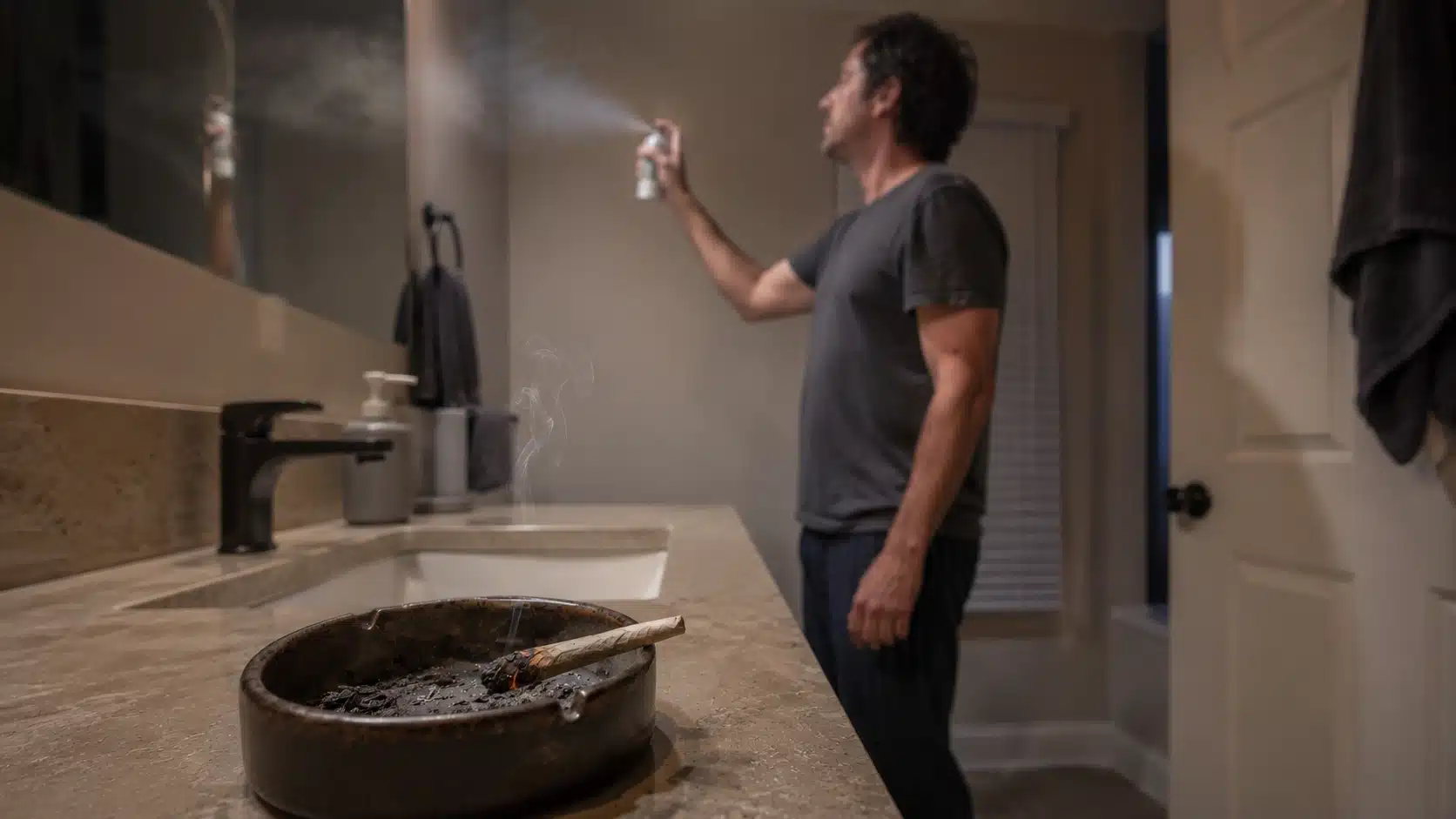
| Situation | Typical Smell Duration |
| Well-ventilated room | 1–3 hours |
| Window open during smoking | 30 minutes to 2 hours |
| Closed room | 6–12 hours |
| Heavy indoor smoking | 24–72 hours |
| Clothes, light exposure | 1–6 hours |
| Hair | A few hours, longer with heavy exposure |
| Furniture, curtains, carpet | 1–3+ days |
| Car, light exposure | 1–2 days |
| Hotboxed car or room | Several days or longer |
| Outside | Minutes to a couple of hours |
| Health note: Cannabis smoke is not just an odor problem. The CDC confirms that secondhand cannabis smoke contains many of the same toxic and cancer-causing chemicals found in tobacco smoke. If you smoke regularly indoors in a space shared with children or anyone with respiratory conditions, ventilation matters for their health, not only for odor management. |
If you have ever finished a session and immediately started sniffing the air like a nervous detective, you are not alone.
How long does weed smell last is one of those questions that sounds simple until you realize the answer depends on about six different factors.
The short version: a well-ventilated room clears in a couple of hours, but a closed space with carpet and curtains can hold that smell well into the next day.
Ventilation, fabric exposure, smoke volume, strain potency, room size, and method of use all play a role. This guide covers every scenario so you know exactly where you stand and what to do about it.
What Is Weed Smell and Why Is It So Distinct?
Cannabis odor is not a single compound; it is a combination of dozens of aromatic chemicals the plant produces. The best-known group is terpenes, the same family of compounds responsible for the scent of pine trees, citrus peel, and lavender.
Different cannabis strains carry different terpene profiles, which is why some smell earthy and skunky while others lean floral or fruity. The sharper, more pungent edge that catches people off guard comes from sulfur-containing compounds.
Research covered in Science News identified these sulfur compounds as the key driver behind cannabis’s skunky scent, noting that some are detectable even at extremely low concentrations.
That is why a small amount of smoke can fill a large room surprisingly fast. When cannabis is burned, these compounds do not just float through the air and disappear. Smoke particles carry them directly onto surfaces, fabric, walls, carpet, curtains, hair, and upholstery, where they settle and continue releasing odor long after the visible smoke is gone. Understanding this is the foundation of understanding why certain cleanup steps work and others do not.
How Long Does Weed Smell Last in a Room?
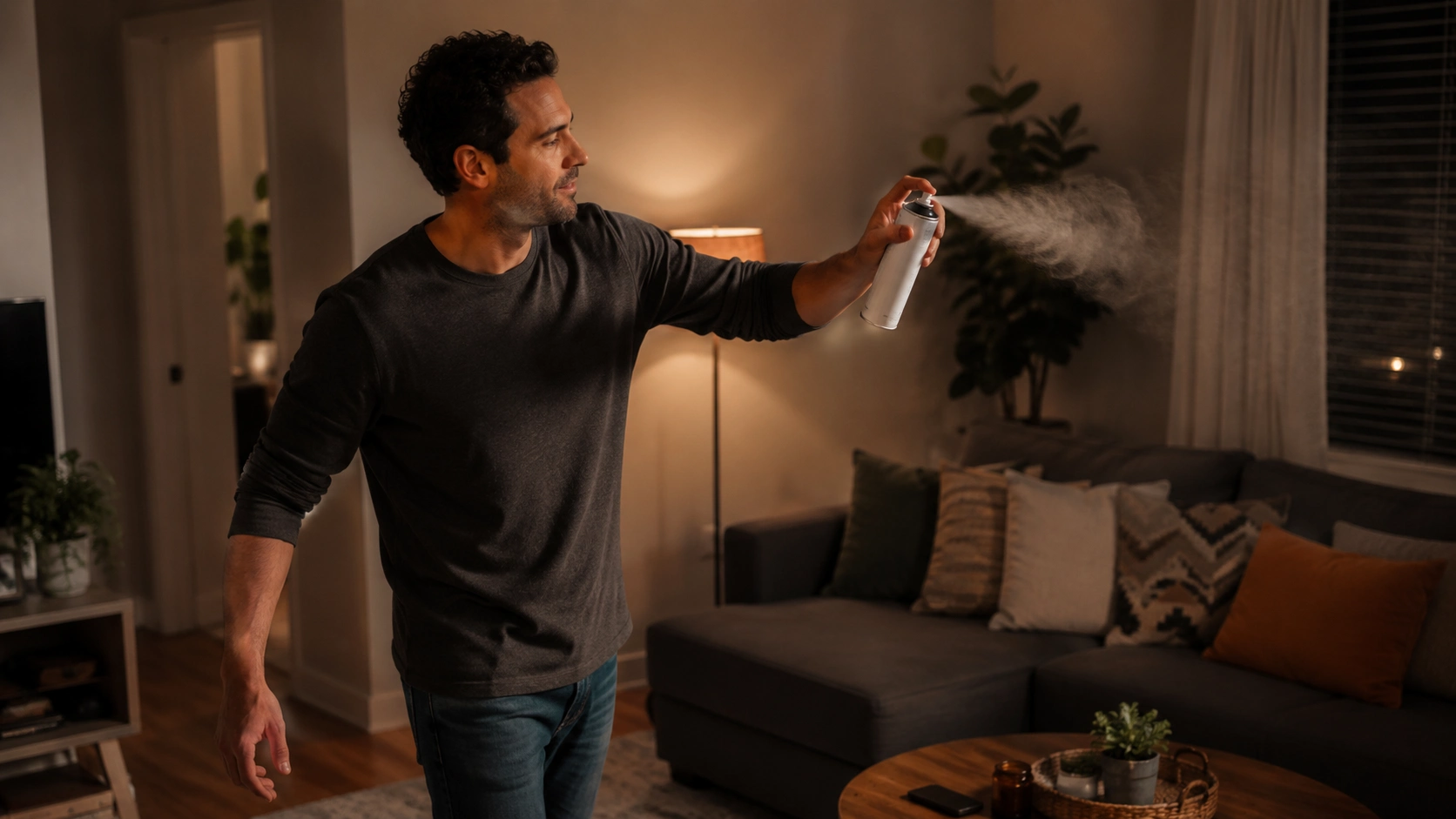
A room is the most common situation, and the answer depends almost entirely on airflow and the room’s construction. With windows open and a fan pushing air outward, the cannabis smell typically clears within one to three hours. The more air movement, the faster it goes.
Surfaces that hold marijuana smell the longest in a room:
- Thick curtains and drapes
- Fabric sofas and armchairs
- Rugs and wall-to-wall carpet
- Bedding and pillows
- Textured or unfinished wood
In a completely closed room with no circulation, that same amount of smoke can linger for six to twelve hours. After heavy indoor smoking or hotboxing, expect one to three days, especially if the room has carpet, thick curtains, or a fabric sofa. Those surfaces absorb smoke like sponges and release it slowly back into the air as the room warms up or is disturbed.
| Tip: One cracked window does very little. For real odor clearance, position a fan to actively push air out through one window while a second window provides fresh intake. That cross-flow moves air through the room rather than just stirring it around. |
How Long Does Weed Smell Last With a Window Open?
This is the single most common scenario, and it makes a bigger difference than most people expect. When a window is open during a session, smoke disperses as it forms rather than accumulating. Less smoke reaches fabric and surfaces, which means far less embedded odor to deal with afterward.
With one window open during a light session, the smell typically fades within thirty minutes to two hours. Add a second window on the opposite side of the room and the timeline shrinks even further. The key variable is whether the window was open before smoke built up or opened after the room was already filled. Opening a window after the room smells means you are ventilating after the damage is mostly done. Opening it first keeps smoke from settling in the first place.
If opening a window during your session is not an option, run a fan facing outward through any opening and ventilate as early as possible. The head start matters more than how long you air things out afterward.
How Long Does Weed Smell Last on Clothes?
Smoke odor clings differently depending on fabric weight and how long you were exposed. Here is how long it typically lingers on common clothing types before washing:
| Fabric / Situation | Odor Duration | Key Factor |
| Light cotton shirt, brief outdoor exposure | 1–2 hours | Airflow speeds up fading |
| Hoodie or fleece, indoor exposure | 4–6+ hours | Thicker fibers trap particles |
| Denim or wool, heavy exposure | 8+ hours | Dense weave holds odor deep |
| Closed the closet after exposure | Transfers to other clothes | No airflow = odor spreads |
| Perfume or cologne applied over smoke | Makes the smell worse | Creates a layered, detectable mix |
The fastest solution is a full change of clothes. Before returning jackets to your closet, air them out near an open window for 15 minutes; this breaks down trapped odors and keeps nearby clothing from picking them up.
How Long Does Weed Smell Last in a House or Apartment?
Cannabis odor does not respect room boundaries. It travels through open doors, hallways, shared HVAC systems, bathroom exhaust vents, and gaps around door frames. One session in a back bedroom can reach the front of a house within minutes if interior doors are open.
Apartments create a more complicated situation. In multi-unit buildings, weed smell can migrate through shared ventilation ducts, gaps under hallway doors, bathroom fans that feed into shared shafts, and thin or poorly sealed walls.
Whether a neighbor smells it depends on building construction, air pressure, and smoke volume, but in older buildings with shared ventilation, it absolutely travels.
Lighting a candle inside your unit addresses nothing outside your door. Source control and ventilation before smoke builds up are the only approaches that actually work in shared buildings.
| Caution: Smoking near a bathroom exhaust fan is a common tactic, but in many buildings, those fans connect to shared shafts. Rather than removing the smell from the building, they can send it directly into a neighboring unit or the hallway. |
How Long Does Weed Smell Last in a Car?
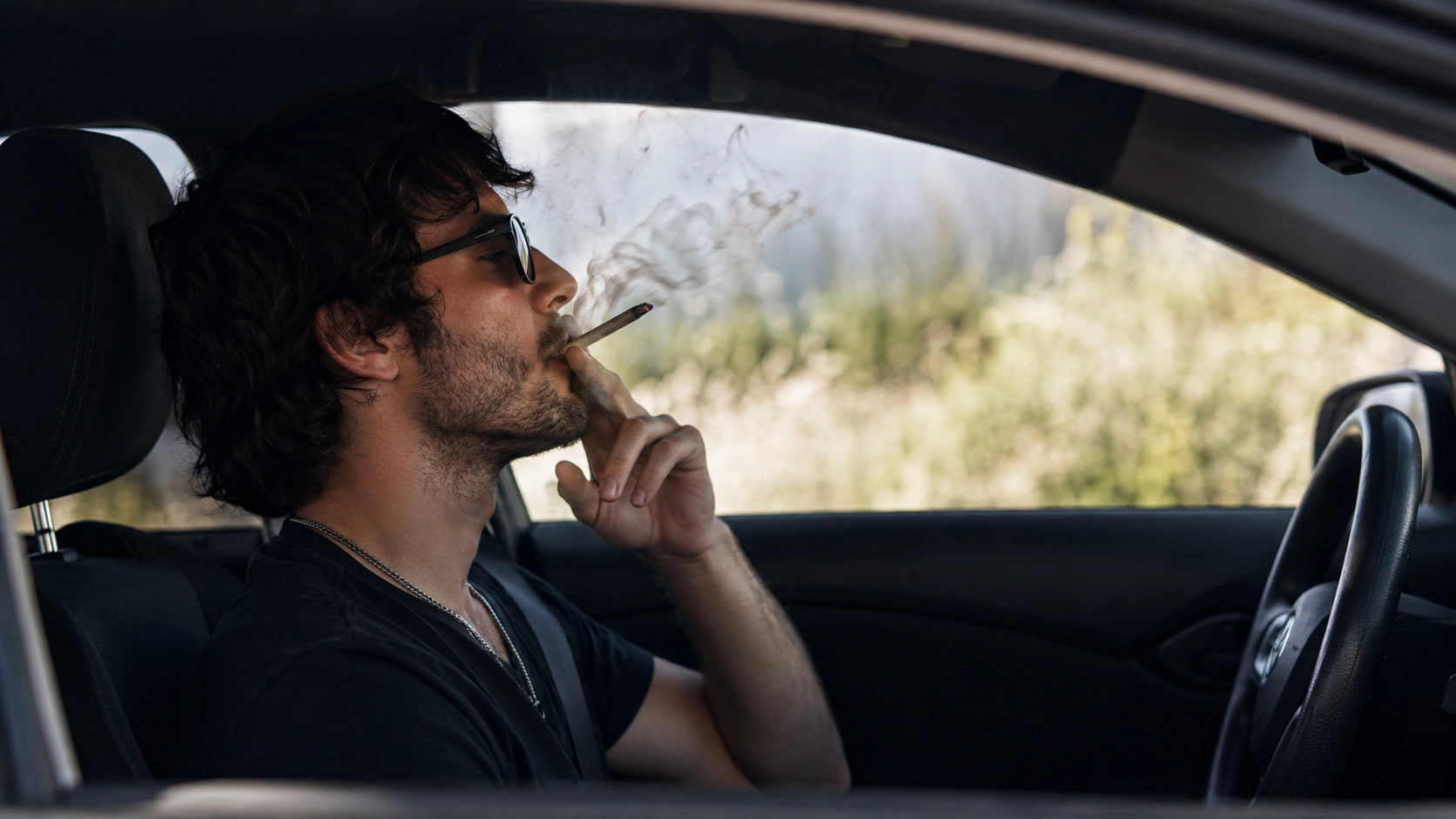
Cars hold cannabis odor longer than almost any other environment. The enclosed space, recirculated air, and abundance of soft materials create perfect conditions for smell to embed deeply.
1. Light Exposure With Windows Down
Brief smoke exposure with windows open gives odor far less opportunity to settle. Most soft surfaces escape saturation, and fresh airflow does the heavy lifting.
Parking outside with windows slightly cracked accelerates clearing considerably. Expect the interior to return to normal within one to two days, especially if you wipe hard surfaces and vacuum promptly after exposure.
2. Closed-Window Smoking
Keeping windows up forces smoke directly into the seat fabric, the headliner, and the air vent system, three surfaces that hold odor stubbornly. Even after thorough airing, the smell can persist for several days.
The ventilation system is the most overlooked culprit, continuously recirculating embedded odors whenever the fan runs until the cabin air filter is cleaned or replaced.
3. Hotboxing
Hotboxing saturates every soft interior surface: seats, seat belts, floor mats, headliner, and the ventilation system. Odor can persist for a week or more without a deep clean.
Fragrance sprays and hanging air fresheners only mask the smell temporarily. Once they fade, the embedded odor returns. Proper cleaning requires vacuuming, wiping all surfaces, cleaning the windows inside, and using activated charcoal absorbers.
How Long Does Weed Smell Last on Your Body, Hair, and Skin?
Hair and skin both absorb smoke odor, but how long it lingers depends on the level of exposure, hair length, and how quickly you act. Here is what to do:
- Wash your hands immediately after handling cannabis, as fingers hold the strongest direct odor.
- Brush teeth and use mouthwash to clear odor around the mouth.
- Wash your face to remove smoke particles that settle on your skin during exposure.
- Showering after heavy exposure, rinsing hair and skin, is the only fully reliable fix.
- Beards trap odor like head hair and need the same washing attention after significant exposure.
Light exposure fades from skin within a couple of hours on its own. Hair takes longer, especially when thick or long. Acting within the first hour keeps odor from setting in deeply.
How Long Does Weed Smell Last Outside?
Outdoors, wind is your best tool and it works immediately. Cannabis smoke that would linger for hours inside a room typically fades within a few minutes to a couple of hours when you are in the open air. Wind disperses the smoke as it forms, preventing it from concentrating around any single surface.
That said, outdoor conditions vary. On a still day with no breeze, the smell lingers longer around your immediate area, your clothing, and anyone nearby. In those conditions, some odor may settle for fifteen to thirty minutes before dispersing. On a breezy day, it is mostly gone within minutes.
Your clothes, hair, and skin still absorb some odor during an outdoor session, regardless of the wind. The smoke may be gone from the air around you quickly, but what landed on your hoodie or in your hair came back inside with you. A change of clothes handles most of that problem before you reenter a space where the smell matters.
Does Vaping Weed Smell Last as Long as Smoking?
No, but it is not odorless. Cannabis vapor, whether from a desktop vaporizer or a weed pen, dissipates faster than smoke because no plant material is being combusted. There is no ash, no burning byproducts, and far fewer particles settling onto surfaces.
In a ventilated room, vapor odor often clears within thirty to sixty minutes. A ScienceDirect study measuring volatile organic compounds from indoor cannabis use found that even vaping affects indoor air quality in closed spaces.
In a sealed room, the vapor odor can linger for a few hours. Burning a joint, a blunt, or a pipe produces far more residue than vapor. The smell embeds in fabric and surfaces much more aggressively, and the cleanup required is substantially more involved.
If reducing lingering cannabis odor matters to you, vaping indoors is meaningfully better than smoking indoors, though not a complete solution.
| Note: Edibles do not produce any odor in the room during consumption. However, cooking or decarbing cannabis at home creates a strong, persistent smell that travels easily through a building. |
Does Weed Smell Stick to Furniture, Curtains, and Carpets?
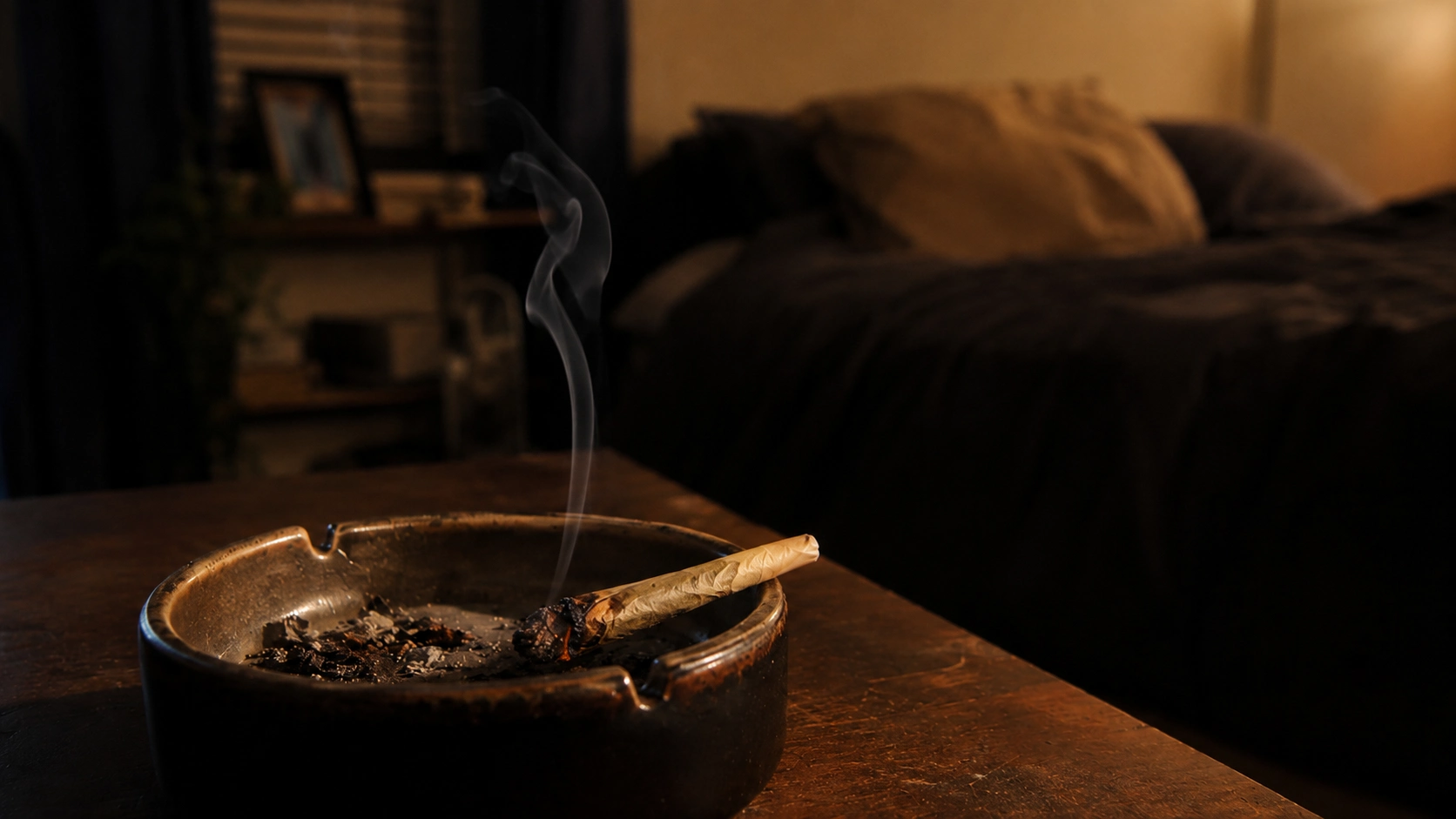
Yes, and this is the main reason a room can smell fine immediately after ventilating but stale again an hour later. Soft furnishings act as odor reservoirs, absorbing smoke during exposure and releasing it back into the air when disturbed or warmed up.
Priority order for cleaning smoke-exposed surfaces:
- Wash bedding and removable cushion covers first, as they absorb the most odor.
- Wash or steam curtains thoroughly, as fabric folds trap concentrated smoke particles.
- Vacuum carpets, rugs, and upholstered furniture to pull embedded particles from the fibers.
- Sprinkle baking soda on carpets, leave for thirty minutes, then vacuum again completely.
- Wipe all hard surfaces, including windows, mirrors, and tables, with a damp cloth.
- Use a fabric-safe odor-neutralizing spray, never perfume, cologne, or scented air freshener.
- Place activated charcoal bags near heavily exposed furniture to absorb residual odor overnight.
Surface cleaning removes most of the odor, but activated charcoal handles what cleaning misses. Work through this list top to bottom for the most reliable, complete result.
How to Remove Weed Smell Fast
Speed determines how much odor embeds into surfaces. The sooner you act after a session, the easier removal becomes. Here is a tiered action plan based on available time.
1. 15-Minute Plan
You have a short window, but you can still make a real difference. Focus on airflow and removing the source materials; these two steps alone significantly reduce odor:
| Action | Where to Focus | Why It Works |
| Open two windows | Opposite sides of the room | Creates cross-ventilation and pushes air through |
| Position a fan | Facing outward through one window | Actively pulls stale air out of the space |
| Remove all smoking materials | Ash, papers, tools, and roaches | Source removal stops ongoing odor release |
| Change clothes | Place in a wash or sealed laundry bag | Fabric carries odor out of the cleaned space |
| Wash your hands and face | Sink with soap | Removes surface residue from direct contact |
Even with just 15 minutes, removing source materials and opening airflow cuts the bulk of detectable odor. The room will not be fully clear, but the difference is immediate and noticeable.
2. 1-Hour Plan
With an hour available, you can address surfaces, not just air. This tier moves beyond ventilation into active cleaning that pulls embedded odor from fabric and hard surfaces:
| Action | Where to Focus | Why It Works |
| Run an air purifier | HEPA and activated carbon filters | Captures particles and neutralizes odor molecules |
| Vacuum thoroughly | Carpets, rugs, and sofa | Pulls smoke particles out of embedded fibers |
| Wipe all hard surfaces | Tables, shelves, and windowsills | Removes thin smoke film that releases odor later |
| Wash small fabric items | Pillowcases and throw blankets | Fast-wash cycle clears heavily exposed soft items |
| Clean windows and mirrors | Interior glass surfaces | Smoke leaves a film that holds and radiates odor |
| Apply odor-neutralizing spray | Upholstery only, not cologne | Breaks down odor rather than layering scent over it |
The one-hour plan handles what ventilation alone cannot. For a more thorough breakdown of these steps in order, the full process for clearing weed smell from a house covers exactly what to do at each stage to get the best result without wasting effort.
3. Overnight Plan
When time is not a constraint, a longer approach reaches odor that short sessions cannot. Overnight methods work passively while you sleep, setting up a clean start the next morning:
| Action | Where to Focus | Why It Works |
| Keep airflow running | Windows cracked safely overnight | Continuous fresh air exchange clears residual odor |
| Wash bedding and curtains | Before sleeping, if in the room | Removes the largest fabric reservoirs before overnight absorption |
| Place activated charcoal bags | Near heavily exposed furniture | Absorbs residual odor passively without adding competing scent |
| Deep clean carpet or upholstery | Next morning, if stale smell remains | Addresses what overnight airflow could not fully reach |
Overnight methods do the work you cannot see. By morning, combining passive charcoal absorption with sustained airflow typically clears even heavier exposure that a quick clean would leave behind.
What Not to Do
Covering up the smoke odor rarely works and often makes detection easier. These are the most common mistakes people make when trying to clear a space quickly:
- Do not rely on candles or incense: layering fragrance over smoke residue creates a more noticeable, detectable combination.
- Do not ignore soft surfaces: curtains, bedding, and upholstery keep releasing trapped odor back into the air for hours.
- Do not stop at ventilation: airflow clears the air but does nothing for particles already embedded in fabric and surfaces.
- Do not assume the room is clean: it smells neutral immediately after airing out, but residual odor returns once surfaces warm up.
Ventilation and fragrance products each handle only part of the problem and cannot substitute for surface cleaning. As the EPA confirms, ventilation and filtration reduce indoor marijuana smoke exposure but are unlikely to fully eliminate all harmful substances. Opening a window improves air quality but does not make a room fully clean.
Is Weed Smell Harmful or Just Annoying?
The smell signals that smoke particles and chemical residue are present in the air and on surfaces. Secondhand cannabis smoke is not a purely social inconvenience.
The CDC states that secondhand cannabis smoke contains THC along with many of the same toxic and cancer-causing chemicals found in tobacco smoke.
A study published in JAMA Network Open found that secondhand cannabis smoke exposure indoors creates measurable fine particulate matter concentrations that affect air quality even for people who are not actively participating.
This does not mean a single well-ventilated session is a crisis. It does mean that regular indoor smoking in shared spaces, particularly around children, anyone with respiratory conditions, or people who did not choose to be exposed, carries considerations beyond odor management.
| Caution: If you smoke regularly indoors in a home shared with others, an air purifier with an activated carbon filter is worth the investment for everyone living there, not just as an odor tool. |
How to Prevent Weed Smell From Settling In
Prevention takes far less effort than cleanup. The core goal is keeping smoke away from soft surfaces before it has a chance to settle:
- Smoke outdoors where that is a legal and available option
- Run ventilation before smoking, not after the room has already filled with smoke
- Store cannabis in airtight glass containers, since fresh flower produces a strong odor even before it is lit
- Empty ashtrays and remove smoking tools from the space immediately after each session
- Keep sessions away from rooms with heavy fabric furnishings, like bedrooms
- Avoid hotboxing any enclosed space, whether a room or a car
- Use a HEPA and activated carbon air purifier as a regular fixture rather than only bringing it out during cleanup
Knowing what different cannabis strains smell like and why they vary so much can also help you anticipate which sessions are likely to produce the strongest, most persistent odors and prepare your space accordingly.
Frequently Asked Questions
How long does weed smell last with a window open?
With one window open during a light session, the smell typically fades within thirty minutes to two hours. Opening a second window on the opposite wall creates cross-ventilation that shortens the timeline further. The critical factor is timing: opening the window before smoking begins prevents smoke from concentrating, while opening it after the room has already filled only removes what is still airborne, not what already landed on fabric and surfaces.
Does airing out a room get rid of weed smell?
Partially. Ventilation clears airborne smoke particles effectively, which is why a room can smell fine right after airing out. The problem is that soft surfaces, carpet, curtains, and upholstered furniture, absorb smoke and release it back into the air as the room warms up or is disturbed. Airing out handles the air. Removing embedded odor from surfaces requires vacuuming, washing fabric items, and wiping hard surfaces separately.
How long until weed stops smelling on its own?
In a well-ventilated space with hard floors, the smell can dissipate within one to three hours without any active cleanup. In a closed room with carpet and upholstered furniture, it can take six to twelve hours, or longer after heavy use. The smell does not simply fade because time has passed; it fades because the odor compounds either disperse into fresh air or are absorbed by surrounding surfaces. Without ventilation or surface cleaning, the smell can persist well into the next day.
How long will weed stay in the air?
In a ventilated space, airborne cannabis smoke typically clears within one to three hours. In a sealed room with no airflow, smoke particles can remain suspended for six hours or longer. This matters most for people who did not choose to be exposed: research from the JAMA Network Open found that secondhand cannabis smoke in enclosed indoor spaces creates measurable fine particulate matter even for bystanders who are not smoking.
Does vaping weed smell as strong as smoking?
Cannabis vapor, whether from a vaporizer or a weed pen, is noticeably less persistent than smoke from a joint or pipe. Vapor fades faster and deposits fewer particles on surfaces. In a ventilated room, odor often clears within an hour. In a sealed space, it may linger a few hours, but it is meaningfully milder than combustion smoke.
Can neighbors smell weed through shared walls?
Yes, especially in apartments. Shared ventilation ducts, bathroom exhaust shafts, door gaps, and thin construction can all carry cannabis odor between units. Building age and HVAC configuration affect how much it travels. Reducing smoke volume at the source and improving ventilation before smoking are the most practical approaches.
What actually removes weed smell versus just masking it?
Fresh cross-ventilation, activated carbon filtration, fabric washing, vacuuming, and wiping hard surfaces genuinely remove odor. Candles, incense, and perfume sprays only layer fragrance on top of existing residue. Once the added scent fades, the smell of smoke is still there. Actual removal requires addressing the surfaces where it is embedded.
Does smoking outside mean your clothes will not smell?
Smoking outdoors greatly reduces cannabis odor settling into indoor surfaces, but your clothes, hair, and skin still absorb smell during the session. Wind disperses the smoke, yet standing near it means you carry some back inside. A change of clothes after an outdoor session handles most of the remaining odor.
Closing Thoughts
At the end of the day, how long the smell of weed lasts comes down to one simple truth: air clears on its own, but surfaces do not. A well-ventilated room with hard floors might smell neutral within a couple of hours.
That same session in a carpeted room full of soft furniture can still be detectable the next morning. The difference is not the smoke; it is what the smoke landed on.
Ventilate early, deal with fabrics before they hold the smell overnight, and use actual odor removal rather than fragrance cover-ups. You now know exactly why each step works, which makes it a lot easier to get it right the first time rather than wondering why the candle did not help. Drop a comment below and let me know if this was helpful.
Sources
- Oswald, I.W.H. et al. “Identification of a New Family of Prenylated Volatile Sulfur Compounds in Cannabis Revealed by Combined Biomimetic Total Synthesis and Untargeted Metabolomics.” ACS Omega, 2021. Referenced in Science News.
- U.S. Environmental Protection Agency. “Secondhand Marijuana Smoke and Indoor Air Quality.” EPA.gov.
- Centers for Disease Control and Prevention. “Cannabis and Secondhand Smoke.” CDC.gov.
- Cobb, C.O. et al. “Fine Particulate Matter Exposure From Secondhand Cannabis Bong Smoking.” JAMA Network Open, 2022. Full article.
- Hasan, H. et al. “Volatile Organic Compounds From Indoor Cannabis Smoking.” Sustainable Environment, 2024. Full article.
“`html id=”weed-smell-faq-schema”
“`