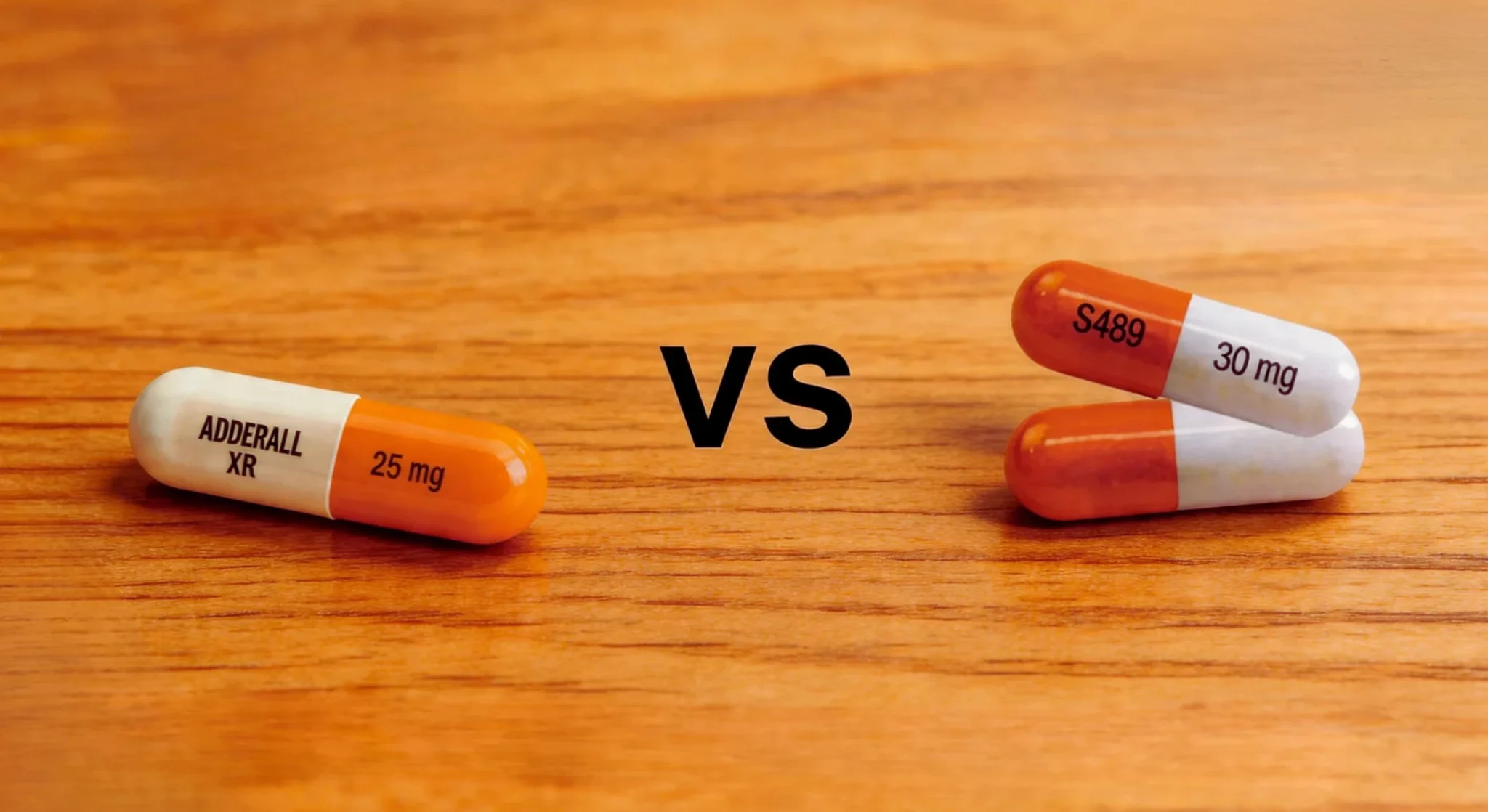
Quick Glance: Vyvanse vs Adderall XR
| Factor | Vyvanse (lisdexamfetamine) | Adderall XR (mixed amphetamine salts) |
| Drug type | Prodrug, inactive until metabolized | Direct-acting mixed amphetamine salts |
| Onset | 60-90 minutes | 30-60 minutes |
| Duration | 10-14 hours | 10-12 hours |
| FDA-approved uses | ADHD, binge eating disorder | ADHD (narcolepsy for IR version only) |
| Approved age | 6 years and older | 6 years and older (XR); 3 years and older (IR) |
| Available forms | Capsule, chewable tablet | Capsule (can be opened and sprinkled) |
| Crash/wear-off | Generally smoother, more gradual | More noticeable for some users |
| Abuse potential | Lower; prodrug design limits misuse | Higher, direct-acting formulation |
| Generic available? | Yes (since August 2023) | Yes, widely available |
| Typical cost (generic) | Lower than brand; still varies | Generally, the more affordable option |
| DEA schedule | Schedule II | Schedule II |
If you’ve been prescribed one of these and switched to the other, or if you’re sitting in your doctor’s office trying to figure out what the actual difference is, you’re in good company. Vyvanse and Adderall XR are two of the most commonly prescribed ADHD medications in the US, and the question of which one works better is one of the most searched topics in the ADHD community.
The honest answer is that neither is definitively better than the other across the board. But they work differently enough that the wrong one for you can make your day significantly harder, and the right one can change how you function in ways that are hard to overstate. This comparison covers the pharmacological differences, what the research actually shows, and how to think through the decision clearly.
| ⚠️ Advisory: This content is for informational purposes only and does not constitute medical advice. Both Vyvanse and Adderall XR are Schedule II controlled substances that require a prescription. Always consult a licensed healthcare provider before starting, stopping, or changing any prescription medication. |
What Each Drug Actually Is
Both Vyvanse and Adderall XR are central nervous system stimulants that increase dopamine and norepinephrine levels in the brain, improving focus, attention, and impulse control in people with ADHD. That’s where much of the similarity ends.
Adderall XR contains a mixture of four amphetamine salts: dextroamphetamine saccharate, amphetamine aspartate, dextroamphetamine sulfate, and amphetamine sulfate. The extended-release capsule delivers 50% of the dose immediately and releases the remaining 50% approximately four hours later, mimicking twice-daily immediate-release dosing in a single capsule.
Vyvanse contains lisdexamfetamine dimesylate, a prodrug that is chemically inactive until the body metabolizes it. Once absorbed, it converts to dextroamphetamine through contact with red blood cells. Vyvanse is available as both capsules and chewable tablets, which makes it an option for patients who have difficulty swallowing pills.
This metabolic conversion is what gives Vyvanse its defining characteristics: a slower onset, a smoother effect curve, and a lower misuse potential. You can’t crush it, snort it, or inject it for a faster effect; the conversion requires the digestive process.
As GoodRx’s clinical comparison of Vyvanse and Adderall notes, both medications share many side effects because they ultimately deliver similar active compounds, but the routes each takes to reach those active compounds produce noticeably different experiences for many users.
| ⚠️ Advisory: Both Vyvanse and Adderall XR are DEA Schedule II controlled substances, the highest level of control for prescribable medications. This means they require a new written prescription for each refill and cannot be called in by phone for routine refills. |
Onset, Duration, and the Crash

This is where the day-to-day experience diverges most noticeably between the two medications.
Onset: Which One Kicks In Faster
Adderall XR typically takes effect within 30-60 minutes of taking it. Users describe it as a more abrupt shift into focus, which some find helpful for morning productivity and others find jarring.
Vyvanse takes 60-90 minutes to begin working, sometimes closer to two hours, because the prodrug conversion adds a processing step. The upside is that the onset feels gradual rather than sudden. The downside is that if you need to be functional at 8 am and you take your Vyvanse at 7:30 am, you may be waiting.
| ⚠️ Advisory: If you’re taking Vyvanse and noticing a slow morning before it kicks in, some prescribers suggest taking it 30-60 minutes before you need to be functional. Discuss timing adjustments with your doctor before making any changes. |
Duration: How Long Each Lasts
Adderall XR generally lasts 10-12 hours. SingleCare’s pharmacist-reviewed comparison of Adderall XR and Vyvanse confirms Vyvanse typically lasts 10-14 hours, giving it a somewhat longer effective window.
For most adults, that extra hour or two from Vyvanse covers evening tasks, homework supervision, and after-work responsibilities without requiring a booster dose. Whether that extended window is an advantage or a liability depends on your schedule and your sleep. A medication that’s still active at 10 pm is not helpful if you need to be asleep by 11. This duration difference is comparable to how other long-acting medications work: just as the duration of benzodiazepines like Ativan determines how they fit into someone’s day, the window of action for each ADHD medication is a practical scheduling question, not just a pharmacological one.
The Crash: What Actually Happens When It Wears Off
The “crash” is the period when stimulant medication wears off, and ADHD symptoms return, sometimes with added irritability, fatigue, or emotional dysregulation. It’s one of the most discussed topics in ADHD communities.
Because Adderall XR releases in two distinct pulses (an immediate release and a 4-hour delayed release), the drop-off at the end of the day can be more noticeable. Some users describe abrupt mood shifts or a return of symptoms. The immediate-release version (Adderall IR) has an even steeper wear-off curve.
Vyvanse’s prodrug mechanism produces a more gradual decline. The conversion process smooths both the onset and the exit, which is why users frequently describe it as feeling more like a “fading” than a “stopping.” This doesn’t mean the crash is eliminated; it means it’s less pronounced for many people.
| ⚠️ Advisory: Both medications can produce rebound symptoms as they wear off, including irritability, increased emotional reactivity, or fatigue. These are a function of how stimulants interact with dopamine regulation. Talk to your prescriber if the wear-off period is significantly disrupting your evenings. Some patients who experience significant psychiatric medication wear-off find it useful to understand how withdrawal symptoms from psychiatric medications are typically managed. |
Side Effects: What to Expect From Both
Because both drugs ultimately deliver amphetamines to the same receptors, their side effect profiles are nearly identical. According to Healthline’s clinically reviewed Vyvanse vs Adderall guide, the most commonly reported side effects for both include decreased appetite (particularly during the medicated hours; most users find hunger returns in the evening), insomnia or disrupted sleep especially if taken too late in the day, dry mouth, headache, increased heart rate and blood pressure, mood shifts including irritability or emotional flatness in some users, and weight loss as a side effect of reduced appetite over time.
Both medications carry serious cardiovascular warnings. Anyone with a history of heart conditions, high blood pressure, or structural cardiac abnormalities should discuss these risks explicitly with their doctor before starting either medication.
The practical difference in side effects: Vyvanse’s slower onset means the appetite suppression and stimulant effects build more gradually, which some users find more tolerable than Adderall XR’s more abrupt effect curve. Users switching from Adderall XR to Vyvanse frequently report feeling “less medicated,” not because Vyvanse is weaker, but because the smoother delivery curve reduces the peaks.
| ⚠️ Advisory: Do not combine Vyvanse and Adderall XR. Both target the same neurotransmitter systems, and taking them together significantly increases the risk of cardiovascular events, overstimulation, and serious adverse reactions. |
Is Vyvanse Stronger Than Adderall?
This question comes up constantly, and the answer depends on what you mean by “stronger.” Adderall often feels stronger to users because the onset is faster and more pronounced. That sense of a sudden shift into focus is more noticeable with Adderall XR’s immediate-release component.
Vyvanse’s gradual build can feel more subtle even at equivalent therapeutic doses. In terms of clinical efficacy, research does not show one is categorically more effective than the other. One analysis of 20 studies found that in adults, ADHD symptoms improved significantly with either lisdexamfetamine or mixed amphetamine salts, with outcomes trending somewhat stronger for Vyvanse.
One study comparing Adderall XR and Vyvanse in children found 32% of children on Vyvanse reported being “very much improved,” compared with 16% on Adderall XR. These are individual studies, and individual responses vary widely across the research literature overall.
| ⚠️ Advisory: “Stronger” in the context of ADHD medication doesn’t mean better. A medication that feels more intense isn’t necessarily providing better symptom control, and the sensation of medication “kicking in hard” is not a reliable indicator of therapeutic effectiveness. |
Dosage and Conversion
Vyvanse and Adderall XR are not dose-for-dose equivalent. If you’re switching between them, your prescriber needs to adjust the dose accordingly. The rough conversion from the ADHD Advisor’s clinical resource on Vyvanse vs Adderall is as follows:
| Adderall XR | Approximate Vyvanse Equivalent |
| 5 mg | 20 mg |
| 10 mg | 30-40 mg |
| 20 mg | 50-60 mg |
| 30 mg | 70 mg |
These conversions are approximations, not prescriptions. Individual metabolism, body weight, and response to the different drug formulations all affect how a person responds at any given dose. Always work with a prescriber on dose transitions; self-adjusting based on a conversion chart is not safe with Schedule II medications.
Cost and Availability
For years, cost was a clear differentiator: Adderall XR had widespread generic availability, making it significantly cheaper. Vyvanse was brand-only and often ran hundreds of dollars per month without insurance.
As of August 2023, generic lisdexamfetamine became available in the US, closing that gap meaningfully. Generic Vyvanse is still typically more expensive than generic Adderall XR, and insurance coverage varies widely for both. If cost is a significant factor, generic Adderall XR remains the more affordable option in most cases. GoodRx and similar pharmacy discount platforms can dramatically reduce out-of-pocket costs for both medications.
| ⚠️ Advisory: If you’re uninsured or paying out of pocket, both manufacturers offer patient assistance programs. GoodRx, RxSaver, and similar tools routinely show significant savings on both generic and brand-name versions at specific pharmacies; the price can vary by $50-$100 at different locations for the same prescription. |
Which One Is Right for You
This isn’t something a comparison article can determine; it’s something you work out with a prescriber, often through trial. But some patterns are consistent enough to be useful.
Vyvanse may be a better fit if you’ve experienced a significant crash or mood shift with Adderall XR; you need all-day coverage including evenings without a booster; you have a history of substance use concerns, because Vyvanse’s prodrug design provides some built-in deterrent to misuse; you’re sensitive to the abrupt effect of faster-onset stimulants; or you also have a binge eating disorder, as Vyvanse is the only stimulant FDA-approved for this condition. Patients with a history of substance use disorder who are working through an outpatient recovery program may find Vyvanse’s lower misuse potential a relevant clinical consideration worth discussing with their prescriber.
Adderall XR may be a better fit if you need a faster onset, particularly for mornings that start early; cost is a primary consideration, as generic Adderall XR remains more widely available and generally cheaper; you’ve tried Vyvanse and found the 60-90 minute onset window too long for your schedule; or you need dosing flexibility, since Adderall comes in both IR and XR forms, allowing for a booster dose if needed.
| ⚠️ Advisory: Many people who switch from one to the other do so because the first choice didn’t fit their schedule or side effect tolerance, not because it wasn’t working therapeutically. The “right” medication is often the one that works within your actual life, not just in clinical terms. |
What Users Consistently Report
Across ADHD communities and clinical feedback, two patterns repeat consistently. Users switching from Adderall XR to Vyvanse most often describe the experience as smoother: a less intense onset, a less pronounced crash, and sometimes less appetite suppression. Some interpret “less medicated” as less effective, when the reality is that Vyvanse’s gradual curve simply doesn’t produce the same pronounced kick-in sensation.
Users switching the other way tend to report faster morning effectiveness at the cost of a more noticeable afternoon drop-off, and some experience irritability in the evening that Vyvanse hadn’t caused.
Neither pattern is universal. Individual neurochemistry, metabolism, and lifestyle make these medications genuinely variable between people; the only reliable way to know which works for you is to try it under medical supervision. Patients who have prior experience with managing dependence on other medications should discuss that history openly with their prescribing physician, as it may affect which medication is the safer starting point.
Final Thoughts
The Vyvanse vs Adderall XR question doesn’t have a universal answer. They’re different tools with different delivery mechanisms, and the right one is the one that fits your neurochemistry, your schedule, and your life. Vyvanse is not the “better” version that Adderall XR failed to be. Adderall XR is not the cheaper knockoff that Vyvanse improves on. They work differently, and some people do meaningfully better on one versus the other.
The only way to find out which you’re in is to try one under medical guidance, give it a fair run of 4-6 weeks at a therapeutic dose, and report back to your prescriber. If you’ve been prescribed one and it’s not working, that’s a conversation to have with your prescriber rather than a reason to give up on ADHD medication as a category.
Frequently Asked Questions
Is Vyvanse the same as Adderall?
No. Both are amphetamine-based stimulants that treat ADHD, but they are chemically distinct. Adderall XR contains mixed amphetamine salts that act directly on the brain. Vyvanse is a prodrug; it must be metabolized first before becoming active dextroamphetamine. This difference drives most of the variation in onset, duration, and user experience.
Is Vyvanse stronger than Adderall XR?
Not categorically. Adderall XR often feels stronger because the onset is more pronounced and faster. In clinical studies, both show similar overall efficacy for ADHD. “Stronger-feeling” is not the same as being more therapeutically effective.
Why would a doctor switch someone from Adderall XR to Vyvanse?
Common reasons include significant crash or mood issues with Adderall XR, a preference for longer duration coverage, a history of substance use concerns (Vyvanse has lower misuse potential), or an additional diagnosis of binge eating disorder, which Vyvanse is FDA-approved to treat.
What is 40 mg Vyvanse equal to in Adderall XR?
Approximately 15 mg of Adderall XR. Dosage conversions are estimates, not exact equivalents; always consult a prescriber for any dose transition between the two medications.
Can you take Vyvanse and Adderall XR together?
No. Both target the same neurotransmitter systems. Combining them significantly increases the risk of serious cardiovascular and psychiatric adverse effects.
Does Vyvanse cause less of a crash than Adderall?
For many users, yes. The gradual onset and decline of Vyvanse produce a smoother wear-off. But individual responses vary. Some people experience a meaningful crash with Vyvanse, too, particularly at higher doses or if taken later in the day.
Which is cheaper, Vyvanse or Adderall XR?
Generic Adderall XR is generally the more affordable option, though generic lisdexamfetamine has been available since August 2023 and has narrowed the cost gap. Costs vary significantly by pharmacy, insurance, and dose.
Does food affect how Vyvanse or Adderall XR works?
Neither medication’s absorption is significantly affected by food, but taking Vyvanse with a high-fat meal may delay the onset slightly. Neither should be taken with acidic foods or vitamin C supplements close to dosing time, as these can reduce amphetamine absorption.
Sources
- GoodRx, “Vyvanse vs Adderall: 6 Similarities and Differences.” Clinically reviewed comparison of the mechanism of action, side effects, and cost.
- SingleCare, “Adderall XR vs Vyvanse: Use, Side Effects, and Costs.” Pharmacist-reviewed breakdown of onset, duration, FDA approvals, and clinical trial data.
- Healthline, “Vyvanse vs Adderall: What’s the Difference for ADHD?” Medically reviewed side-by-side guide covering side effects, misuse potential, and cost.
- ADHD Advisor, “Vyvanse vs Adderall: Side Effects, Dosage, and Mood Changes.” Clinical dosage conversion chart and detailed mechanism comparison.