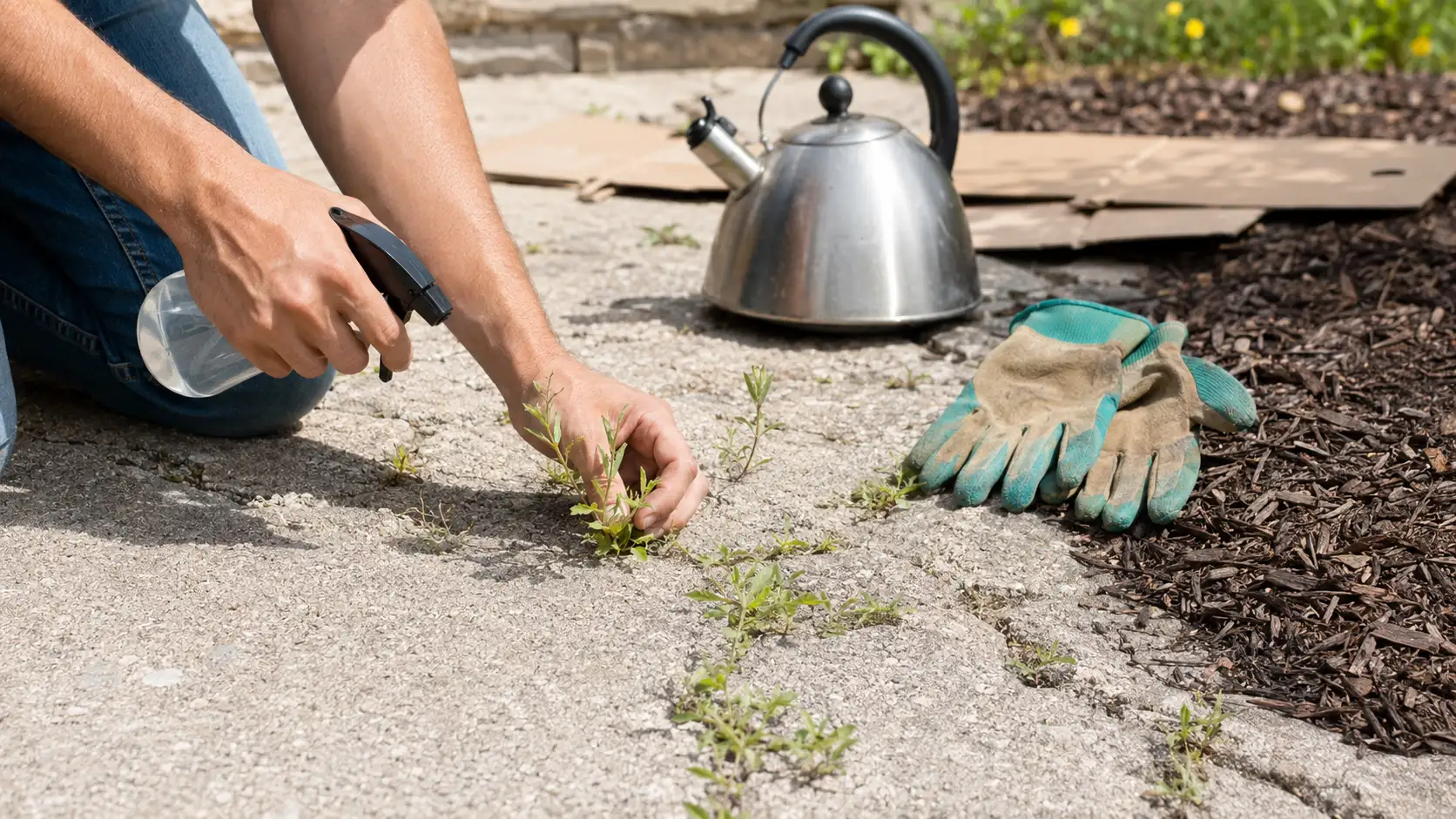
| ⚠️ Advisory: This article is about garden weeds, not cannabis. Yes, really. If you came here for strain guides, terpene breakdowns, or how to get the most out of your grow, you’re on a cannabis education site that also, apparently, knows how to handle the other kind of weed problem. Read on. |
If you grow cannabis outdoors, you already know the one thing nobody talks about in the grow guides: the other weeds. The uninvited ones. The ones crowding the raised beds, splitting the driveway, and pushing through every crack in the patio before your plants even hit the vegetative stage.
A homemade weed killer made from ingredients already in your kitchen is one of the fastest ways to clear them out without reaching for a chemical herbicide that you definitely do not want anywhere near a cannabis garden.
Weed pressure is also one of the biggest seasonal headaches for anyone trying to time multiple outdoor harvests without disrupting the grow area between cycles.
This guide covers four natural methods that actually work, where each one belongs, what to avoid, and how to keep the problem from coming back season after season. No glyphosate. No soil contamination. Just the kind of practical, specific guidance that growers and home gardeners both need.
Quick Reference: Which Homemade Weed Killer Works Where
| Method | Best Location | Avoid Using On | Speed |
| Vinegar and dish soap spray | Driveway cracks, patio gaps, gravel paths, fence lines | Lawns, garden beds, near cannabis plants | Fast (hours on hot days) |
| Boiling water | Sidewalk joints, patio edges, isolated hard-surface cracks | Garden beds, near roots of any wanted plant | Immediate |
| Mulch and cardboard smothering | Garden beds, bare soil, ornamental areas | Areas where new planting is planned within weeks | Slow (days to weeks) |
| Hand pulling after rain | Lawns, vegetable beds, planted beds, cannabis garden perimeters | Large infestations without additional methods | Immediate but labor-intensive |
The method itself is not the problem. Using it in the wrong spot is. Each section below covers exactly what to use, how to mix or apply it, and what to watch out for.
What a Homemade Weed Killer Can Actually Do?
Before mixing anything, it helps to understand what you’re actually working with. A homemade weed killer is not a single recipe. It is a set of methods, each effective in a specific context.
According to University of Connecticut Extension, vinegar-based mixtures are pesticides in the functional sense regardless of their household origin: they are intended to kill a plant, and they work by contact damage, not soil action.
That distinction matters for anyone with a garden. Contact herbicides damage what they touch. They do not distinguish between a weed and a cannabis plant, a tomato, or a flower. Used correctly in the right location, they are effective and safe. Used carelessly near anything you want to keep, they are simply a faster way to make a mistake.
A few limits worth knowing before you start:
- Vinegar at household concentration (5% acidity) is most effective on young, shallow-rooted annual weeds. University of California DANR research puts organic herbicide effectiveness at 60 to 100 percent on weeds under 12 days old, dropping below 40 percent on broadleaf weeds past 26 days old.
- Boiling water kills on contact but can disrupt soil organisms and nearby roots if poured broadly.
- Mulch and cardboard work slowly but are the best option for long-term suppression in garden beds.
- Hand pulling is the only method that physically removes the root, which is why weeds return after surface treatments alone.
- Deep-rooted perennials like dandelions will regrow from the taproot after any surface-only treatment. Oregon State University Extension confirms that dandelion taproots survive contact spraying and require hand removal for lasting control.
- Timing matters as much as the formula. Independent testing published in 2025 found that application conditions made a 40 percent difference in effectiveness across natural herbicide methods. Sunny days above 70 degrees Fahrenheit with no rain for 24 hours produced the best results.
What These Ingredients Actually Do?
- Vinegar contains acetic acid, which burns and desiccates weed leaf tissue on contact. Household vinegar at 5% acidity is effective on young annual weeds. Horticultural vinegar at 20% is significantly stronger, irritates skin and eyes, and should be handled with full protective gear.
Oregon State University Extension identifies horticultural vinegar as approximately four times the concentration of household varieties. The University of Maryland Extension also notes that vinegar acts strictly as a contact herbicide, meaning it affects only the tissue it touches and does not translocate to roots. For most driveway and patio weed situations, the 5% version is sufficient when applied at the right time. - Dish soap acts as a surfactant. It reduces surface tension so the vinegar spreads across the waxy leaf surface rather than beading up and sliding off. It does not kill weeds independently. One tablespoon per gallon is sufficient; more does not improve results and can affect soil biology if it runs off into garden areas.
- Boiling water works through thermal damage. It scalds leaf tissue, stems, and the crown of the plant on contact, with no chemical residue once it cools. It is the cleanest option for isolated hard-surface weeds, but NC State Extension cautions on burn risk: closed-toe shoes, gloves, and a pot with a controlled pour spout are not optional.
- Cardboard and mulch suppress weeds by blocking sunlight. Without light, photosynthesis stops and weeds cannot synthesize food, typically dying within four weeks according to University of Minnesota Extension research on smothering methods. This combination is slower than spraying but significantly better for soil health and long-term weed prevention in garden beds.
- Hand pulling requires no ingredients. It is the only method that removes the root system. Damp soil after rain or deep watering is the key: roots release cleanly without snapping, which is what allows regrowth.
Eco-Friendly Weed Control Methods: Full Instructions
Natural weed control works best when you match the method to the specific location. A spray that handles patio cracks cleanly can damage garden soil, cannabis plants, or nearby roots if used in the wrong area. These four methods cover every common situation.
Method 1: Vinegar and Dish Soap Spot Spray
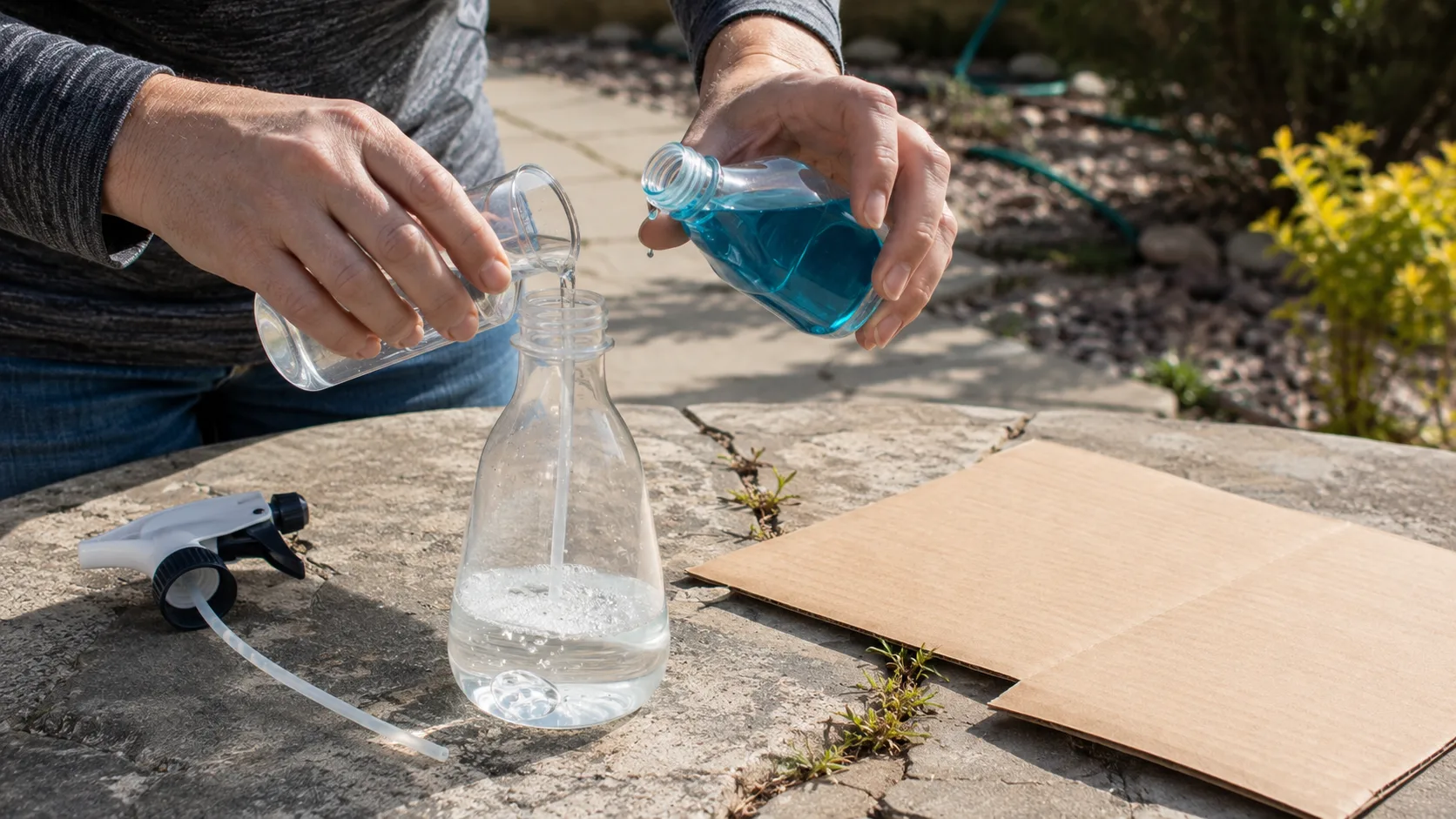
The vinegar and dish soap spray is the fastest option for driveways, gravel paths, and patio gaps. It leaves no lasting chemical residue on pavement and uses ingredients most people already have.
This recipe skips salt entirely. Salt builds up in soil over repeated applications and can sterilize the ground for extended periods, according to UConn Extension. It is not necessary for the vinegar to work and is never worth the soil risk.
| Ingredient | Amount | Role |
| White vinegar, 5% acidity | 1 gallon | Burns and desiccates weed leaf tissue on contact |
| Liquid dish soap | 1 tablespoon | Helps the vinegar adhere to waxy leaf surfaces |
How to mix and apply:
- Pour vinegar into a spray bottle or garden sprayer.
- Add dish soap and mix gently to avoid excessive foam.
- Label the container clearly.
- Apply on a sunny, dry day with temperatures above 70 degrees Fahrenheit and no rain expected for at least 24 hours. Heat accelerates the desiccation effect significantly.
- Spray directly onto weed leaf surfaces only, not the surrounding soil.
- Hold a piece of cardboard as a drift shield near any wanted plants or your cannabis garden perimeter.
- Rinse the sprayer with clean water after each use. Acetic acid degrades metal components over time.
This method works best on young annual weeds with shallow roots. Oregon State University Extension notes that household vinegar’s lower concentration limits how deeply it affects plant tissue, meaning established perennial weeds with deep taproots often regrow. For those, combine spraying with hand pulling to remove the root.
Method 2: Boiling Water for Cracks and Joints
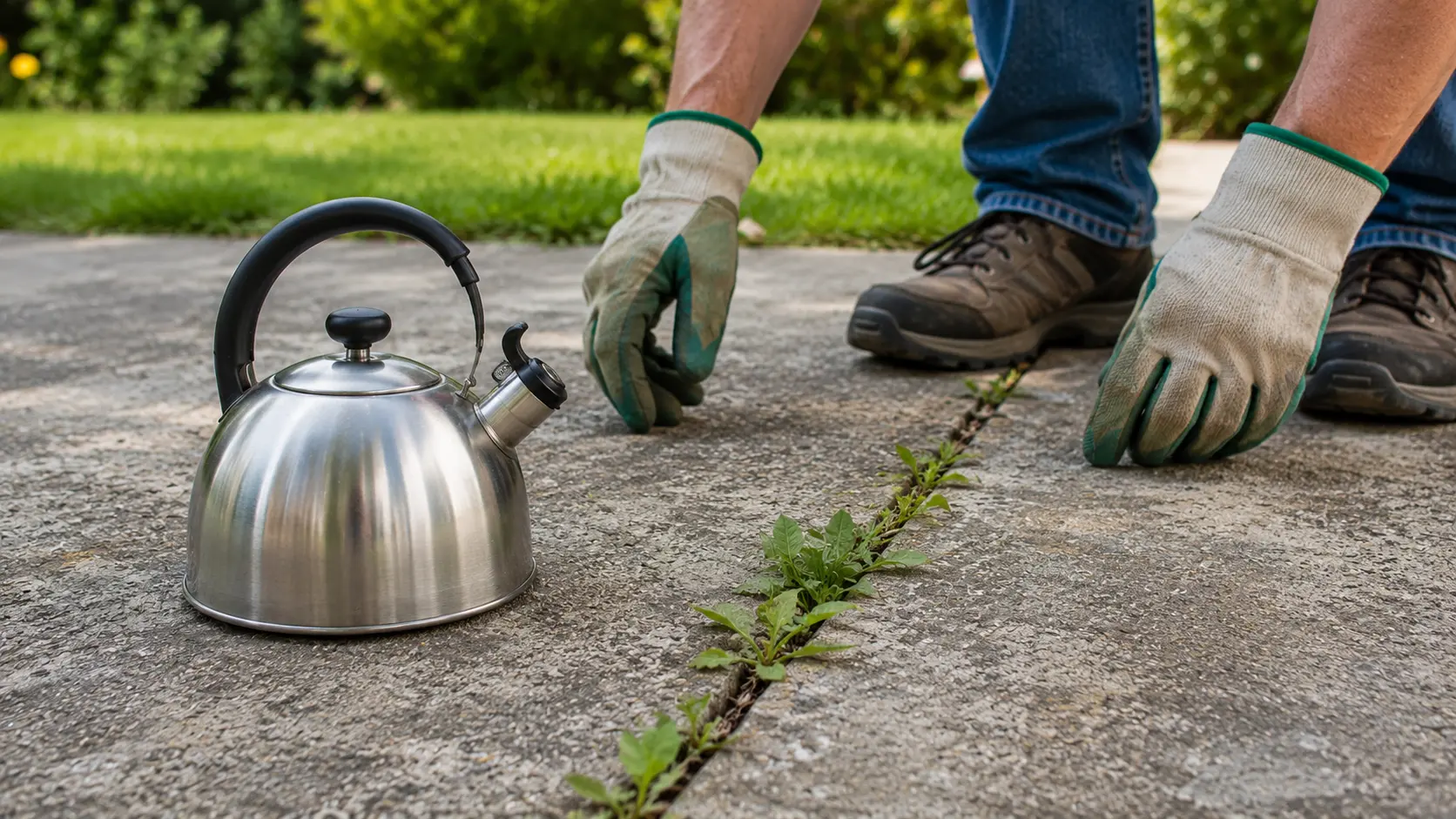
Boiling water is the cleanest natural weed control option for isolated hard-surface weeds. It leaves zero chemical residue, does not affect soil pH, and is safe on concrete, brick, and stone pavers. The only risk is the water itself.
| Tool or Material | Amount | Role |
| Boiling water | 1 kettle or pot | Scalds weed leaves, stems, and crown on contact |
| Heat-safe kettle or pot with pour spout | 1 | Allows controlled, targeted pouring |
| Closed-toe shoes and gloves | Required | Protects against scalding during handling |
How to use it:
- Boil water fully.
- Carry carefully to the target area using both hands, keeping the pot stable.
- Pour slowly and directly over the weed crown and leaves, keeping the stream tight to the target.
- Avoid pouring onto soil adjacent to any wanted plant, tree, or shrub roots.
- Repeat in five to seven days if the weed regrows from the crown.
Do not use boiling water in active garden beds or anywhere near the root zones of cannabis plants or other cultivated plants. Outdoor grows, including setups that use light deprivation for cannabis, rely on undisturbed root health throughout the flowering cycle, and scalding nearby soil disrupts that directly.
Method 3: Mulch and Cardboard Smothering
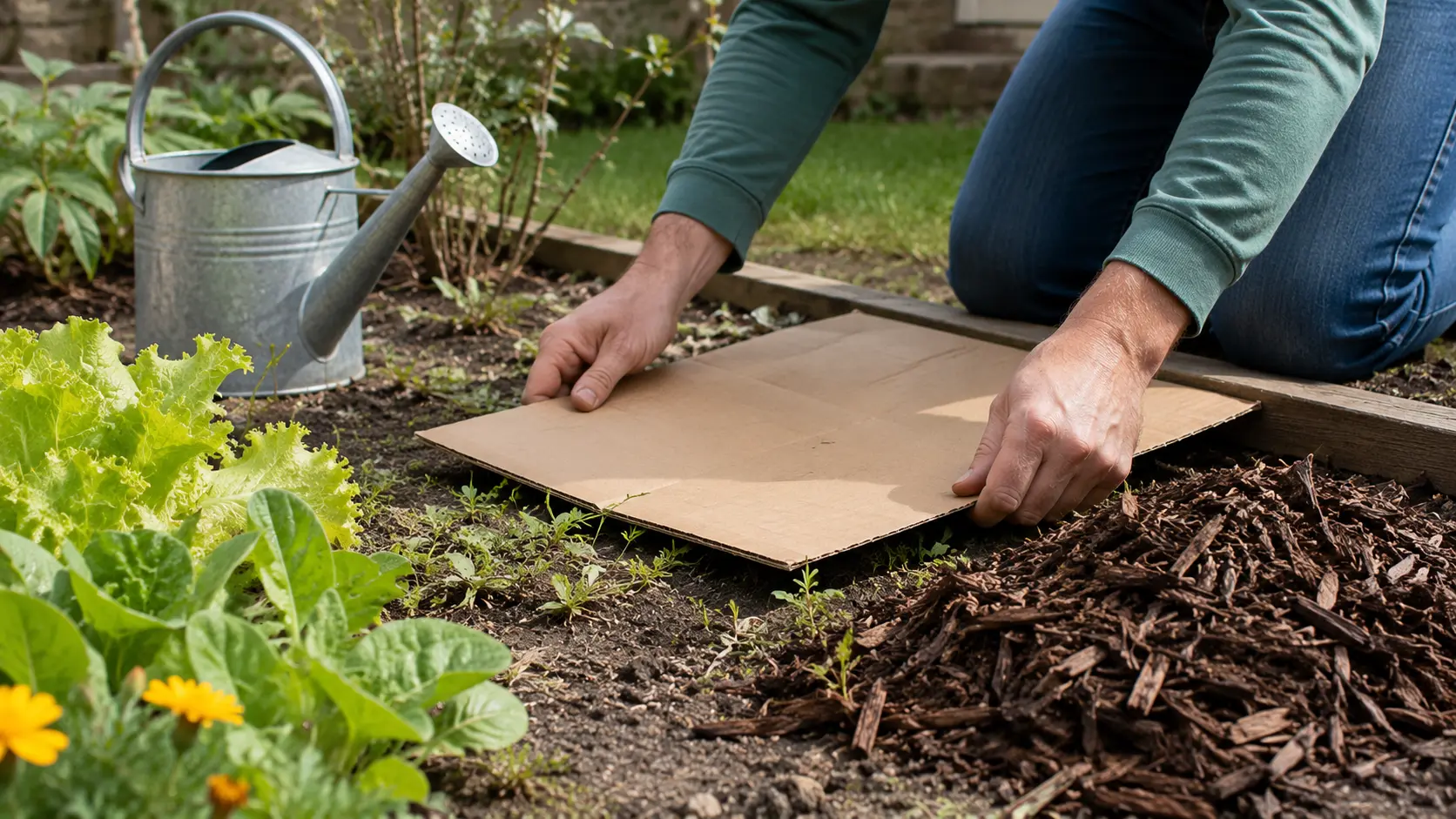
For garden beds, cannabis grow perimeters, and bare soil areas, cardboard and mulch smothering is the safest and most soil-friendly natural weed control method.
It works by cutting off light, and without light, photosynthesis stops. University of Minnesota Extension places typical weed kill from smothering at four weeks with adequate mulch depth.
| Material | Amount | Role |
| Plain uncoated cardboard (no tape, no glossy panels) | Enough to cover with 4-inch overlaps at edges | Blocks sunlight and suppresses existing weeds |
| Organic mulch (wood chips, straw, or compost) | 3 to 4 inches deep | Holds cardboard flat and prevents new weed seed germination |
| Water | Light amount | Settles cardboard flat and initiates decomposition |
How to apply:
- Pull or cut down tall weeds first so the cardboard lies flat against the soil.
- Lay uncoated cardboard over the entire area with edges overlapping by several inches so no light gets through the seams.
- Wet the cardboard lightly to help it conform and stay in place.
- Cover with 3 to 4 inches of organic mulch.
- Keep mulch a few inches away from plant stems and cannabis stalk bases to avoid moisture-related rot.
University of Minnesota Extension notes that combining mulch with hand removal works particularly well in garden beds because mulch prevents new weed seeds from germinating, while pulling removes weeds already established.
For cannabis gardens specifically, this is the preferred perimeter method: no spray contact risk, no soil disruption, and the cardboard decomposes into the soil over time.
Healthy, undisturbed soil is also a meaningful factor in sun-grown cannabis terpene profiles, which is one more reason not to spray anything near the root zone.
Method 4: Hand Pulling After Rain
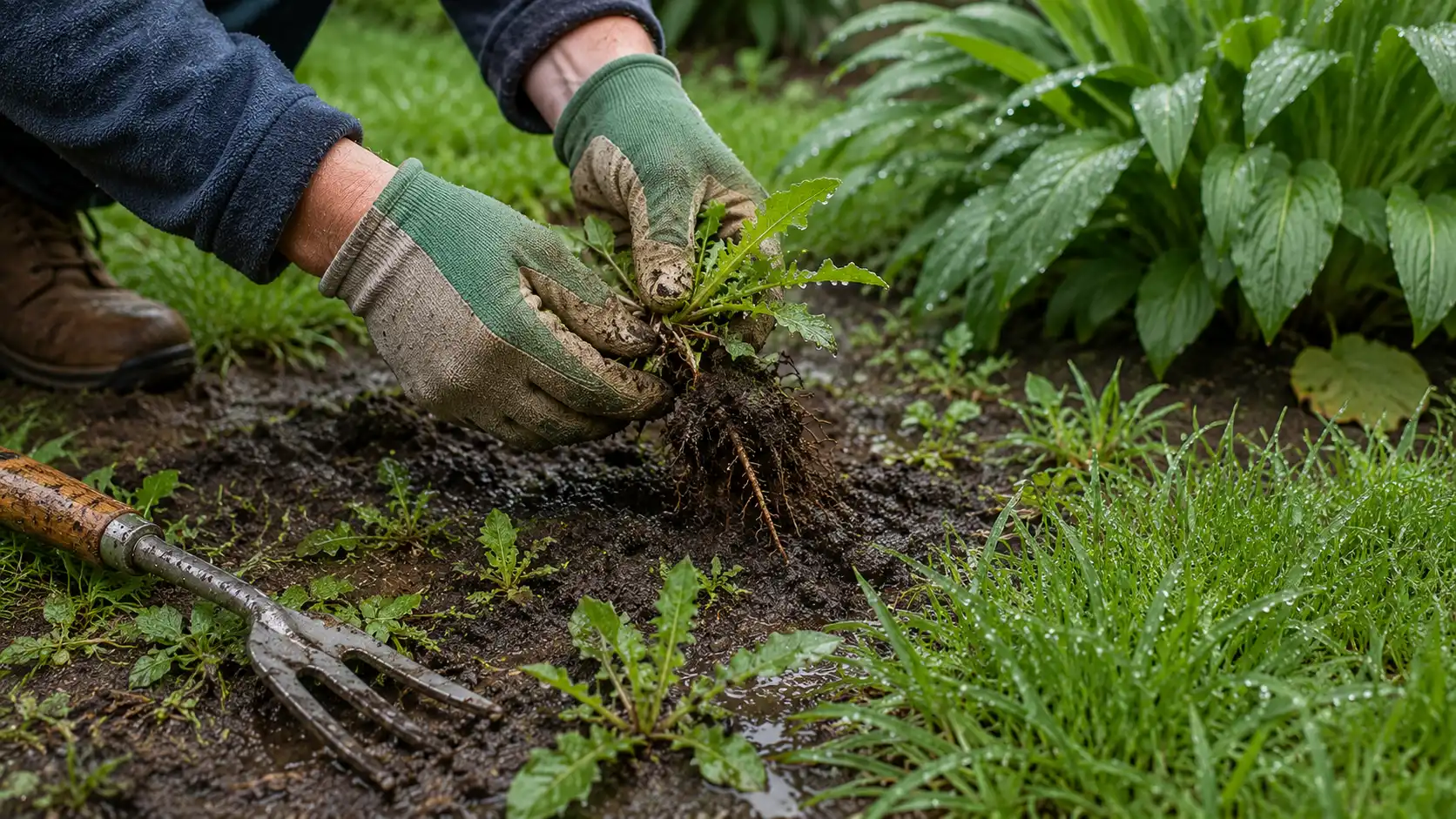
Hand pulling is the most ecologically sound weed control option and the only method that removes the entire root system.
Every surface treatment, spray or heat, leaves the root intact. If the root survives, the weed regrows. Hand pulling is the only approach that addresses that directly.
| Tool or Condition | Role |
| Soft, damp soil within 24 hours of rain or deep watering | Allows roots to release cleanly without snapping at the crown |
| Hand weeder or dandelion fork tool | Levers deep taproots out intact without disturbing the surrounding soil |
| Garden gloves | Protects hands and improves grip on stems during repeated pulling |
How to do it:
- Pull within 24 hours of rain or irrigation, when the soil is still soft.
- Grip the weed at the base, close to the soil line, not the top of the stem.
- Pull slowly and steadily with a slight rotating motion so the root comes out intact rather than snapping.
- Use a hand weeder for dandelions, dock, or any other deep taproot weed.
- Remove weeds before seed heads form. One plant going to seed can produce hundreds of new weeds in subsequent weeks.
This is the correct method for lawns, vegetable beds, and cannabis garden perimeters where a spray would risk contact with wanted plants. It takes more time than spraying, but it is the only approach that solves the root problem rather than repeating surface treatment cycles indefinitely.
Where to Use Each Method by Location
| Location | Best Method | Why It Fits |
| Driveway cracks | Vinegar spray or boiling water | Targets weeds without affecting living soil |
| Patio gaps | Vinegar spray or boiling water | Works well on small weeds between pavers |
| Gravel paths | Vinegar spot spray | Practical for isolated weeds without soil disruption |
| Fence lines | Vinegar spray with cardboard drift shield | Shield prevents spray contact with nearby plants |
| Lawn areas | Hand pulling after rain | Protects grass; spray would damage turf |
| Flower beds | Mulch, cardboard, hand pulling | No spray contact risk to wanted plants |
| Vegetable and cannabis garden beds | Hand pulling, hoeing, mulch only | Avoids any spray contact near food crops or cultivated cannabis plants |
University of Minnesota Extension notes that hand-weeding in small lawn areas avoids the need for any herbicide application across the whole area for just a few weeds.
The same logic applies to cannabis grow spaces: the narrow margin for error around cultivated plants makes hand pulling and mulch the correct methods, full stop.
When to Apply: Timing Is Half the Method
Application conditions determine whether a homemade weed killer works or wastes your time. Independent testing published in 2025 identified timing as making a 40 percent difference in natural herbicide effectiveness across all methods tested.
| Condition | Why It Matters |
| Sunny day, above 70 degrees Fahrenheit | Heat accelerates the desiccation effect of acetic acid. Above 80 degrees improves results further. |
| No rain for 24 hours after application | Rain dilutes and washes the solution away before it can penetrate leaf tissue. |
| Low wind | Drifting onto wanted plants or cannabis grows is a real risk on windy days. |
| Morning application | Plants are actively transpiring in the morning, which improves absorption of contact treatments. |
| Weeds under 12 days old | University of California DANR data: 60 to 100 percent effective at this stage, versus below 40 percent past 26 days. |
Ingredients and Methods to Avoid
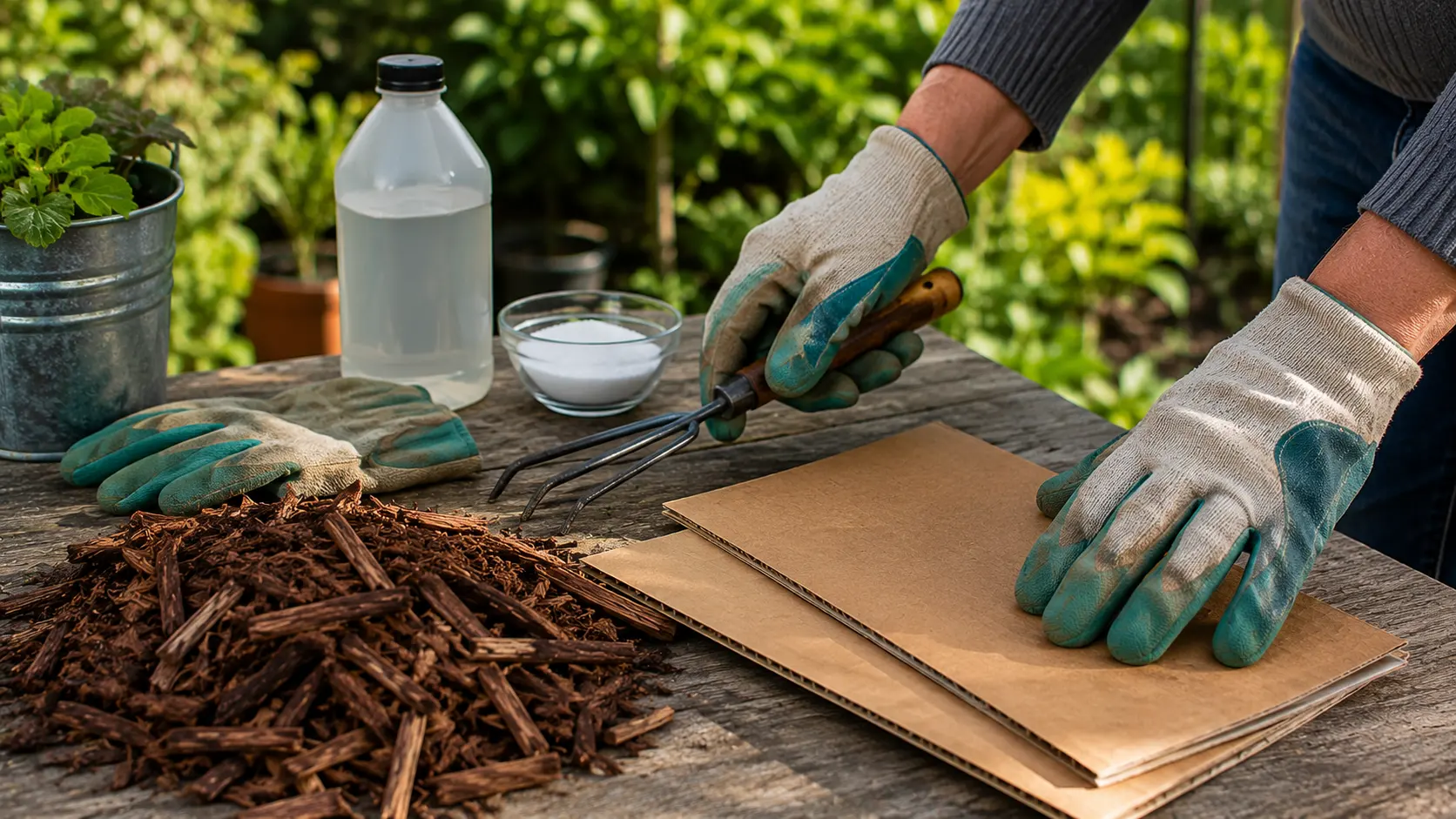
A natural fix should not create a larger problem. Some household solutions circulate widely on social media without any mention of what they do to soil, pets, or nearby plants.
- Bleach: Do not use bleach in any yard application. It damages plants and surfaces, creates toxic fumes when mixed with other cleaners, and has no place in any garden environment.
- Salt-heavy recipes: Table salt (sodium chloride) builds up in soil with repeated applications. UConn Extension and Oregon State University Extension both document that salt kills earthworms and beneficial soil microbes, travels laterally through soil to damage nearby plants and tree roots, and degrades slowly, with the potential to sterilize growing areas for extended periods. Skip it entirely in any recipe used near garden beds, lawns, or cannabis grows.
Salt-damaged soil also makes it harder for plants to absorb nutrients correctly, and if you are already watching for cannabis nutrient deficiency signs, adding salt runoff to the equation makes diagnosis and correction significantly harder. - High-concentration horticultural vinegar without PPE: Vinegar at 20% or 30% acidity causes chemical burns to skin, eyes, and lung tissue. OSU Extension identifies horticultural vinegar as four times the concentration of household vinegar. If you use it, wear chemical-resistant gloves, eye protection, and avoid breathing the vapor. It is not a casual swap for the 5% household version.
- Random cleaner combinations: Do not mix vinegar, bleach, ammonia, or unknown household cleaners together. The chemistry is unpredictable, and the risk is not worth any perceived weed-killing benefit.
How to Keep Weeds From Coming Back Naturally
Prevention reduces the need for any homemade weed killer. Weeds grow where conditions let them: bare soil, open cracks, and thin lawn areas are the three most common entry points.
Remove weeds before seed heads form. One plant going to seed produces hundreds of plants the following season. Fill driveway and patio cracks to block the seed-to-crack pathway. Add mulch over any bare garden soil because it blocks light and protects the surface from new germination.
For lawns, dense, healthy turf is the most effective long-term weed suppression strategy because it leaves no gaps for weed seedlings to establish.
For outdoor cannabis gardens, a maintained mulch border around the grow area handles the surrounding weed pressure without any spray risk to the plants.
Pull young weeds after rain, check problem areas weekly before small plants set seed, and the overall workload drops significantly over the course of a season.
Frequently Asked Questions
Does a homemade weed killer work as well as commercial herbicides?
For young annual weeds on hard surfaces, a vinegar and dish soap spray can match commercial contact herbicides in speed and effectiveness.
For established perennial weeds with deep root systems, commercial herbicides generally outperform household methods because they are formulated to translocate to the root.
Homemade methods work best as part of a routine that also includes root removal, not as a standalone permanent solution for deep-rooted weeds.
Is vinegar weed killer safe to use near cannabis plants?
No. Acetic acid is a non-selective contact herbicide: it damages any plant tissue it touches, including cannabis leaves and stems. Never spray vinegar near your cannabis grow. For weed control around cannabis plants, use hand pulling and mulch only.
Reserve the vinegar spray for hard surfaces like driveways and patio cracks that are well away from any garden bed. If spray contact is a persistent concern, growing cannabis indoors removes the weed problem from the equation entirely.
Does vinegar kill weeds permanently or do they grow back?
Vinegar is a contact treatment that burns visible leaf tissue. For shallow-rooted annual weeds, one application on a hot day often kills the plant completely. Perennial weeds with deep taproots almost always regrow because the root system survives the spray.
Oregon State University Extension specifically documents this for dandelions, which can regenerate from their taproot even after the above-ground plant appears fully dead. Combining a vinegar spray with hand pulling of the root gives a more lasting result.
Is boiling water safe to use near pavement and patio materials?
Boiling water does not damage concrete, brick, or stone pavers. It is fully safe on hard surfaces and leaves no residue once cooled.
The only risk is burn injury during handling. Do not pour it near plastic edging, treated wood decking, or any material that warps under heat. Keep the pour focused on the weed only to avoid scalding adjacent root systems.
Can mulch alone stop weeds from coming back in garden beds?
A 3 to 4 inch layer of organic mulch blocks enough light to prevent most new weed seed germination and significantly reduces new growth. It will not kill established weeds already rooted below the surface.
The correct sequence is to pull or cut existing weeds first, then lay cardboard, then cover with mulch. University of Minnesota Extension recommends this combination for long-term garden bed weed control.
Which method works fastest for driveway and patio weeds?
A vinegar and dish soap spray applied on a sunny day above 70 degrees Fahrenheit is the fastest option. Small annual weeds can show wilting within hours and be fully browned by the following morning. Boiling water produces comparable speed for isolated cracks and joints. Both work fastest when the weed is young and the conditions are hot and dry.
Is hand pulling enough for a large weed infestation?
For large areas, hand pulling combined with cardboard and mulch smothering is the most practical all-natural approach. Pull the largest weeds first, especially any that have already formed seed heads.
Then lay cardboard and mulch over the cleared area to prevent new germination while you continue pulling smaller established weeds in stages. Done this way, a large infestation can be brought under control within one growing season without any chemical input.
Wrapping Up
Weeds are easier to deal with when the method matches the location. A home made weed killer works best when it is chosen for the specific problem: a vinegar and dish soap spray for hard surfaces, boiling water for cracks, mulch and cardboard for garden beds, and hand pulling for any area with wanted plants nearby.
The vinegar recipe stays popular because it is fast and cheap. But the real reason it works well for some people and fails for others comes down to where and how they use it, not the recipe itself.
For how to get rid of weeds naturally across the whole yard, no single method covers every situation. Using the right tool for each spot is what keeps weeds from coming straight back.
Drop a comment below and share where your weeds keep showing up. Driveway, lawn, flower bed, or vegetable patch each get a different answer, and knowing the exact spot makes it much easier to point you toward the right method.
Sources
- Oregon State University Extension Service. “Is vinegar effective for killing weeds?” extension.oregonstate.edu. Available at: https://extension.oregonstate.edu/ask-extension/featured/vinegar-effective-killing-weeds
- Oregon State University Extension Service. “Dandelions: Living with, or without, them.” extension.oregonstate.edu. Available at: https://extension.oregonstate.edu/catalog/em-9510-dandelions-living-or-without-them
- University of Minnesota Extension. “Managing weeds in lawns.” extension.umn.edu. Available at: https://extension.umn.edu/lawn-care/lawn-weeds
- University of Minnesota Extension. “Controlling weeds in home gardens.” extension.umn.edu. Available at: https://extension.umn.edu/planting-and-growing-guides/controlling-weeds-home-gardens
- University of Connecticut Extension. Bailey, Sarah. “Homemade Pesticide Issues: Understanding the Science.” September 2019, updated July 2024. Available at: https://extension.uconn.edu/?p=17012
- University of Maryland Extension. “Vinegar: An Alternative to Glyphosate?” extension.umd.edu. Available at: https://www.extension.umd.edu/resource/vinegar-alternative-glyphosate