
Prescription labels can feel confusing when they use short medical terms instead of plain words. In my work reviewing medication instructions and patient education resources, I have seen how abbreviations such as TID can make simple directions harder to understand.
If you found TID on a bottle, chart, or medication order, you likely want a clear answer before taking the next dose. The TID medical abbreviation means three times a day.
However, that does not always tell you the exact hours, if food is needed, or what to do after a missed dose. Those details depend on the medicine and the full instructions.
In this guide, I explain what TID means in prescriptions, pharmacy labels, and nursing records. You will also learn how it compares with BID and QID, how to read common examples, and which questions to ask a pharmacist when the timing is still unclear.
What does TID Mean in Medical Terms?
TID means that a medicine is taken or given three times during one day. The letters may appear as TID, tid, or t.i.d. on a prescription, pharmacy record, or medication chart.
TID describes dosing frequency, not the amount taken in each dose.
The NIH Clinicalinfo glossary defines TID as three times a day and notes that it commonly appears in drug-dosing instructions, according to the National Institutes of Health.
A complete order should also state the medicine name, dose, route, and any special directions.
For example, “one tablet TID” means one tablet at each of three daily dosing times. It does not explain if the doses must be taken with food or at evenly spaced hours.
The printed pharmacy label and medicine guide should always be checked before a dose is taken.
What does the TID Pharmacy Abbreviation Mean?
TID comes from the Latin phrase “ter in die,” which means three times in a day. The abbreviation has remained common because older prescription writing used many Latin terms to keep medication directions short.
The phrase explains where the letters came from, but patients do not need to know Latin to follow the direction. The full prescription still matters because TID only shows frequency.
It does not state how many tablets to take, which route to use, or how long treatment should continue. A medical order may combine TID with other terms, such as PO for by mouth.
The TID medical abbreviation should be read as one part of the complete instruction, not as a full dosing plan by itself.
Does TID Mean Every Eight Hours?
TID does not always mean every eight hours. It means three times a day, while “every eight hours” gives a specific interval between doses. The prescription label should decide the schedule, not a general rule about TID.
Some medicines prescribed three times daily are taken at roughly eight-hour intervals. Some medication instructions specifically require doses every eight hours, while others schedule three doses during waking hours or around meals.
Other drugs may be scheduled during waking hours or around meals, depending on their instructions. A routine such as morning, afternoon, and evening is not automatically correct for every prescription.
Taking doses too close together may increase side effects, while leaving a long gap may reduce the intended effect. When the label only says three times daily and the hours are unclear, a pharmacist can explain the correct spacing.
Sample TID Medication Schedules
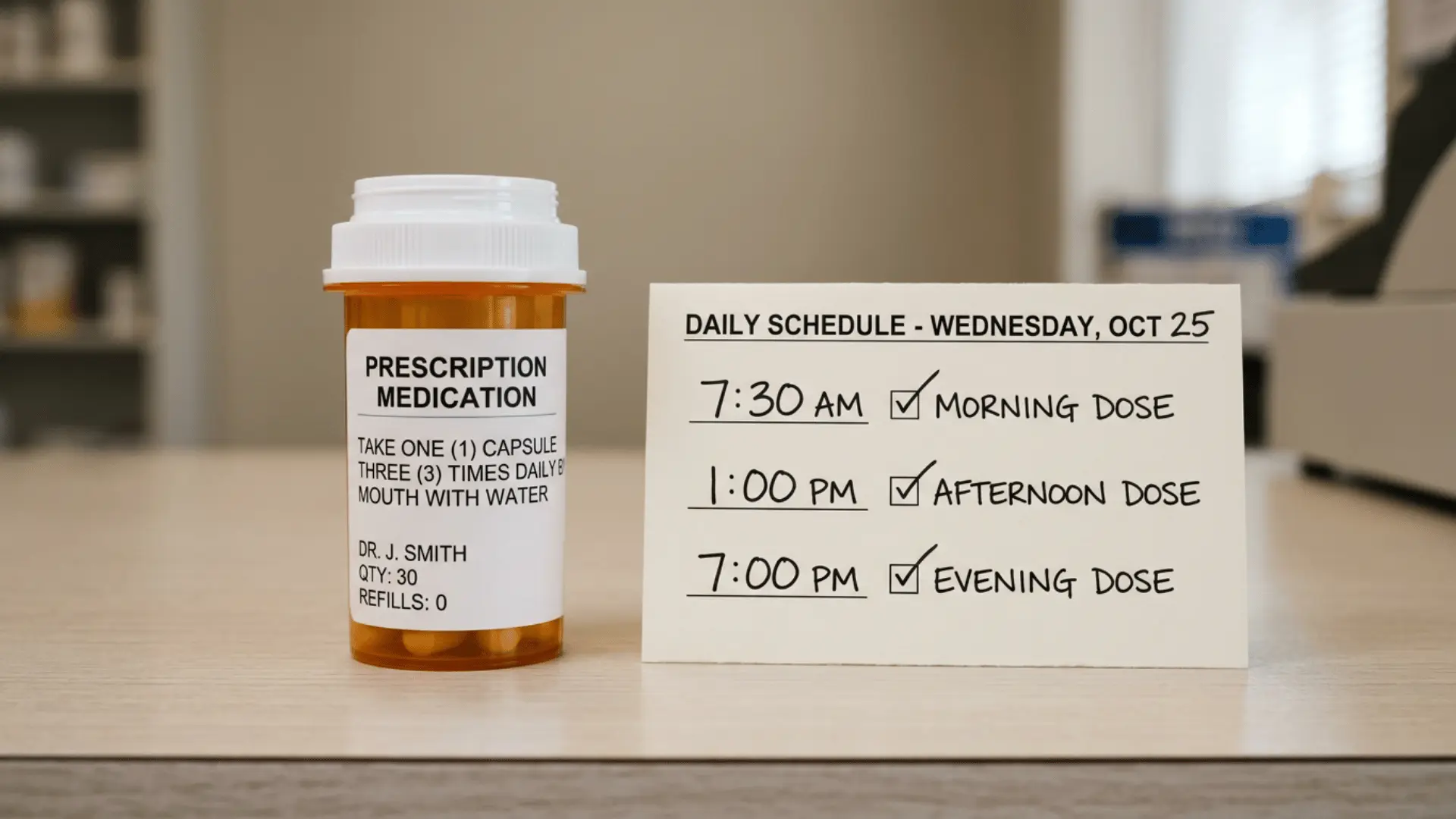
These times are examples only and should not be used unless they match the pharmacy label or instructions from the prescriber or pharmacist.
| Schedule Type | Example Times | Main Point |
|---|---|---|
| Waking hours | 8 a.m., 2 p.m., 8 p.m. | May suit some orders |
| Eight-hour intervals | 6 a.m., 2 p.m., 10 p.m. | Only when required |
| With meals | Breakfast, lunch, dinner | Only when the label or pharmacist approves meal-based timing |
| Facility schedule | Set medication-round times | Follows policy and the order |
The TID medical abbreviation does not select one pattern by itself. Timing may depend on absorption, side effects, sleep, meals, and the condition being treated. A pharmacist should confirm the schedule when the label is not specific.
How to Read a TID Prescription
A TID prescription should be read as several connected instructions, not as one abbreviation. Consider the example “amoxicillin 500 mg PO TID for seven days.” This order means 500 mg by mouth, three times daily, for the stated treatment period.
The medicine name identifies the drug. The number and unit show the amount in each dose. PO describes the oral route, while TID gives the daily frequency.
The final phrase states how long the medicine should be used. Extra wording may also explain food, liquid measurement, or dose spacing. The TID medical abbreviation alone cannot provide these details.
Reading the label helps prevent taking three tablets at once or stopping early. Unclear words, missing units, or conflicting directions should be reviewed with the pharmacy before treatment begins.
Common TID Prescription Examples
TID can appear in several types of medication directions because the abbreviation describes frequency rather than dosage form. Each example must be read with its dose, route, and special instructions.
“Take one tablet TID” means one tablet at each of three daily times. “Apply a thin layer TID” refers to using a topical medicine three times daily. “Take 5 mL PO TID” gives a liquid amount and an oral route.
“One capsule TID with food” adds a meal instruction that should not be ignored. These examples explain how the TID medical abbreviation is used, but they are not personal dosing advice.
Actual labels may include limits, exact hours, treatment length, or warnings. The medicine container and patient information should remain the main sources for the correct directions.
What does PO TID Mean?
PO TID means that the medication dose is taken by mouth three times a day. PO comes from the Latin phrase per os and means the medicine is taken by mouth, while TID gives the daily frequency.
PO TID explains route and frequency, but it does not provide the dose amount. A complete order might read “250 mg PO TID for five days.”
The 250 mg is the amount taken each time, PO means by mouth, and TID means three daily doses. The treatment period is listed separately.
Additional directions may state if the medicine should be taken with food, mixed with liquid, or spaced at exact hours. The TID medical abbreviation must therefore be interpreted with every other part of the label.
A pharmacist should be contacted when the dose, measuring device, or timing is uncertain.
TID vs BID, QID, QD, and PRN
Medication abbreviations can look similar while giving different directions. TID means three times daily and should not be exchanged with another frequency term.
| Abbreviation | Meaning |
|---|---|
| QD | Once daily |
| BID | Twice daily |
| TID | Three times daily |
| QID | Four times daily |
| PRN | As needed |
| STAT | Immediately |
| PO | By mouth |
| AC | Before meals |
| PC | After meals |
The TID medical abbreviation gives scheduled-dose frequency. PRN means the medicine is used only as needed, with limits. PO describes a route, not frequency.
TIW can mean three times weekly and may be confused with TID, so safety groups recommend writing these directions in full.
How Nurses Use TID During Medication Administration

Nurses use TID to place three planned doses on the medication administration schedule. The abbreviation is checked against the provider order and the facility’s approved timing rules.
Each scheduled dose still requires a complete medication safety check.
Before administration, the nurse confirms the patient, drug, strength, amount, route, time, allergies, and relevant clinical instructions.
Some medicines also require checks such as blood pressure, pulse, blood glucose, laboratory values, swallowing ability, or food intake. The dose is then documented so another staff member does not repeat it.
The TID medical abbreviation may appear during shift changes, making accurate records especially important.
Any mismatch between the order, pharmacy label, and administration record should be resolved before the medicine is safely given.
What to do After Missing a TID Dose
A missed TID dose should be handled according to the specific medicine’s label or patient guide. There is no single missed-dose rule that is safe for every drug. A double dose should not be taken unless a qualified clinician gives that instruction.
Many medication guides advise taking a forgotten dose when remembered, then skipping it if the next scheduled dose is near. However, the correct action can differ by medicine, timing, and health condition.
The TID medical abbreviation only states normal frequency and does not explain missed-dose steps.
The pharmacist or prescriber should be contacted when the instructions are missing or confusing. Prompt advice is especially important for medicines used for seizures, blood clotting, heart rhythm, diabetes, serious infections, or other conditions where timing may strongly affect treatment.
Common TID Medication Mistakes to Avoid
Small errors can change how a medicine works or increase the chance of side effects. The table below explains the most common problems linked with the TID medical abbreviation.
| Mistake | Why It Can Be a Problem | Safer Approach |
|---|---|---|
| Doubling the next dose | Taking extra medicine may increase side effects or lead to an overdose. | Check the missed-dose instructions or contact a pharmacist. |
| Ignoring the dose amount | TID only describes frequency and does not state how many tablets or milliliters to take. | Read the full label before every dose. |
| Missing food instructions | Food may affect how the medicine is absorbed or how it affects the stomach. | Follow directions such as with food or on an empty stomach. |
| Confusing TID with TIW | TID means three times daily, while TIW may mean three times weekly. | Ask for written clarification when an abbreviation is unclear. |
| Taking doses too close together | Short gaps may raise medicine levels and increase unwanted effects. | Use alarms or a written medication schedule. |
| Stopping treatment early | Symptoms may improve before treatment is complete. | Continue for the full prescribed period unless told otherwise. |
Final Thoughts
Seeing TID on a prescription does not need to make medication directions feel confusing.
The key is to remember that it means three times a day, while the rest of the label explains the dose, route, timing, food needs, and treatment length.
A safe schedule should come from the label, pharmacist, or prescriber. It should not be based only on a sample timetable found online.
This matters because some medicines need even spacing, while others may be taken during waking hours or with meals. Missed doses also require specific advice.
Read every part of the instructions before starting treatment. Ask questions when any wording is unclear, and never guess about dose timing.
Have you seen TID or another confusing abbreviation on a prescription? Share your experience in the comments below.
Frequently Asked Questions
Can Two TID Medicines be Taken at the Same Time?
Sometimes, but interactions, food requirements, and side effects may differ. A pharmacist should confirm if both medicines can share the same schedule.
How Should Liquid TID Doses be Measured?
Use the oral syringe, dosing cup, or spoon supplied by the pharmacy. Household teaspoons can give inaccurate amounts and should not be used.
Can a Pill Organizer be Used for TID Medicines?
A pill organizer can help track doses, but some medicines need special storage. A pharmacist should confirm if removing them from the original packaging is safe.