| ⚠️ Warning: If you or someone you know is struggling with alcohol or drug use, free confidential help is available 24/7. Call SAMHSA’s National Helpline at 1-800-662-4357. Call 911 immediately if someone is unconscious, not breathing, having a seizure, or showing signs of overdose. |
| Is Brad Pitt sober now? | Yes, based on current reporting and his own public comments |
| When did he stop drinking? | 2016, following his separation from Angelina Jolie |
| How long has he been sober? | Roughly nine years as of 2026, he has not shared a specific anniversary date |
| Did he go to AA? | Yes, an all-male group for approximately 18 months from late 2016 |
| Did Bradley Cooper help him? | Yes, Pitt publicly credited Cooper at the 2020 National Board of Review Awards |
| Most recent public comments | June 2025 Armchair Expert podcast with Dax Shepard; described AA as “incredible” and said he was “on my knees” before seeking help |
| His own words | “I had taken things as far as I could take it, so I removed my drinking privileges.” (NYT, 2019) |
When people search for Brad Pitt sober, they usually want one of two things: a clear answer about whether he still is, or a real account of what led him to get sober in the first place. Both are fair questions, and this article answers them directly.
Pitt has spoken about quitting drinking more plainly than most celebrities do. He has described being “on his knees,” attending AA for about a year and a half, receiving support from a sober friend, and coming to understand that alcohol was incompatible with the life he wanted to live.
His story is not wrapped in wellness branding or the polished language of redemption. It is grounded in specific choices, a difficult personal period, and a decision that stuck. Here is what the public record actually says.
Is Brad Pitt Sober Now?
Based on his own public statements and current reporting, yes. Brad Pitt has been publicly described as sober since 2016, and his most recent comments, including a June 2025 podcast appearance with Dax Shepard, confirm he remains on that path.
He has not shared a public relapse, and no credible reporting suggests otherwise. The careful wording matters: sobriety for a public figure cannot be independently verified from the outside.
What exists is a consistent public record spanning nearly a decade, in which Pitt discusses alcohol in the past tense, describes his ongoing recovery work in the present tense, and credits specific tools and people with helping him hold the line.
That consistency across multiple interviews, years apart, is the closest available signal to confirmation. It points clearly in one direction: he has done the ongoing work and kept doing it.
| 📝 Note: When writing or reading about a celebrity’s sobriety, “publicly sober” is safer and more accurate than claiming certainty about their private day-to-day life. Pitt has not shared a relapse. He has consistently described being sober. Both of those things are true, and that is the most honest framing available. |
What Led Brad Pitt to Quit Drinking

Pitt’s sobriety did not come from a wellness trend or a publicist’s suggestion. It came from a period of serious personal crisis, accountability work, and a frank acknowledgment that alcohol had carried him as far as it could.
1. The 2016 Incident and Divorce Filing
In September 2016, Jolie filed for divorce after a disputed incident on a private plane. Her legal filings alleged physical altercations; Pitt denied them. The FBI and DCFS both investigated and closed the matter without charges.
What matters here is what Pitt said himself: in a 2017 GQ interview, he acknowledged having a drinking problem at the time of the flight and the split. He did not defend his behavior. He described stopping drinking and beginning therapy shortly after.
2. His Own Words on Drinking
Pitt has used plain language about alcohol across multiple interviews. In 2017, he told GQ he had “run it to the ground” and that stopping felt freeing because he had his feelings back.
That is what many people in recovery describe: alcohol was handling something emotional they then had to face directly.
In 2019, he told the New York Times he had “removed his drinking privileges,” framing it as a deliberate revocation rather than a loss of control. That is specific accountability language.
3. Shame, Avoidance, and What He Was Drinking Around
In his June 2025 Armchair Expert appearance, Pitt said he “needed rebooting” and had to “wake up in some areas.” He was open to AA because of how low he felt: “I was pretty much on my knees, and I was really open.
I was trying anything and everything.” That describes someone who has run out of the defenses that make asking for help feel costly. For many people, that is exactly when real recovery becomes possible: when continuing carries a higher price than asking for help.
Brad Pitt Sobriety Timeline
Brad Pitt stopped drinking in 2016 after a personal crisis forced a clear-eyed look at how alcohol had shaped his decisions. The timeline below tracks the key moments from that year to today:
| Year | What Happened |
| Sep 2016 | Jolie files for divorce after a private plane incident; FBI and DCFS investigate and close the matter without charges against Pitt |
| Late 2016 | Pitt joins an all-male AA group; later describes this period as when he was “pretty much on my knees” |
| 2017 | Tells GQ he is six months sober; says he had “run it to the ground” and that stopping felt freeing |
| 2018 (approx.) | AA attendance ends after roughly 18 months; therapy and personal work continue |
| 2019 | Tells the NYT: “I had taken things as far as I could take it, so I removed my drinking privileges” |
| 2020 | Publicly credits Bradley Cooper with helping him get sober at the National Board of Review Awards; wins a SAG Award |
| June 2025 | Appears on Dax Shepard’s Armchair Expert; gives the most detailed public account of his AA experience to date; says “I needed rebooting” |
| 2026 | Publicly described as sober, roughly nine years in; no relapse reported in any credible source |
Nine years without a public relapse and a consistent record of talking about it honestly across multiple interviews. Pitt’s account is specific and grounded in the work rather than the image, which is what makes it worth reading carefully.
Brad Pitt and Alcoholics Anonymous
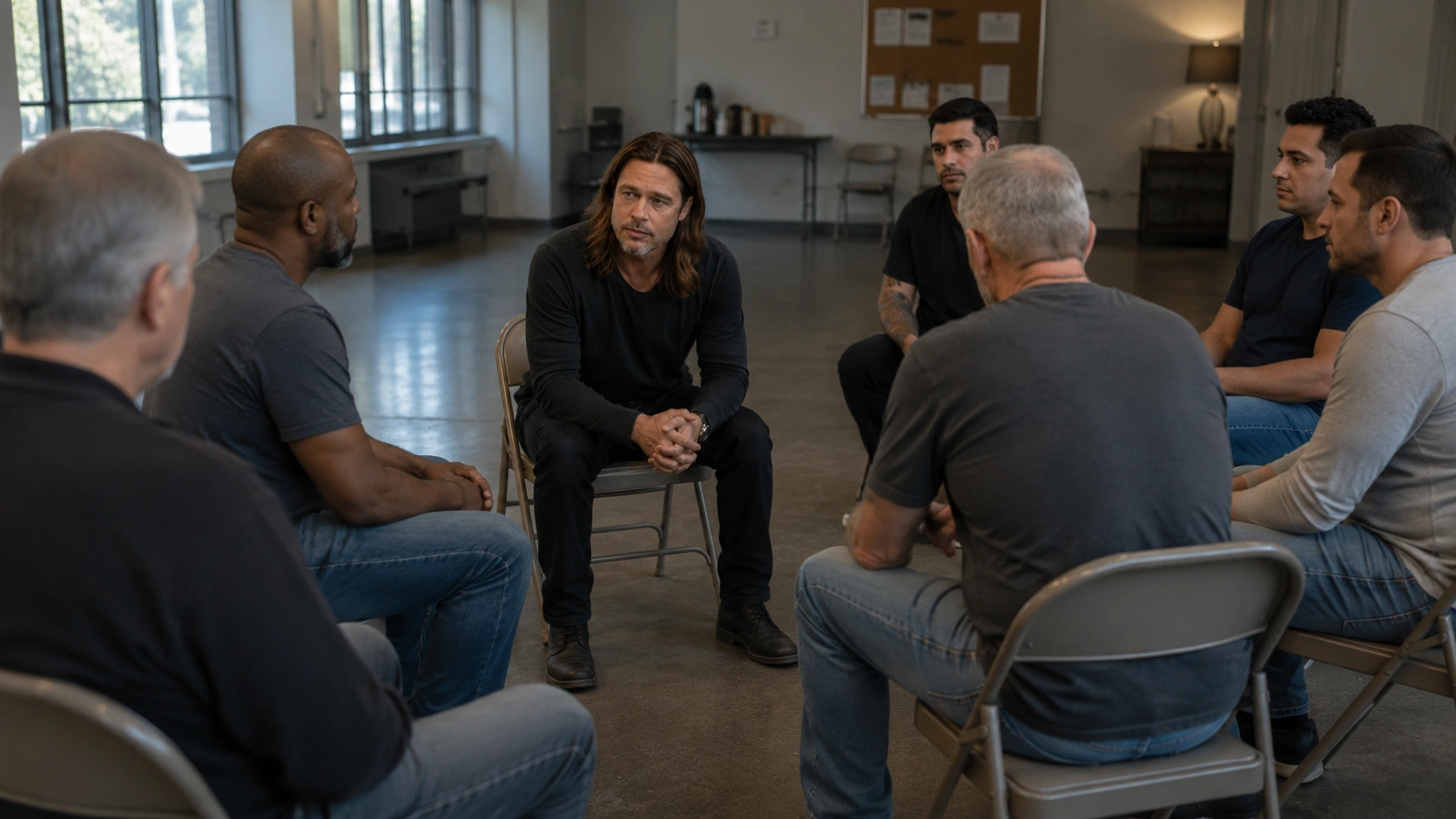
Pitt’s June 2025 Armchair Expert interview with Dax Shepard was his most detailed public account of AA: he arrived shy, opened up as the weeks passed, and said it was “a really special experience.”
The All-Male Group Format
Pitt attended an all-male AA group and said the format mattered. Men spoke honestly about mistakes, pain, and shame without performing for anyone. In his 2019 New York Times interview, he said: “It was this safe space where there was little judgment.”
A Cochrane review, summarized by Stanford Medicine,1 found that 12-step facilitation is among the most effective approaches for alcohol abstinence because social accountability creates conditions that clinical settings alone often do not.
He Attended for About 18 Months
Pitt attended meetings for roughly 18 months from late 2016 into 2018, running concurrently with therapy. He did not share a specific end date, which reflects how AA attendance typically works: it tapers rather than stops on a fixed day.
His account makes clear that AA was one part of a wider recovery structure, not the sole mechanism, and that the personal work continued well after the meetings ended.
| 📝 Note: AA is one tool among several evidence-based approaches to alcohol recovery. It works for many people but not for everyone. Other options include medical treatment, individual therapy, outpatient programs, medication-assisted treatment, and other peer support frameworks. The best fit depends on the individual’s history, needs, and level of support available. |
What Peer Support in Recovery Actually Does
Pitt’s experience with AA touches on something that the clinical research supports: peer accountability and shared experience create conditions for change that individual willpower does not. It involves regular accountability, exposure to people at different stages of recovery, and the normalization of asking for help.
For people with the kind of public-image pressures Pitt describes, peer support in a private, structured setting addresses a specific barrier: the fear that vulnerability will make the news. An all-male, closed-group format provided that containment.
His comfort discussing AA publicly eight years later, including with Dax Shepard on a widely distributed podcast, suggests the privacy was protective rather than permanent, used to build confidence rather than to keep the subject hidden forever.
The pattern his story reflects is not unique to celebrities. The broader picture of celebrity addiction and recovery2 shows that structured peer support, combined with therapy and personal accountability work, produces significantly more durable outcomes than any single intervention alone. Pitt used all three.
Bradley Cooper’s Role in Pitt’s Recovery
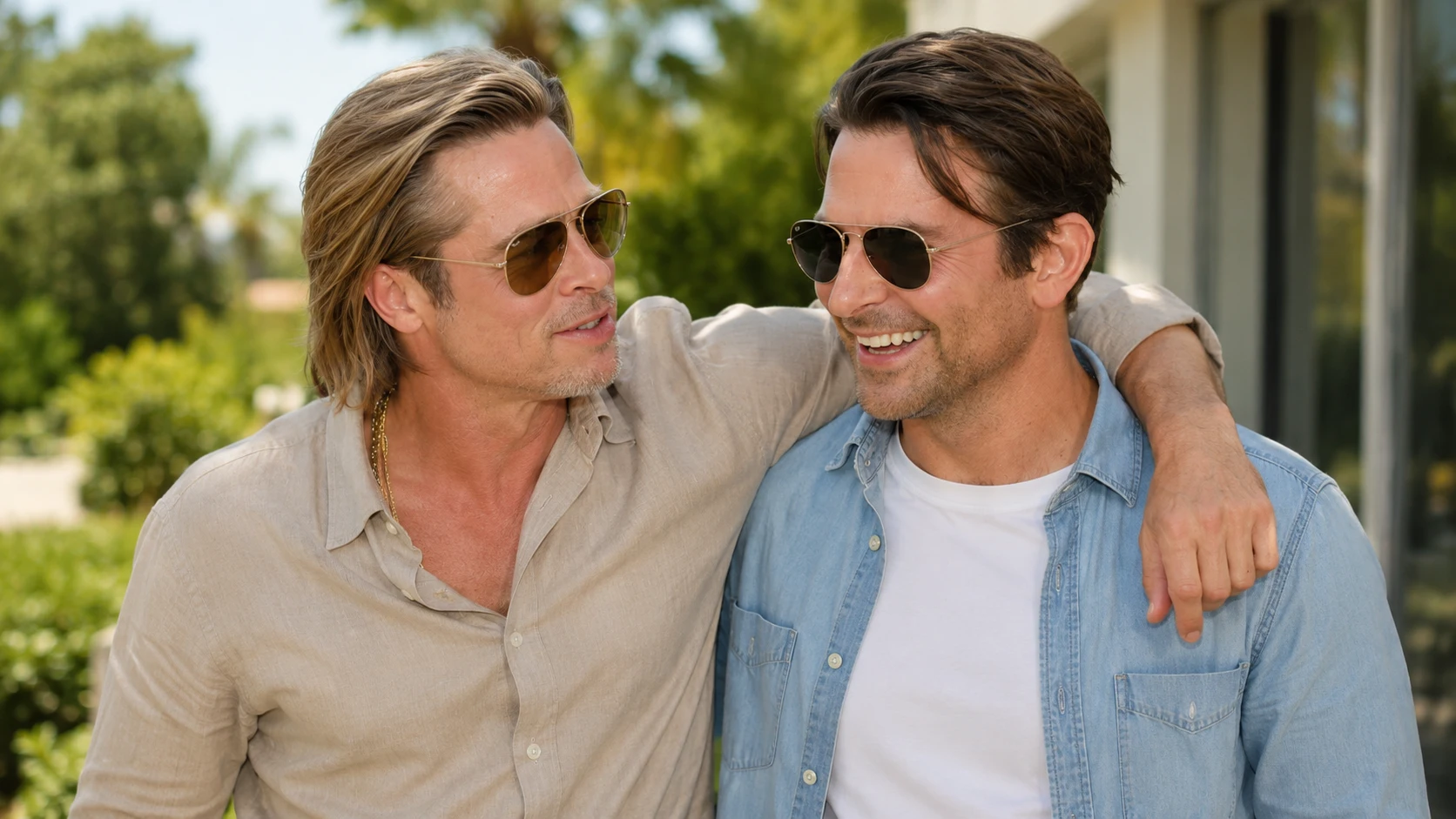
In January 2020, at the National Board of Review Awards, Brad Pitt accepted an award and publicly credited Bradley Cooper with helping him get sober. He said he got sober because of Cooper, and that every day had been happier since.
That is a significant statement to make in a public speech, and it tells a useful story about how recovery support actually works. Cooper has been publicly sober since around 2004,3 more than a decade before Pitt’s sobriety began.
His longevity as a sober person in Hollywood appears to have made him a credible presence for Pitt: proof that someone with major professional success and a high-visibility life had already done what Pitt was trying to do.
That kind of living example can matter in early sobriety when the long-term picture is hard to see. This does not mean Cooper did the work for Pitt.
What it suggests is that a trusted person, already further along in sobriety, can lower the perceived risk of the decision to get help. That is a pattern that recurs in recovery stories across all levels of fame and circumstances.
Why Brad Pitt’s Sobriety Story Holds Attention
Pitt’s recovery gets searched because it reads as honest rather than managed. He does not issue sobriety statements. He brings it up when it fits a larger conversation, using plain language people recognize:
- He does not frame sobriety as a brand or a wellness identity, which makes his account more credible to people who are skeptical of polished recovery narratives.
- He uses specific language, including shame, rebooting, removing privileges, and getting his feelings back, that registers with people who are close to the subject personally or through someone they care about.
- Many people searching celebrity sobriety stories are researching alcohol or addiction in their own life; a famous person’s account can lower the threshold for those conversations and reduce stigma.
- He does not hold press conferences about sobriety; he mentions it when asked, which keeps the subject from feeling like a performance.
- His post-2016 career, including Once Upon a Time in Hollywood, Bullet Train, and F1, shows that getting sober did not slow his output; by his own account, it gave him access to himself that he had not had before.
The Sober Curator’s review4 of his post-2016 work covers that career arc in detail and makes the case that his most productive decade came after he stopped drinking. Sobriety did not cost him the work. The evidence runs in the opposite direction, which is part of why the story keeps circulating.
What His Recovery Story Does Not Resolve
Sobriety is one part of what repair requires. Pitt has said he is good at taking responsibility, but the record shows that personal damage from alcohol use takes longer to address than the drinking itself:
| Area | What the Record Shows |
| Legal proceedings | Divorce and custody case lasted eight years; settled in December 2024 |
| Family relationships | Several children have distanced themselves; one daughter petitioned to remove his name from hers in 2024 |
| Public allegations | Jolie’s filings alleged physical altercations on the 2016 flight; Pitt denied them; no charges were filed |
| Sobriety status | No relapse reported; publicly described as sober since 2016 |
For people in early recovery, the table above is useful context. Getting sober is the beginning of facing these layers clearly, not a conclusion that resolves them. Pitt’s ongoing complexity is honest, not a contradiction of his sobriety.
How Alcohol Addiction Works and Why It Is Hard to Stop
Alcohol is a central nervous system depressant that, over years of heavy use, changes how the brain regulates mood, impulse control, and stress response. When someone with established dependence stops drinking, they are not simply removing a habit.
They are managing a brain that has rewired itself around alcohol’s presence. That neurological adaptation is part of why quitting is difficult and why external support structures produce more reliable outcomes than willpower alone.
Pitt’s story includes a relapse, a restart, and sustained sobriety built on therapy and peer support.
The same complexity appears in other long public recovery arcs, including the Demi Lovato recovery5 case, which shows how often the work continues long after a person first commits to getting sober.
When to Seek Help for Alcohol Problems
| ⚠️ When to Seek Emergency Help:
Call 911 immediately if someone is unconscious or cannot be woken up, is not breathing normally, has blue lips or fingertips, is having a seizure, or if you suspect alcohol poisoning. Signs of alcohol poisoning include: confusion, vomiting while unconscious, seizures, slow or irregular breathing, low body temperature, and pale or bluish skin. Do not wait to see if they “sleep it off.” Alcohol poisoning can be fatal without immediate medical attention. |
Frequently Asked Questions
Is Brad Pitt still sober in 2026?
Based on his public comments and current reporting, yes. Pitt’s most recent public discussion of sobriety was in June 2025 on the Armchair Expert podcast with Dax Shepard, where he described his AA experience and his decision to stop drinking in detail. No credible source has reported a relapse. His sobriety is widely reported as dating to 2016, placing him at roughly nine years in 2026.
Did Brad Pitt call himself an alcoholic?
He has not consistently used the word “alcoholic” in public interviews, though he has said clearly that he had a drinking problem, that drinking had reached a point where he removed his own “privileges,” and that he attended AA. Whether or not someone uses a specific label, the behavior he describes and the help he sought reflect the experience of alcohol use disorder as clinicians define it.
What was Brad Pitt’s drinking like before getting sober?
In his 2017 GQ interview, Pitt said he had “run it to the ground” and described himself as someone who was genuinely skilled at drinking heavily. He joked about his capacity in a way that, on closer reading, acknowledged real harm. He also connected alcohol to decision-making and avoidance, describing the relief of getting sober as having his feelings back. That suggests alcohol was functioning as emotional management over a long period.
Closing Thoughts
So, is Brad Pitt sober? Based on the public record, yes. He stopped drinking in 2016, attended AA for about 18 months, credited a trusted sober friend, and has spoken about recovery plainly across multiple interviews ever since.
He did not package it as a brand. He did not claim perfection. He described a hard period, a decision, and years of consistent work. The story keeps coming back in search results because it holds up over time.
Nine years of the same account, told in the same direct language, points in one clear direction. If this topic matters to you personally, the same steps that helped him, AA, therapy, honest self-assessment, and trusted support, are available outside of Hollywood too.
Drop a comment below and let me know which is your favourite brad pitt movie? Mine is se7en. “What’s in the box?”
Sources
- Good Morning America / ABC News. “Brad Pitt on Attending Alcoholics Anonymous: ‘I Needed Rebooting.'” June 2025. youtube.com. Full Dax Shepard interview segment covering AA attendance, “on my knees” quote, and sobriety details.
- Stanford Medicine. “Alcoholics Anonymous Most Effective Path to Alcohol Abstinence.” March 2020. med.stanford.edu. Cochrane review data on AA and 12-step program effectiveness for alcohol abstinence.
- FunWithDizzies. “31 Celebrities with Drug Addictions: The Untold Stories.” funwithdizzies.com. Broader context on structured peer support and recovery outcomes across celebrity cases.
- FunWithDizzies. “Bradley Cooper Sober: A Story of Struggle and Strength.” funwithdizzies.com. Cooper’s own sobriety timeline and his role as a peer support figure for others in recovery.
- The Sober Curator. “Brad Pitt Has Been Sober for Nine Years. He Looks Like It.” May 2026. thesobercurator.com. Review of Pitt’s post-2016 career arc and the case that his most productive decade followed sobriety.
- FunWithDizzies. “Demi Lovato Drugs: Her Overdose and Recovery Path.” funwithdizzies.com. Parallel recovery arc showing the ongoing complexity of long-term sobriety after public substance use.