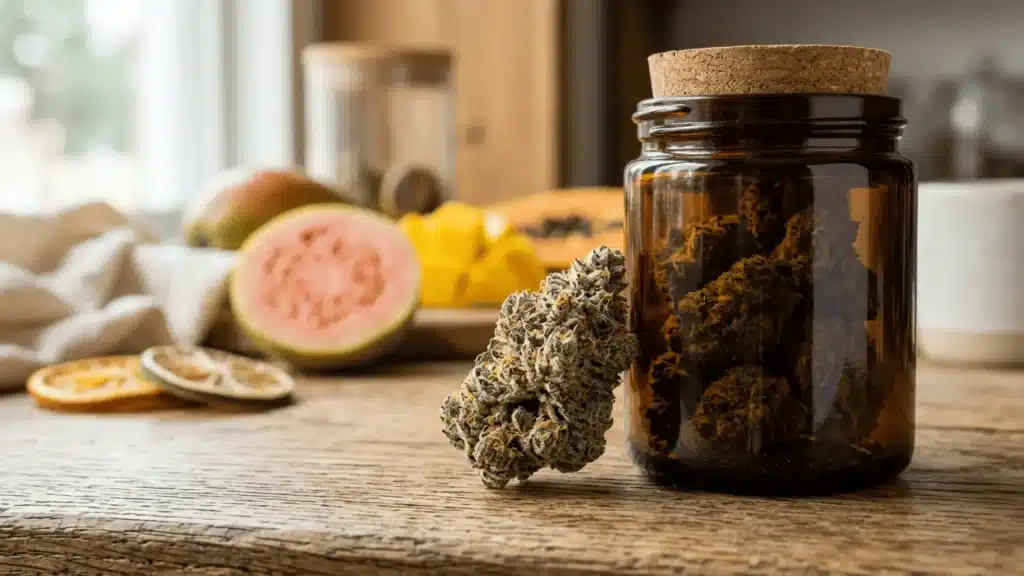
That first sip of coffee can wake up your brain, but it may also bring shaky hands, a racing heart, or a tense feeling.
CBD coffee is often sold as a way to keep the focus while taking the edge off caffeine. The idea sounds simple, yet the science is still taking shape.
Some people say the mix feels calmer than regular coffee. Controlled studies, however, do not yet prove that CBD reliably blocks caffeine jitters.
Dose, product quality, medications, and THC content can all change the result. Legal rules also differ by state and product type.
Before adding CBD to your morning cup, it helps to know what the research shows, what remains unclear, and which safety checks matter most.
| ⚠️Disclaimer: This article is for informational purposes only and is not medical advice. CBD products have not been evaluated by the FDA for safety or effectiveness in food or beverages. Talk to a doctor or pharmacist before adding CBD to your routine, especially if you take medication or have a health condition. |
What Is CBD Coffee, Exactly?
CBD coffee is regular coffee mixed with cannabidiol, usually through CBD oil, water-soluble powder, or infused beans. It is different from hemp coffee and THC-infused coffee, even though all three may use similar hemp wording.
| Product | What It Contains | Can It Cause a High? | What to Check |
|---|---|---|---|
| CBD coffee | Coffee with added CBD | Usually no | CBD dose, THC level, lab report |
| Hemp coffee | Coffee with hemp seeds or hemp seed oil | No | Do not assume it contains CBD |
| THC-infused hemp coffee | Coffee with hemp-derived THC | Yes, it can | THC dose, serving size, local law |
The key is the active ingredient, not the word “hemp” on the package.
The FDA explains that CBD and THC are cannabis-derived compounds, while NCCIH explains how CBD differs from intoxicating THC. Hemp seed ingredients contain little to no CBD unless CBD is added separately.
What Happens in Your Body: The Actual Mechanism

When CBD and coffee are combined, they do not fight against each other. Instead, they work through different systems in the body.
Caffeine mainly affects alertness, while CBD interacts with pathways involved in stress, mood, and balance. Here’s a simple breakdown.
| Caffeine | CBD |
|---|---|
| Blocks adenosine receptors, making the brain feel more awake. | Interacts with the endocannabinoid system, which helps regulate mood, sleep, pain, and stress. |
| Can improve focus, reaction time, and energy. | Does not produce a high because it does not strongly activate CB1 receptors like THC. |
| May also increase heart rate, nervousness, or jitters, especially in high doses. | Its effects are indirect and can vary based on the dose, product, and the individual. |
| Usually starts working within 15 to 45 minutes. | Effects depend on the form used, but may take anywhere from 15 minutes to over an hour. |
What a Real Study Found
A 2024 study by Ferretti et al. tested different doses of CBD alongside 200 mg of caffeine in regular caffeine users. The researchers found that CBD did not significantly reduce caffeine-related anxiety or noticeably change how participants felt during the test period. Since the study included a small group of participants and looked only at short-term effects, more research is needed before concluding that CBD consistently offsets coffee jitters.
Does CBD Actually Cancel Out Coffee Jitters?

Some CBD coffee drinkers say they feel alert without the shaky hands, racing thoughts, or tension that regular coffee can cause.
Those reports matter as personal experiences, but they do not prove that CBD blocks caffeine’s effects.
A controlled study by Ferretti and colleagues tested caffeine with several CBD doses. CBD did not clearly reduce caffeine-related anxiety or change how participants felt compared with caffeine alone.
The study was small and only measured short-term effects, so the evidence remains early.
CBD has shown possible anxiety-related effects in other settings, but NCCIH notes that human evidence is still limited. The FDA also warns that CBD may increase or extend caffeine’s effects in some people.
CBD may make coffee feel calmer for some people, but it has not been proven to cancel jitters reliably.
Reported Benefits, Labeled by Evidence Level
CBD coffee is often linked with calmer focus, less tension, and better mood. The problem is that research usually studies CBD or caffeine alone, not the drink itself. Here is what the evidence supports right now.
| Reported Benefit | Evidence Level | What It Actually Shows |
|---|---|---|
| Better alertness | Research-supported | Caffeine can improve wakefulness and attention by blocking adenosine receptors. CBD has not been shown to improve this effect. |
| Fewer coffee jitters | Preliminary | One controlled trial found that CBD did not clearly reduce caffeine-related anxiety. Larger and longer trials are still needed. |
| Calmer mood | Preliminary | Some small human studies suggest CBD may affect anxiety in certain settings, but results are mixed and often use much higher doses than CBD coffee. |
| Better focus without tension | Anecdotal-only | Some users report smoother energy, but controlled studies have not confirmed this benefit. |
| Pain relief | Preliminary | NCCIH reports limited evidence for cannabinoids and chronic pain, but this does not prove that low-dose CBD coffee relieves pain. |
| Better sleep later | Anecdotal-only | CBD may feel relaxing to some people, but caffeine can delay sleep, especially when consumed later in the day. |
The safest reading of these claims is simple: the caffeine-related boost is well established, while the added benefits of CBD coffee remain uncertain. The FDA also notes that major questions remain about CBD safety, dose, and product quality.
Risks, Side Effects, and Medication Interactions

Before adding CBD to a daily coffee routine, it is worth knowing where the real concerns are. Most people are not worried about serious side effects from a single cup.
Instead, the bigger questions are how CBD interacts with medications, who should avoid it, and when it is better to skip it altogether.
1. Common Side Effects
CBD may cause drowsiness, diarrhea, appetite changes, or changes in liver enzymes. Caffeine may add restlessness, poor sleep, or a faster heartbeat.
The FDA’s CBD safety guidance notes that the risk can rise with higher doses or when CBD is combined with other medicines. Effects reported with prescription CBD may not occur at the lower doses found in coffee.
| Side Effect | What It Feels Like | How Common Is It?* |
|---|---|---|
| Dry mouth | Mouth feels unusually dry | Common |
| Drowsiness | Feeling sleepy or less alert | Common at higher CBD doses |
| Upset stomach | Nausea or diarrhea | Less common |
| Appetite changes | Eating more or less than usual | Less common |
| Caffeine jitters | Restlessness or a racing heart | Depends on caffeine sensitivity |
*Based on FDA-approved CBD safety information and published clinical studies.
2. Can CBD Interact With Medications?
This is one of the more important concerns. CBD can affect liver enzymes, including CYP1A2 and pathways involving CYP3A4, that help process certain medicines.
As a result, some drugs may remain in the body longer or work differently.
The FDA-approved Epidiolex prescribing information lists known and possible interactions seen with prescription cannabidiol.
Check with a doctor or pharmacist before use when taking:
- Blood thinners
- Anti-seizure medicines
- Certain antidepressants
- Heart rhythm medicines
- Organ transplant medicines
These findings come mainly from prescription-level CBD doses. A coffee containing 10 to 25 mg may carry a lower risk, but research has not confirmed a risk-free dose for drug interactions.
3. Who Should Skip CBD Coffee?
Some people should avoid CBD coffee or ask a healthcare professional before trying it. The FDA strongly advises against CBD during pregnancy and breastfeeding.
People with heart rhythm problems, uncontrolled high blood pressure, liver disease, or daily prescriptions also need extra care.
Drug-tested workers should remember that full-spectrum CBD may contain small amounts of THC.
| Group | Why It Matters |
|---|---|
| Pregnant or breastfeeding people | The FDA advises avoiding CBD because safety has not been established. |
| People with heart rhythm problems or uncontrolled high blood pressure | Caffeine may worsen symptoms. |
| Anyone taking daily prescription medicines | CBD may change how certain medicines are processed. |
| Workers who are drug tested | Full-spectrum CBD may contain small amounts of THC that could trigger a positive drug test. |
Knowing these risks helps make CBD coffee a more informed choice, especially when medications or existing health conditions are involved.
Is CBD Coffee Legal in 2026?

CBD coffee sits in a legal gray area. Hemp-derived CBD may meet the federal definition of hemp, but that does not automatically make CBD coffee legal everywhere.
Federal rules, FDA policy, and state laws all play a role, so what is sold legally in one state may not be allowed in another.
1. Federal Rules Still Limit CBD in Food
The 2018 Farm Bill removed qualifying hemp from the federal list of controlled substances, but it did not legalize adding CBD to foods or beverages.
According to the FDA’s regulation of cannabis and cannabis-derived products, it remains unlawful under the Federal Food, Drug, and Cosmetic Act to introduce CBD into foods or drinks sold through interstate commerce.
2. State Laws Can Be Different
Federal law is only one part of the picture. States can create their own rules for hemp-derived products, including CBD beverages.
Some states allow retail sales with certain restrictions, while others have tighter limits or licensing requirements.
The USDA’s overview of hemp laws and regulations explains how federal hemp production works, while individual states regulate many retail products.
| Legal Question | What Buyers Should Know |
|---|---|
| Is hemp-derived CBD federally legal? | Yes, if it meets the federal hemp definition. |
| Has the FDA approved CBD coffee? | No. CBD has not been approved as a food ingredient for interstate commerce. |
| Can states set their own rules? | Yes. State laws may be stricter than federal law. |
| Can CBD coffee be carried across state lines? | It depends on the destination state’s laws. |
| Does being sold in a store mean it is FDA-approved? | No. Retail availability is not the same as FDA approval. |
3. What Changes on November 12, 2026?
A federal law (not an FDA rule), signed November 12, 2025, takes effect on November 12, 2026, redefining hemp by total THC, including THCA and delta-8, instead of delta-9 alone, and capping finished products at 0.4 mg of total THC per container.
That cap alone could push most full-spectrum CBD products out of compliance, though CBD-isolate products with no THC are largely unaffected, and pending bills in Congress could still delay or change it before the deadline.
Important: Laws surrounding CBD products continue to change. Before buying CBD coffee, check your state’s current hemp regulations and review the product’s third-party lab report to confirm its CBD and THC content.
How Much CBD Should You Start With?
There is no official starting dose for CBD coffee because the FDA has not approved CBD for this use.
The right amount depends on the reason for using it, body weight, sensitivity, and any medications. Most experts suggest starting low and increasing slowly only if needed.
| Goal or Sensitivity | Suggested Starting Dose* | Notes |
|---|---|---|
| First-time CBD user | 5 to 10 mg | Try it for several days before increasing the dose. |
| Mild relaxation | 10 to 15 mg | Avoid taking extra CBD from other products at the same time. |
| Regular coffee drinker | 10 to 20 mg | Keep caffeine intake consistent to better judge the effects. |
| Sensitive to caffeine | 5 to 10 mg CBD + less caffeine | Reducing caffeine may help more than adding extra CBD. |
| Taking prescription medication | Talk to a doctor first | CBD may interact with certain medicines, even at lower doses. |
*These are general starting ranges based on expert recommendations and published research, not medical guidelines.
Tip: More CBD is not always better. If a cup contains 20 mg of CBD and feels effective, there is little reason to double the dose the next day. Increasing gradually makes it easier to notice both benefits and side effects.
The FDA advises that CBD can affect people differently and may interact with certain medications. The NCCIH also notes that research has not established a standard dose for over-the-counter CBD products, including beverages.
How to Make CBD Coffee at Home

Making CBD coffee at home gives better control over the dose, taste, and product type. The steps are simple, but careful measuring matters because CBD strength can differ from one product to another.
- Choose Your CBD Product: Pick CBD oil, tincture, water-soluble powder, or pre-infused coffee. Check the label for CBD per serving, THC content, and third-party lab testing before use.
- Brew Your Coffee: Prepare coffee as usual. Let it cool for a minute or two if the CBD label warns against very high heat.
- Measure the CBD Carefully: Use the dropper, scoop, or serving guide that comes with the product. First-time users may prefer a lower amount rather than guessing.
- Add CBD After Brewing: Stir the CBD into the finished coffee. Water-soluble powder mixes more evenly, while oils and tinctures may sit on the surface.
- Blend It Well: Use a spoon, milk frother, or blender to spread the CBD through the drink. Milk or cream can help oil-based products mix better.
- Drink One Serving First: Avoid adding another dose right away. Wait and notice how the first cup affects alertness, mood, stomach comfort, and sleep later that day.
- Store the Product Properly: Keep CBD in a cool, dry place away from sunlight. Follow the storage directions on the label to protect strength and quality.
How to Choose a Quality Pre-Made CBD Coffee
A good CBD coffee should tell you exactly what is inside each serving. Clear labels, recent lab results, and a known hemp source matter more than bold package claims.
The FDA’s CBD testing and warning records show why buyers should verify product contents instead of trusting the front label alone.
Check These Five Things:
CBD products are intended for adults only. Most retailers require buyers to be 18 or 21, depending on the state, so check the product label and local law before purchasing.
-
Third-party lab testing: Look for a current certificate of analysis that lists CBD, THC, pesticides, heavy metals, and solvents.
-
Hemp source: Choose products made from hemp grown under U.S. state or federal programs.
-
Spectrum type: Full-spectrum may contain trace THC. Broad-spectrum should remove THC. Isolate contains CBD only.
-
CBD per serving: Check the exact milligrams in one cup, not just the total amount in the package.
-
Extraction method: CO2 extraction is common because it can limit leftover solvents when done correctly.
The USDA hemp production program confirms that U.S. growers must be licensed or authorized under an approved state, tribal, or federal program.
Skip products with no batch number, no lab report, or vague phrases such as “hemp blend” without a stated CBD amount.
Is CBD Coffee Right for You? Real-Life Scenarios
CBD coffee can affect people differently based on caffeine tolerance, medication use, work rules, and sports testing. This table shows where extra care may be needed.
| Scenario | What to Consider | Practical Choice |
|---|---|---|
| Caffeine-sensitive coffee lover | If coffee already causes shakiness, poor sleep, or a racing heartbeat, CBD may not fix the main issue. The FDA explains that caffeine sensitivity varies by person. | Try half-caf, a smaller serving, or less caffeine before adding CBD. |
| Athlete | CBD is not banned by WADA, but THC and some other cannabinoids are. The USADA warns that mislabeled CBD products can still cause a positive test. | Choose tested THC-free products, but remember no product can promise zero testing risk. |
| Drug-tested professional | Full-spectrum CBD may contain trace THC, and repeated use can raise the chance of a positive test. The SAMHSA CBD advisory notes labeling and contamination concerns. | Avoid full-spectrum products and check workplace rules before use. |
| Person taking medication | CBD can affect how some medicines are processed. The FDA advises speaking with a doctor or pharmacist before mixing CBD with medication. | Get medical advice first, especially with blood thinners, seizure drugs, or transplant medicines. |
CBD coffee may fit some routines, but medication use, testing rules, and caffeine sensitivity should guide the decision.
One more thing before you decide: if you’re in a safety-sensitive job, a licensed profession, or any role with regular drug testing, full-spectrum CBD’s trace THC is a real risk, not a theoretical one. A single mislabeled product can cost you a test. If this applies to you, choose THC-free isolate products and confirm it with a current lab report, not just the label.
The Bottom Line
CBD coffee is not a simple fix for caffeine jitters, and the research still leaves key questions open. Caffeine clearly raises alertness, while CBD may affect stress, mood, and drug processing.
The final effect depends on dose, product quality, THC content, medications, and personal caffeine tolerance.
Legal rules also vary by state and may change again in November 2026. For some adults, a low-dose, lab-tested product may feel manageable.
For others, especially pregnant people, drug-tested workers, athletes, or anyone taking prescriptions, the risks may outweigh the appeal.
Before making it part of your routine, check the label, lab report, local law, and medication warnings. Take a minute to check the CBD dose, THC level, lab report, and your local rules before buying.
If you already use CBD coffee, drop a comment and share what you noticed, including the dose and product type.
Frequently Asked Questions
Does CBD Coffee Taste Different From Regular Coffee?
CBD oil can add an earthy or bitter note. Water-soluble CBD usually changes the flavor less, especially when mixed with milk or sweetener.
Can CBD Coffee Be Used In Cold Brew?
Yes. Water-soluble CBD mixes best in cold brew, while oils may separate and collect on top unless shaken or blended well.
Should CBD Coffee Be Taken With Food?
Taking it with food, especially a meal containing fat, may increase CBD absorption. This can also make its effects feel stronger than expected.
How Long Does CBD Coffee Stay Fresh?
Follow the coffee package date and CBD storage instructions. Heat, sunlight, air, and moisture can slowly reduce flavor and product quality.
Sources
The following sources were consulted in preparing this article and are referenced throughout the body of the text.
- U.S. Food and Drug Administration. “FDA Regulation of Cannabis and Cannabis-Derived Products, Including Cannabidiol (CBD).” FDA Public Health Focus.
- U.S. Food and Drug Administration. “What You Need to Know (And What We’re Working to Find Out) About Products Containing Cannabis or Cannabis-Derived Compounds, Including CBD.” FDA Consumer Updates.
- U.S. Food and Drug Administration. “What You Should Know About Using Cannabis, Including CBD, When Pregnant or Breastfeeding.” FDA Consumer Updates.
- U.S. Food and Drug Administration. “Epidiolex (Cannabidiol) Oral Solution: Highlights of Prescribing Information.” FDA Drug Approvals and Databases.
- National Center for Complementary and Integrative Health. “Cannabis (Marijuana) and Cannabinoids: What You Need To Know.” National Institutes of Health.
- Substance Abuse and Mental Health Services Administration. “Advisory: Cannabidiol (CBD) — Potential Harms, Side Effects, and Unknowns.” SAMHSA Advisory Series.
- U.S. Department of Agriculture. “Hemp.” Farming and Ranching: Plants and Crops.
- Congressional Research Service. “Change to Federal Definition of Hemp and Implications for Federal Enforcement.” Library of Congress.
- U.S. Anti-Doping Agency. “Marijuana FAQ.” USADA Spirit of Sport.
- U.S. Anti-Doping Agency. “Can Hemp Products Cause a Positive Anti-Doping Test?” USADA Dietary Supplements.
- World Anti-Doping Agency. “The Prohibited List.” WADA.
- Ferretti, Morgan L., et al. “A Preliminary Investigation of the Simultaneous Effects of Cannabidiol and Caffeine.” Experimental and Clinical Psychopharmacology, vol. 32, no. 4, 2024, pp. 475–484.
One flag: the November 2026 hemp law provision is still being actively contested in Congress, so if this article stays live past that date, it’s worth a quick check that the 0.4 mg cap didn’t get delayed or amended before it takes effect.