Hemp-derived delta-9 THC is federally legal in the United States, provided the finished product contains no more than 0.3% delta-9 THC by dry weight under the 2018 Farm Bill. Whether it is legal where you are, however, depends entirely on your state, and that answer changes more often than most consumers realize.
This guide covers the federal standard, the incoming 2026 law that reshapes everything, and the specific legal status of delta-9 in the states where most searches originate: Florida, Georgia, Texas, North Carolina, Indiana, and beyond.
Quick Glance: Delta-9 Legal Status at a Glance
| Question | Short Answer |
| Is hemp-derived delta-9 federally legal? | Yes, under 0.3% THC by dry weight |
| Is delta-9 legal in Texas? | Yes, hemp-derived only; marijuana-derived is illegal |
| Is delta-9 legal in Florida? | Yes, hemp-derived delta-9 is legal under state hemp law |
| Is delta-9 legal in Georgia? | Yes, no added restrictions beyond federal compliance |
| Fully banned states (hemp-derived) | Idaho, Wyoming, North Dakota, Kansas |
| Will it show up on a drug test? | Yes, the source does not matter to the test |
| Does it require a medical card? | No, hemp-derived is available to adults 21+ |
| New federal law (Nov 2026)? | Major change coming, 0.4mg per container cap |
| Can it be shipped across state lines? | Usually yes, except to ban states |
Delta-9 THC is sold legally in gas stations across most of the United States, yet people are still getting arrested for carrying it. That contradiction is worth understanding before buying anything.
The answer is messier than a simple yes or no. Delta-9 THC sits at the intersection of federal agriculture law, state politics, and a dry-weight math formula most people never expected to care about.
What Is Delta-9 THC and Why Does the Source Matter?
Delta-9 THC is the main psychoactive compound in cannabis, the one responsible for the high. Chemically, it is the same molecule whether it came from a hemp plant or a marijuana plant. Your body cannot tell the difference, and neither can a drug test.
But under federal law, the source is everything. Hemp and marijuana are both variants of the cannabis sativa plant. The only legal distinction between them is THC concentration: hemp contains less than 0.3% delta-9 THC by dry weight, while marijuana exceeds that threshold.
That one number, 0.3%, is what separates a federally legal product from a Schedule I controlled substance. This distinction exists purely on paper. The same psychoactive effect, the same metabolites in your bloodstream, the same positive on a workplace screening, all of it applies regardless of which plant the THC came from. So when you see “hemp-derived” on a label, understand that it is a legal classification, not a description of how the product will affect you.
| 📝 Note: Since the molecule itself is identical regardless of plant origin, “hemp-derived” is a legal category, not a chemical one. Do not let anyone tell you hemp delta-9 is fundamentally different from marijuana delta-9. It is not. |
Is Delta-9 THC Federally Legal?
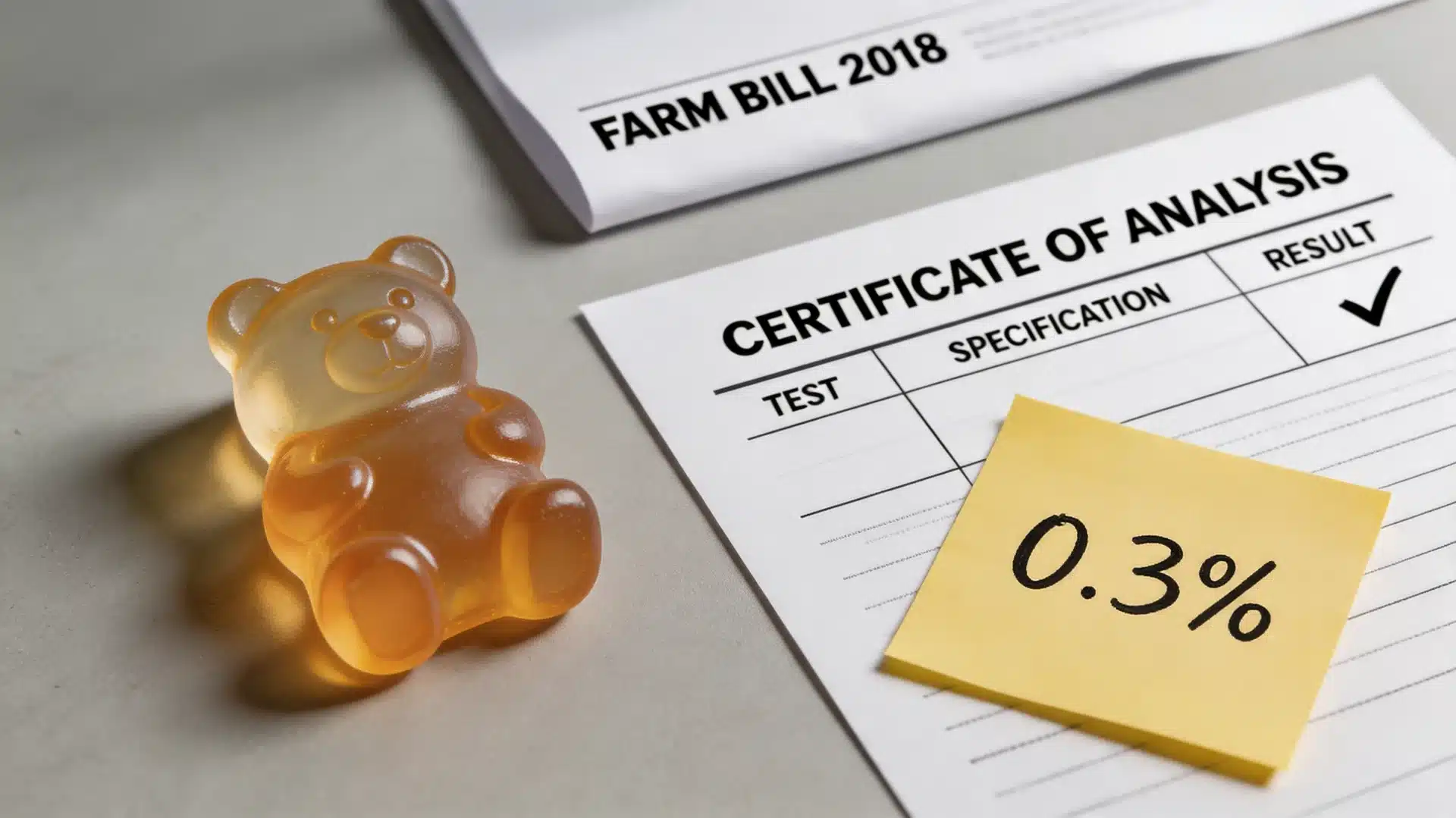
Yes, with one strict condition. The 2018 Farm Bill (officially the Agriculture Improvement Act of 2018) removed hemp and all its derivatives from the Controlled Substances Act. That includes delta-9 THC, as long as it comes from hemp and the finished product does not exceed 0.3% delta-9 THC by dry weight.
The 0.3% Dry Weight Rule Explained
The 0.3% limit applies to the total weight of the product, not to the number of milligrams of THC on the label. A gummy weighing 5 grams has a dry weight of 5,000mg. 0.3% of that is 15mg. So that gummy can legally contain 15mg of delta-9 THC and still be federally compliant.
This is why you see 10mg, 20mg, and even higher-dose delta-9 edibles on store shelves. The gummy is made heavy enough, through added sugars, fillers, or other ingredients, to keep the THC percentage below the threshold. This is not a loophole. It is the exact framework Congress wrote into law, and federal courts have upheld it.
What the DEA and FDA Say
The DEA confirmed in its 2020 interim final rule that any material containing 0.3% or less delta-9 THC by dry weight is not a controlled substance.
That settled most of the enforcement ambiguity at the federal level. The FDA retained authority over hemp products under food and drug safety standards, meaning a product can be Farm Bill compliant and still violate FDA rules if it makes unapproved medical claims or uses unsafe additives.
| ⚠️ Advisory: Always look for a Certificate of Analysis (COA) from a third-party lab before buying any delta-9 product. A COA confirms the product remains within the 0.3% limit and is free of contaminants, including heavy metals and pesticides. |
Is Delta-9 THC Federally Legal After 2026? The Incoming Law
Most people buying delta-9 products today have no idea this is coming. In November 2025, Congress enacted P.L. 119-37, and it changes the federal definition of hemp entirely.
The practical effect: nearly every hemp-derived delta-9 product currently on store shelves will be non-compliant after November 12, 2026, unless reformulated or moved into licensed dispensary channels.
| What’s Changing | Current Rule | After Nov 12, 2026 |
| THC limit type | 0.3% by dry weight | 0.4mg total per container |
| Standard 10mg gummy | Federally compliant | 25x over the legal cap |
| Synthetically derived cannabinoids | Legal gray area | Explicitly excluded from hemp protections |
| Products on shelves now | Legal under the 2018 Farm Bill | Must be reformulated or sold via dispensaries |
| Source of delta-9 | Both plant-derived and synthetic are covered | Only plant-extracted delta-9 retains status |
Until November 2026, everything currently on shelves stays federally legal. After that, the market restructures. You can read the full text of the 2018 Farm Bill and P.L. 119-37 at congress.gov, where both the original legislation and the 2025 amendment are publicly available.
| ⚠️ Advisory: If you are stocking up on hemp-derived delta-9 products, be aware that the legal landscape shifts significantly after November 12, 2026. Buying from reputable brands with current COAs matters more than ever going into this transition period. |
Why Is Delta-9 Legal in the First Place?
The answer is agricultural policy, not drug policy. The 2018 Farm Bill was written primarily to support American hemp farmers, a crop that had been caught up in federal marijuana prohibition despite having minimal psychoactive THC.
Congress drew the 0.3% dry weight line to distinguish industrial hemp from marijuana, and in doing so, it also inadvertently created legal space for hemp-derived delta-9 products at meaningful doses.
A 5-gram gummy staying under 0.3% can still contain 15mg of actual THC. That is a psychoactive dose, but it is farm bill compliant.
The reason this remains legal is that federal courts have consistently held that the Farm Bill says what it says. Hemp derivatives, including delta-9 THC, are not controlled substances as long as the dry weight threshold is met. The DEA’s 2020 interim final rule confirmed this interpretation. No subsequent rulemaking reversed it, which is why gas stations and CBD shops can sell 10mg delta-9 gummies today without violating federal law.
How Is Delta-9 Legal at Such High Doses?
The math is the mechanism. Because the 0.3% threshold applies to the entire product weight and not to the milligram count on the label, manufacturers can produce a compliant edible that still delivers a meaningful amount of THC by making the product itself heavier. A 5-gram gummy can contain up to 15mg of delta-9 THC and remain under 0.3% by dry weight.
A 10-gram gummy can contain up to 30mg. The THC content is real and the effects are real. The legality hinges entirely on the ratio to product weight, not on the total milligrams ingested.
Delta-9 Legal Status by State
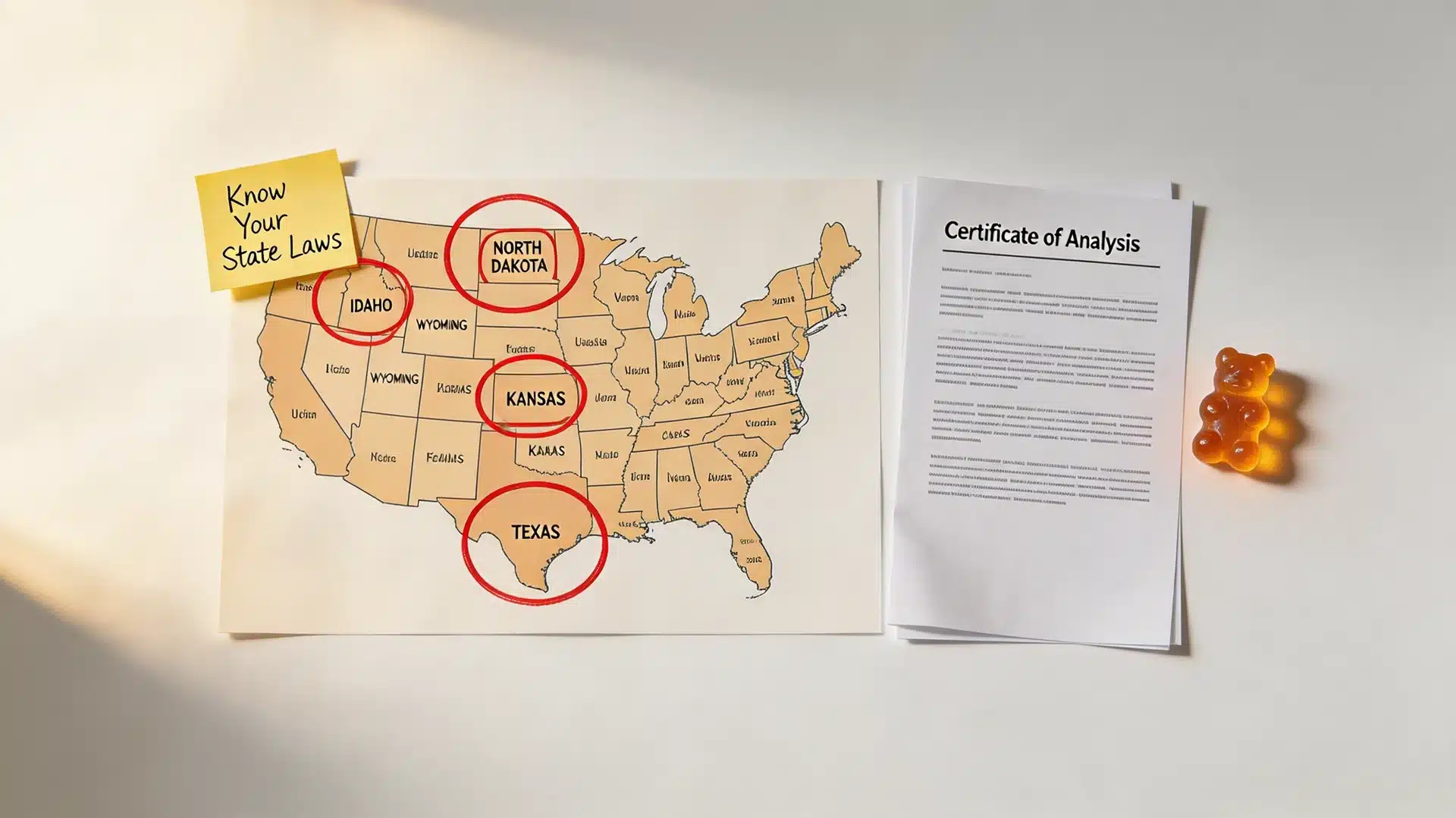
Federal law is the floor. States can and do go stricter. The result is a patchwork where the same gummy you bought legally in Tennessee could get you in serious trouble in Idaho. Below is the current landscape by category, with the highest-traffic states covered individually.
States Where Hemp-Derived Delta-9 Is Fully Legal
As of 2025, recreational delta-9 use is permitted in 24 states, and 39 states allow medical use. Most of the country allows hemp-derived delta-9 without restrictions beyond federal compliance. The state-by-state legal status table below covers the states where search volume is highest.
| State | Hemp-Derived Delta-9 | Notes |
| Florida | Legal | State hemp law aligns with Farm Bill; marijuana-derived remains illegal except for medical use |
| Georgia | Legal | No additional state restrictions; hemp-derived products sold openly in retail |
| North Carolina | Legal | State hemp program aligned with Farm Bill; marijuana remains illegal |
| Tennessee | Legal | Broadly permissive; no added hurdles beyond federal COA compliance |
| Indiana | Legal | Hemp-derived delta-9 permitted under state hemp law; carry your COA |
| South Carolina | Legal | No restrictions beyond Farm Bill compliance |
| Kentucky | Legal | Major hemp-producing state; permissive retail environment |
| Pennsylvania | Legal | Hemp-derived delta-9 permitted; no added state restrictions as of 2025 |
| Iowa | Legal | Follows federal Farm Bill standard |
| Wisconsin | Legal | Hemp-derived delta-9 is legal; marijuana remains restricted |
| Alabama | Legal | Broadly permissive; no added hurdles |
| Mississippi | Legal | Follows federal standard; verify current rules near borders |
| Colorado / Oregon / California | Legal (plus recreational marijuana) | These states legalized marijuana-derived delta-9 as well; California placed temporary restrictions on certain hemp-derived products in 2024 |
| Idaho | Banned | Prohibits any detectable delta-9, including hemp-derived |
| Wyoming | Banned | Prohibits delta-9 regardless of source |
| North Dakota | Banned | Banned all intoxicating hemp-derived cannabinoids |
| Kansas | Banned | Maintains a strict prohibition on delta-9 |
| Alaska | Restricted | Hemp-derived ingestibles limited to licensed marijuana dispensaries only |
| 📝 Note: State laws change frequently, sometimes faster than product labels get updated. Always verify your state’s current rules before purchasing, especially near state borders. |
Is Delta-9 Legal in Florida?
Yes. Florida’s state hemp law aligns with the 2018 Farm Bill, and hemp-derived delta-9 products are sold openly across the state in CBD shops, wellness stores, and some gas stations.
Marijuana-derived delta-9 remains restricted to medical use only through licensed dispensaries.
If you are buying hemp-derived delta-9 in Florida, the standard rules apply: verify the product has a current COA showing it is under 0.3% by dry weight, and confirm there are no synthetic cannabinoids in the formulation. Carrying your COA is always advisable.
Is Delta-9 Legal in Georgia?
Yes. Georgia is among the most permissive Southern states for hemp-derived delta-9. The state follows the federal Farm Bill standard with no additional restrictions on compliant hemp products.
Hemp-derived delta-9 gummies, tinctures, and edibles are available in retail stores across the state. Marijuana-derived delta-9 is illegal for recreational use in Georgia, so the hemp-derived distinction matters more here than in states with full legalization.
Is Delta-9 Legal in North Carolina?
Yes. North Carolina operates a state hemp program aligned with the Farm Bill, and hemp-derived delta-9 is legal to purchase and possess.
Marijuana itself remains illegal for recreational use in the state, so consumers relying on hemp-derived products need to be especially careful that what they are buying is properly labeled and COA-backed.
Law enforcement in some NC counties has struggled to distinguish compliant hemp products from illegal marijuana, making documentation more important, not less.
Is Delta-9 Legal in Indiana?
Yes. Indiana permits hemp-derived delta-9 under its state hemp law, which tracks the federal Farm Bill definition. Products must stay under 0.3% delta-9 THC by dry weight.
Indiana has not added restrictions beyond federal compliance, and hemp-derived delta-9 products are available from licensed retailers across the state. Marijuana-derived delta-9 remains illegal in Indiana with no recreational or medical program as of 2025.
Is Delta-9 Legal in Texas?
Hemp-derived delta-9 is sold openly across Texas under Texas House Bill 1325, which aligned the state with the federal Farm Bill.
But thousands of Texans were arrested in 2022 carrying what they believed was legal hemp, because officers cannot field-test the difference between legal hemp and illegal marijuana on the spot.
Always carry your COA. If you are traveling across state lines, the TSA rules and federal transport guidelines for THC gummies are more nuanced than most people expect and worth reviewing before any trip.
| ⚠️ Advisory: In Texas, products exceeding 0.3% THC fall under Penalty Group 2 of the Controlled Substances Act. Possession of 1 to 4 grams can be a third-degree felony. Mislabeled products are more common than most consumers expect. A COA is your primary legal protection. |
States With Bans or Severe Restrictions
Idaho prohibits any detectable delta-9, including hemp-derived. North Dakota banned all intoxicating hemp-derived cannabinoids. Wyoming prohibits delta-9 regardless of source.
Alaska restricts hemp-derived ingestibles to licensed marijuana dispensaries only. Kansas maintains a strict ban. California, despite legal recreational marijuana, passed a temporary emergency restriction on certain intoxicating hemp products in 2024 that pulled some delta-9 items from general retail shelves.
Hemp-Derived vs. Marijuana-Derived Delta-9: The Actual Difference
The molecule is chemically identical regardless of source. What changes is everything around it: the legal status, where you can buy it, and how it can be transported. For consumers interested in products formulated for specific uses, the best hemp-derived THC gummies for pain management cover the formulation differences in more detail.
| Factor | Hemp-Derived Delta-9 | Marijuana-Derived Delta-9 |
| Chemical structure | Identical to marijuana delta-9 | Identical to hemp delta-9 |
| Federal legal status | Legal under the 2018 Farm Bill | Schedule I controlled substance |
| THC threshold | Must stay under 0.3% dry weight | No federal threshold, state-regulated |
| Where you can buy it | CBD stores, online retailers, and gas stations | Licensed dispensaries only |
| Ships across state lines | Yes, except to ban states | No, illegal regardless of state laws |
| Requires a medical card | No, available to adults 21+ | Yes, in medical-only states |
| Legal foundation strength | Stronger, explicitly covered by the Farm Bill | State-by-state only |
| vs. Delta-8 | Clearer legal standing than delta-8 | Not applicable |
| Post-Nov 2026 status | Subject to a 0.4mg per container cap | Unchanged, state law governs |
Will Delta-9 Show Up on a Drug Test?
Yes. Drug tests do not check where your THC came from. They detect the presence of THC metabolites. Hemp-derived delta-9 produces the exact same metabolites as marijuana-derived delta-9. A standard urine test will return a positive result either way.
This trips people up constantly. Someone buys a federally legal 10mg delta-9 gummy, assumes “legal” means “safe for testing,” and fails a workplace screening.
The law protecting your right to buy it offers zero protection once that result comes back positive. Employers, courts, and probation officers do not distinguish between hemp-derived and marijuana-derived THC. They see a positive and act on it. Delta-9 metabolites can stay detectable in urine for up to 30 days in regular users, and for several days even after a single use.
For consumers exploring cannabis edibles for recovery purposes, understanding this detection window matters. The best edibles for post-surgical pain covers product selection considerations alongside the practical questions about THC in medical contexts.
| ⚠️ Advisory: If you face workplace drug testing, random screening, or any situation where a positive THC result carries professional or legal consequences, avoid delta-9 products entirely, regardless of their legal status or where you purchased them. |
How to Buy Delta-9 THC Safely and Legally
Buying delta-9 legally is not complicated, but it does require basic due diligence. The hemp market lacks consistent federal oversight, so product quality varies significantly between brands. For consumers who want lower-THC options while navigating this space, the guide to low-THC strains for calm and focus covers the broader landscape of moderate-dose cannabis options.
- Age requirement: Most reputable retailers enforce a 21+ minimum both in-store and online
- Third-party lab results: Only buy from brands that publicly share current COA documents
- Check the cannabinoid panel: A good COA confirms delta-9 stays under 0.3% dry weight
- Contaminant screening: The COA should verify that the product is free from heavy metals and pesticides
- QR codes on packaging: Many compliant brands link directly to lab reports via QR code
- State age laws: Some states enforce stricter age minimums; always verify your local rules
The hemp market rewards buyers who ask questions. Reputable brands welcome COA requests. For the official federal standard, the DEA’s 2020 interim final rule in the Federal Register is the clearest published statement on what legally qualifies as hemp-derived THC.
| ⚠️ Advisory: If a brand will not share lab results when asked, walk away. Mislabeled products exceeding the legal limit are common enough that skipping this step puts your safety and legal standing at genuine risk. |
Final Thoughts
Hemp-derived delta-9 is federally legal today and available in most U.S. states without any special card or permission. The 0.3% dry weight rule makes it work, and the math behind it allows for meaningful doses in a compliant product.
But state laws vary enough that the same product is a convenience store purchase in Georgia and a criminal matter in Idaho. Texas is legal on paper, but complicated in practice.
Florida, North Carolina, Indiana, and South Carolina are all legal with no added hurdles, making them relatively low-risk for consumers who stay within compliant products.
Come November 2026, a new federal cap will reshape the entire category. The short version: know your state, carry your COA, avoid delta-9 if you face drug testing, and pay attention to what is changing in federal law before the end of the year.
Frequently Asked Questions About Delta-9 THC Legality
Is delta-9 THC the same as regular marijuana THC?
Chemically, yes. It is the same molecule regardless of source. The legal difference is purely about plant origin. Hemp-derived delta-9 under 0.3% dry weight is federally legal under the 2018 Farm Bill; marijuana-derived delta-9 is federally a Schedule I controlled substance. Both affect the body and drug tests identically.
Is delta-9 federally legal right now?
Yes, hemp-derived delta-9 THC is federally legal under the 2018 Farm Bill as long as the finished product does not exceed 0.3% delta-9 THC by dry weight. The DEA confirmed this in its 2020 interim final rule. That standard holds until November 12, 2026, when P.L. 119-37 imposes a stricter 0.4mg-per-container cap.
Why is delta-9 legal when marijuana is not?
The 2018 Farm Bill redrew the legal line based on THC percentage rather than plant type. Hemp, defined as cannabis with under 0.3% delta-9 THC by dry weight, was removed from the Controlled Substances Act entirely. Marijuana, which exceeds that threshold, remains a Schedule I substance federally. The legality of delta-9 comes entirely from which side of that percentage line the source plant falls on.
How is delta-9 legal at 10mg or 20mg doses?
Because the 0.3% limit applies to total product weight, not milligram count. A heavier gummy can contain more total milligrams of delta-9 THC while still keeping the THC percentage under the federal limit. A 5-gram gummy can legally hold up to 15mg of delta-9 THC and remain compliant. Manufacturers formulate to the percentage threshold, not the dose.
Can delta-9 gummies be shipped across state lines?
Hemp-derived delta-9 products can be shipped federally under the Farm Bill. The exceptions are states with explicit bans: Idaho, Kansas, Wyoming, North Dakota, and Arkansas. Shipping to those states risks legal issues for both the sender and the recipient. Always confirm destination laws before ordering online.
Will delta-9 show up on a drug test?
Yes. Drug tests detect THC metabolites, and hemp-derived delta-9 produces the same metabolites as marijuana-derived delta-9. A standard urine test will return a positive result either way. “Legal” and “undetectable” are not the same thing. In regular users, THC metabolites can remain detectable for up to 30 days.
Is delta-9 stronger than delta-8?
Generally yes. Delta-9 produces a stronger, more direct psychoactive effect. Delta-8 is widely described as milder and is often marketed as a gentler alternative. Both come from cannabis, though delta-8 is typically manufactured by chemically converting CBD, which complicates its legal standing more than delta-9.
Will the 2026 federal cap make current delta-9 products illegal?
Effectively, most will become non-compliant for general retail. P.L. 119-37 caps finished hemp products at 0.4mg total THC per container starting November 12, 2026. A single 10mg gummy exceeds that cap by 25 times. Products sold before that date remain legal under current law, but the category will need to restructure significantly.
Does buying hemp-derived delta-9 require a medical marijuana card?
No medical card is needed in states where hemp-derived delta-9 is legal. It is available from general retailers and online stores to adults typically 21 or older without medical authorization. That is a key distinction from marijuana-derived delta-9, which does require cards in medical-only states like Florida.
Sources
U.S. Congress. Agriculture Improvement Act of 2018 (Farm Bill) and P.L. 119-37 (2025 Hemp Amendment). Public legislation. congress.gov
Drug Enforcement Administration. Implementation of the Agriculture Improvement Act of 2018: Interim Final Rule. Federal Register, Vol. 85, No. 163, August 21, 2020. federalregister.gov