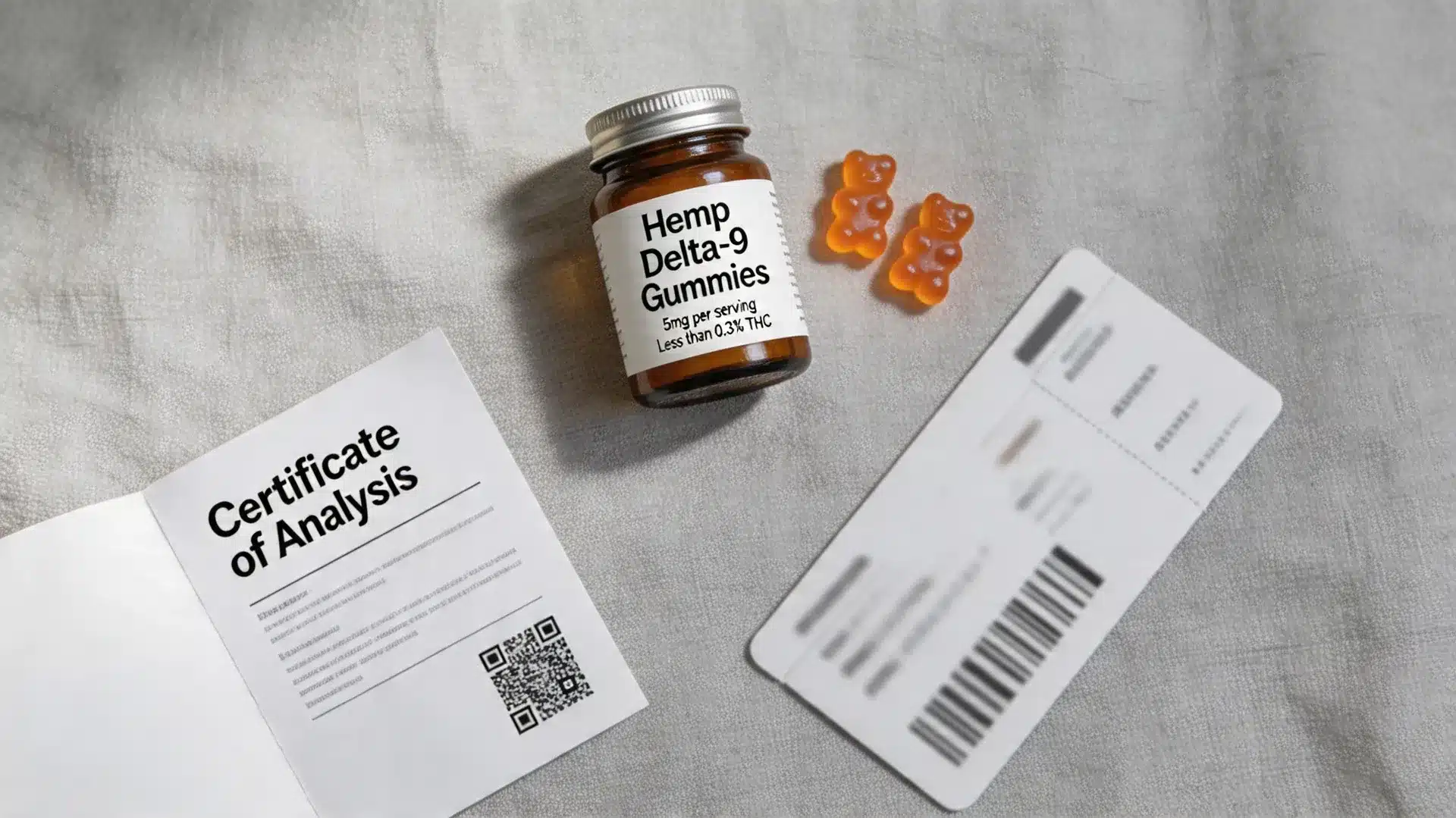
Quick Glance: Flying With THC Gummies
| Scenario | Legal? | Risk Level | Outcome If Found |
| Hemp-derived, under 0.3% THC | Federally legal | Low | Generally cleared; COA helps |
| Dispensary THC gummies, legal departure state | Federally illegal | Medium | Confiscation; possible disposal |
| Dispensary THC gummies, a prohibition state | Federally illegal | High | Possible arrest, criminal charges |
| Medical marijuana card holder | Federally illegal regardless | Medium to high | The card provides no federal protection |
| Domestic flight, both states are legal | Federally illegal | Medium | Varies by airport and officer |
| International flight, any THC | Varies; mostly illegal | Very high | Potential detention, criminal prosecution |
| Checked bag vs carry-on | The same rules apply | Same | No meaningful difference in legal exposure |
Hemp-derived gummies under 0.3% THC are federally legal and can be carried through a TSA checkpoint with the right documentation.
Dispensary THC gummies are federally illegal at every airport, regardless of which state you are leaving from or landing in. That distinction covers most of what travelers need to know, but the details of what happens at the checkpoint and what the stakes are by state require more than a one-line answer.
The question “can you fly with THC gummies” sits at the gap between state cannabis law and federal jurisdiction, and the answer depends entirely on what kind of gummies you have, where you are flying to, and what happens if a TSA officer finds them. This guide covers each of those variables clearly.
What the Question Actually Means
“Can you fly with THC gummies?” is doing a lot of heavy lifting for one search. Most people asking it are actually asking one of three different questions, each with a meaningfully different answer.
The first is a legal question: Is it lawful under federal law to carry THC gummies through a TSA checkpoint? The answer depends entirely on whether the gummies are hemp-derived or marijuana-derived, two products that can look identical but sit on opposite sides of federal law.
The second is a practical question: will TSA actually stop you, and what happens if they do? TSA is not actively hunting for edibles, but officers are required to report anything that appears to violate federal law to local law enforcement.
The third is a product question: Does it matter where the gummies came from? Yes, significantly. Understanding how hemp tinctures and other hemp products differ from dispensary cannabis products is a useful context for sorting out which items in your bag are federally compliant before you pack. The source of the THC, hemp versus marijuana, determines the legal classification entirely, regardless of how the product is packaged or marketed.
The Federal Law Problem
Airports in the United States operate under federal jurisdiction, regardless of which state they are in. That is the starting point for every question about flying with cannabis products. The airspace, the TSA checkpoint, and the aircraft itself are all federal territory, which means federal law governs what you can carry, not state law.
Marijuana remains a Schedule I controlled substance under the federal Controlled Substances Act. This classification does not change because you are flying from California to Colorado. It does not change because both states have legalized recreational cannabis.
The Marijuana Policy Project notes that while TSA’s focus has shifted toward security threats rather than cannabis enforcement, the legal framework has not changed: marijuana remains a Schedule I substance, and federal jurisdiction at airports remains absolute.
The TSA’s official policy on medical marijuana states clearly: cannabis products remain illegal under federal law except for those containing no more than 0.3% THC on a dry weight basis or those approved by the FDA. TSA officers are required to report suspected violations to local, state, or federal authorities.
| 📝 Note: A medical marijuana card provides no legal protection at a federal TSA checkpoint. The card is issued under state law. TSA operates under federal law. These two systems do not recognize each other at the checkpoint. |
Hemp vs Marijuana: The Line That Determines Everything
The 2018 Farm Bill drew a legal line that now defines what you can and cannot fly with. Hemp is defined as cannabis containing 0.3% Delta-9 THC or less by dry weight, federally legal. Anything above that threshold is classified as marijuana and is federally illegal at every airport checkpoint.
| Product Type | Source | Federal Status | TSA Permitted? | Key Complication |
| Hemp-derived gummies | Hemp plant, under 0.3% Delta-9 THC by dry weight | Federally legal | Yes, with proper labeling and COA | TSA cannot test on the spot; the officer has discretion |
| Dispensary THC gummies | State-licensed cannabis retailer; typically 5-30% THC | Federally illegal | No | Illegal regardless of the departure or destination state law |
| Delta-8 THC hemp gummies | Hemp-derived; under 0.3% Delta-9 THC | Federally legal under the Farm Bill | Technically yes | Several states have banned Delta-8 independently |
| Delta-10 THC hemp gummies | Hemp-derived; under 0.3% Delta-9 THC | Federally legal under the Farm Bill | Technically yes | Same state-level restriction risk as Delta-8 |
| Medical marijuana gummies | Cannabis dispensary; prescription holder | Federally illegal | No | A medical card provides no federal protection at a checkpoint |
| Homemade or unlabelled gummies | Unknown | Cannot be verified | No | Immediate red flag; no documentation to support compliance |
The critical practical problem with all of the above: TSA agents cannot test gummies on the spot. An officer looking at a container cannot determine whether it contains 0.3% or 30% THC.
That uncertainty cuts both ways: compliant hemp products may be flagged, and non-compliant products may pass through without notice. Clear labeling and a COA are the only tools available to resolve that uncertainty in your favor.
| ⚠️ Advisory: Even hemp-derived THC products that are fully compliant with the Farm Bill can be confiscated or flagged by TSA if the product is not clearly labeled as hemp-derived with a visible THC percentage. Unlabelled or homemade gummies are a significant red flag at any checkpoint. |
What TSA Actually Does (and Does Not Do)
TSA’s primary mission is to detect threats to aviation security: weapons, explosives, and dangerous items. Officers are not drug enforcement agents, and their procedures are built around threat detection, not cannabis enforcement.
In practice, TSA agents are not actively scanning bags looking for gummies. Their X-ray equipment is calibrated to detect threats, not to identify plant-derived edibles. As Green Rush News confirms in their breakdown of TSA airport procedures, TSA explicitly states that its screening procedures are “not designed to detect marijuana or other illegal drugs,” and airport K9 units at domestic checkpoints are trained for explosives detection, not cannabis.
What happens when gummies are discovered is a different matter. If a TSA officer spots something during routine screening that appears to violate federal law, they are required to report it to local law enforcement. What happens next is determined by the airport’s location and the local jurisdiction’s cannabis policies, not by TSA.
In California, Colorado, or New York, local enforcement may simply ask you to dispose of the product. At an airport in Texas or Florida, where cannabis remains fully illegal at the state level, the same discovery could result in criminal charges.
| ⚠️ Advisory: The risk calculus changes dramatically based on your destination. Flying between two legal states with cannabis gummies is lower risk than flying into a prohibition state. The TSA referral process hands the outcome to local law enforcement, and local law enforcement is bound by local law, not where you came from. |
Carry-On vs Checked Bag: Does It Matter?
Both carry-on and checked bags go through TSA screening and carry identical legal exposure. Understanding the differences in how each is processed matters for practical decisions.
| Factor | Carry-On Bag | Checked Bag |
| TSA screening | X-ray at checkpoint; you are present | Separate screening process; you are not present |
| Random deeper searches | Less common | More common |
| Ability to explain or show COA | Yes, you are there in real time | No, the bag is processed without you |
| Outcome if found | Referral to law enforcement; you handle it immediately | Same referral; you may not know until later |
| Legal risk difference | None | None |
| Practical advantage for compliant products | Higher: documentation is on your person | Lower: no opportunity to provide context |
Both options carry the same legal exposure under federal law. For genuinely compliant hemp gummies, carry-on is the more practical choice because you are present, your COA is accessible, and you can respond to questions in real time if the product is flagged.
| 📝 Tip: Keep hemp-derived gummies in their original packaging, with the brand’s label clearly visible. The label should indicate “hemp-derived” and show the THC content below 0.3%. A printed or digital COA from the manufacturer gives you something concrete to show if questioned. |
State-by-State Risk and Airport Policies
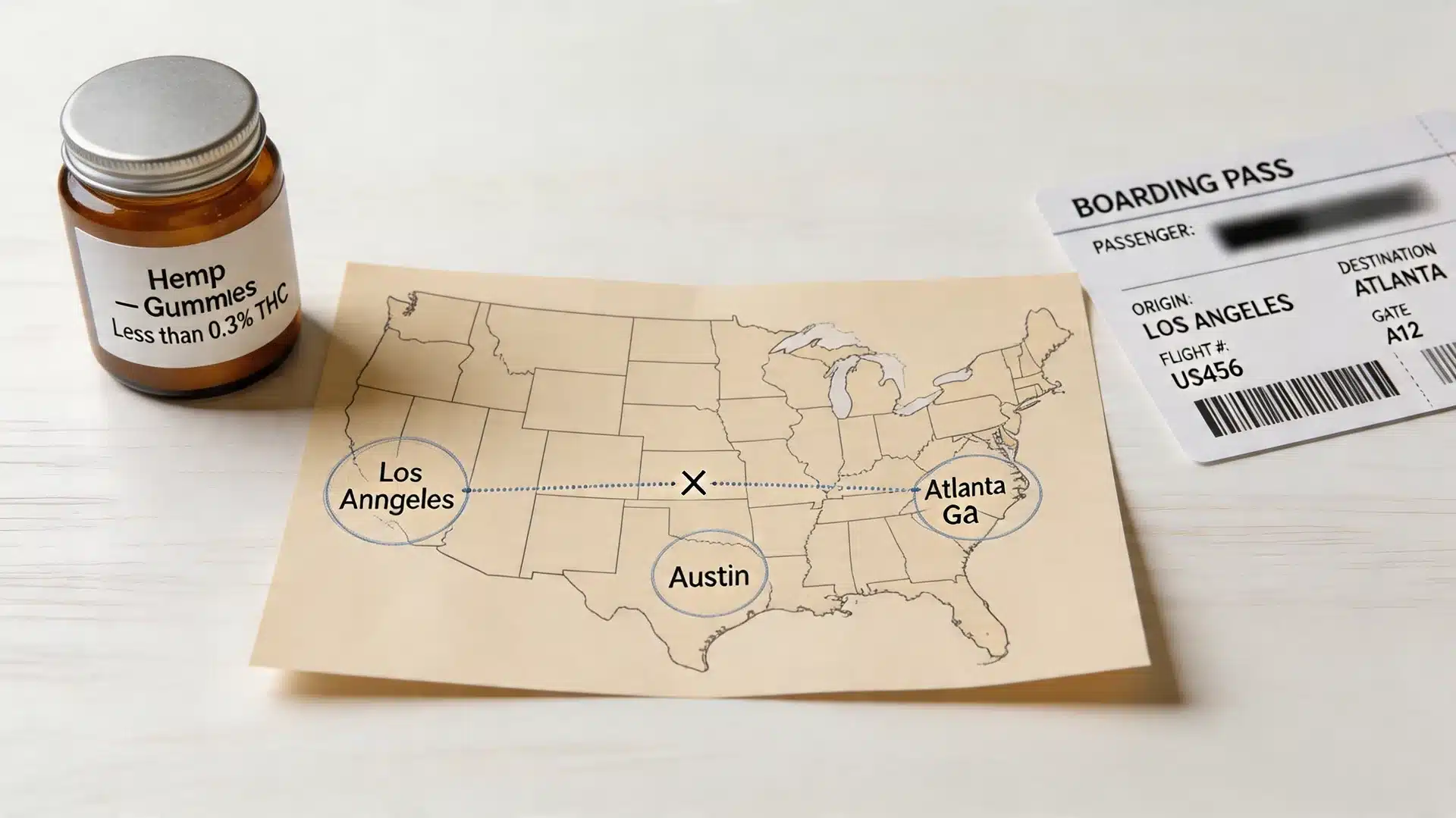
Airport enforcement outcomes vary significantly depending on local state cannabis laws. Understanding the legal environment at both your departure and arrival airports significantly changes the risk calculation.
Legal States: Lenient but Not Safe
Some cannabis-legal states have updated airport policies to reflect state law, but these changes apply only to airport grounds, not to aircraft or airspace.
Los Angeles International Airport (LAX) allows passengers aged 21 and older to possess up to 28.5g of cannabis on airport property under California law. Portland International and Seattle-Tacoma have similar local tolerance policies. The moment you enter the airspace, federal jurisdiction resumes regardless of the airport’s ground-level policy.
Prohibition States: High Exposure
States where cannabis remains fully illegal represent a significantly different enforcement reality at the airport level. Texas, Florida, Alabama, and Georgia treat marijuana-derived THC gummies the same as any other controlled substance.
In Texas, possessing less than 2 ounces is a Class B misdemeanor carrying a penalty of up to 180 days in jail. Gummy concentrates are classified as extracts under Texas law and carry penalties higher than flower possession.
The Transit State Problem
A layover in a prohibition state creates legal exposure even when both your departure and destination are cannabis-legal jurisdictions. During the layover, you are physically present in that state, and if your bag is searched for any reason, local law applies to what is found.
Routing through cannabis-neutral or legal-state airports reduces this specific risk when the option is available at the time of booking.
Medical Marijuana Card Reciprocity
Some states have enacted medical cannabis reciprocity programs, which allow out-of-state patients to access dispensaries or possess medical cannabis under local law. This is a state-level accommodation only.
It does not create any protection at a federal TSA checkpoint. If you are a medical patient traveling between two reciprocity states, you may have some protection on airport ground property in those states, but that protection ends the moment federal screening begins.
International Travel: A Hard No
International travel with any THC product, hemp-derived or otherwise, is a risk that most legal professionals strongly advise against. The 2018 Farm Bill’s 0.3% THC standard is a US federal definition. It does not apply internationally.
Countries with strict drug laws, including much of Southeast Asia, parts of the Middle East, Singapore, and Japan, treat any amount of cannabis as a serious criminal offense. Penalties can include lengthy imprisonment. The fact that your gummies were legally purchased in California provides zero legal protection once you cross an international border.
Even in countries where cannabis is more tolerated, the definition of legal THC content varies. The European Union generally applies a 0.2% THC standard, not 0.3%. Canada has legal cannabis but prohibits bringing it across its borders, including from the United States, treating cross-border transport as trafficking regardless of the amount.
| ⚠️ Advisory: Do not bring THC gummies on international flights under any circumstances. Even hemp-compliant products that are perfectly legal domestically may result in criminal charges, detention, or imprisonment at international destinations. If you need cannabis products at your destination, research local laws and purchase them upon arrival. |
How to Travel Legally With Hemp THC Gummies
If your gummies are genuinely hemp-derived and contain 0.3% Delta-9 THC or less on a dry weight basis, the following steps reduce your risk of a difficult airport experience. When choosing a reputable hemp brand with transparent third-party testing, the same criteria that apply to CBD products apply directly to hemp THC gummies you plan to travel with: verify COA accessibility, check for full cannabinoid panels, and confirm the Delta-9 THC percentage on the panel matches the label claim.
Practical steps for compliant travel:
- Keep products in original packaging with brand name, THC content, and “hemp-derived” clearly visible on the label.
- Carry a Certificate of Analysis (COA): a lab report from a third-party testing facility confirming the product contains 0.3% THC or less. Print it or save it on your phone.
- Research your destination state before traveling. Even hemp-compliant products may face stricter local interpretation in states like Idaho, which does not recognize the Farm Bill’s hemp definition in the same way as other states.
- Check your airline’s policy. TSA sets the federal standard, but individual airlines may have their own restrictions on cannabis-adjacent products.
- Keep quantities personal-use sized. Anything that looks like a commercial quantity raises the risk of being treated as trafficking rather than personal consumption.
- Consider buying at your destination if you are traveling to a state where compliant hemp products are readily available. Removing the product from your bag eliminates the checkpoint risk entirely.
What Happens If TSA Finds Them
As Elevate Right’s legal breakdown of TSA checkpoint outcomes confirms, even hemp-compliant products are subject to officer discretion since no on-site testing equipment is available. The outcome depends as much on the officer and the airport as it does on what the product actually contains. Knowing how to read a COA for hemp products before you travel means you can explain your product’s compliance clearly if you are stopped, rather than waiting for an officer to make that determination alone.
Outcomes range widely depending on the airport, product type, and local enforcement priorities:
| Outcome | When It Happens | Who Decides |
| No action taken | Small personal amount; legal state airport; officer prioritizes security | TSA officer discretion |
| Asked to dispose | Legal state airport; officer confirms personal use; product appears cannabis-derived | TSA officer or local police |
| Confiscation without charges | Product seized; matter treated as closed; passenger continues | Local law enforcement |
| Referral to local law enforcement | Product appears to violate federal law; local police called to handle | TSA refers; police decide |
| Citation or fine | Prohibition state; personal amount; local law allows a civil penalty | Local law enforcement |
| Criminal charges | Prohibition state; larger quantity; clear evidence of marijuana derivation | Local law enforcement |
No outcome is predictable in advance because it depends on the officer, the airport, local policies, and the specific circumstances of discovery. The only consistently favorable outcome is one involving clearly labeled, COA-verified hemp-compliant products, which gives officers something to confirm compliance rather than nothing to work with.
Final Thoughts
Hemp-derived gummies under 0.3% THC are federally legal and flyable with the right documentation. Dispensary THC gummies are federally illegal regardless of what your home state allows. International travel with any THC product is a serious risk that is not worth taking, and the simplest solution for any destination where cannabis is available is to buy locally when you arrive.
The gap between “TSA isn’t actively looking” and “TSA is required to report if they find something” is where most of the confusion lives. That gap does not make flying with non-compliant products safe; it makes the outcome unpredictable, which is a different and arguably worse situation. If you need cannabis products for travel, the genuinely low-risk path is hemp-compliant products, properly labeled, with a COA, going to a destination state where hemp products are legal.
Disclaimer: This content is for informational purposes only and does not constitute legal advice. Cannabis laws vary by state, country, and airport. Always verify current regulations before traveling.
Frequently Asked Questions
Can you fly with THC gummies domestically?
It depends entirely on the type. Hemp-derived gummies under 0.3% Delta-9 THC are federally legal and TSA-compliant. Dispensary THC gummies exceed federal limits and are technically illegal at every domestic airport checkpoint, regardless of state laws at departure or destination.
Can THC gummies be detected by TSA?
TSA scanners are calibrated for security threats, not edibles. Gummies typically pass through X-ray without triggering alerts.
However, if a bag is opened for any reason during screening and gummies are visible, TSA officers must report any suspected violations to local law enforcement.
What is the penalty for flying with edibles?
It depends on where you are caught. In legal states, confiscation or disposal is the most common outcome.
In prohibition states like Texas or Florida, possession of marijuana-derived edibles can result in misdemeanor or felony charges, depending on the quantity and local law. In Texas, concentrates like gummy extracts carry higher penalties than flower possession.
Can I fly with Delta-8 or Delta-9 hemp gummies?
Yes, if they are hemp-derived and contain 0.3% Delta-9 THC or less by dry weight, they are federally legal under the 2018 Farm Bill. The complication is that several states have enacted their own restrictions on Delta-8 and other hemp-derived cannabinoids.
Understanding the difference between Delta-8 and Delta-9 THC helps clarify which products fall under the federal hemp definition and which may face additional state scrutiny. Always check the laws in your destination state before flying with these products.
Does a medical marijuana card protect you at TSA?
No. A medical marijuana card is issued under state law and provides no protection at a federal TSA checkpoint. TSA operates under federal law, where marijuana remains a Schedule I controlled substance regardless of your state’s medical program.
Some states have reciprocity agreements that allow out-of-state patients to access cannabis on state-regulated ground property, but that protection does not extend through the federal security checkpoint.
Is it safer to put edibles in a checked bag?
No. The same federal rules apply to checked bags as to carry-on bags. Checked baggage goes through its own TSA screening process and is subject to more frequent, random, and deeper searches than carry-on bags.
If non-compliant products are found in a checked bag, the legal consequences are identical to those for carry-on. For compliant hemp products, carry-on is actually the more practical option because you are present to show your COA if the product is flagged.
Can you fly with THC gummies internationally?
No. International travel with any THC product, including hemp-compliant products, carries serious legal risk. Countries have their own cannabis laws, which are frequently far stricter than US federal law.
Some jurisdictions carry criminal penalties, including imprisonment, for any detectable amount of cannabis. The US Farm Bill’s 0.3% definition has no legal standing in other countries.
The safest approach for international travel is to leave all cannabis products at home and research whether compliant hemp products are available and legal at your destination.
What should I do if TSA stops me over gummies?
Stay calm and do not attempt to conceal or discard the product. If your gummies are hemp-derived and compliant, show the officer your COA and original packaging immediately.
Explain clearly that the product contains less than 0.3% Delta-9 THC and is federally legal under the 2018 Farm Bill.
If the product is non-compliant and TSA refers you to local law enforcement, cooperate with officers and consult a criminal defense attorney before making any statements about the product beyond basic identification.
Sources
- Marijuana Policy Project, “Can I Travel on an Airplane With Marijuana?” Policy analysis confirming federal jurisdiction at airports remains absolute regardless of shifting enforcement priorities. mpp.org
- TSA, “Medical Marijuana.” Official TSA statement on cannabis products, the 0.3% THC threshold, and officer reporting requirements. tsa.gov
- Green Rush News, “Flying with Weed: What TSA Actually Does When They Find Cannabis in Your Bag.” Detailed breakdown of TSA’s non-enforcement posture and the mandatory reporting requirement. greenrushnews.com
- Elevate Right, “Can You Fly With THC Gummies: What the Law Actually Says.” Legal analysis of officer discretion, on-site testing limitations, and outcome variability by jurisdiction. elevateright.com