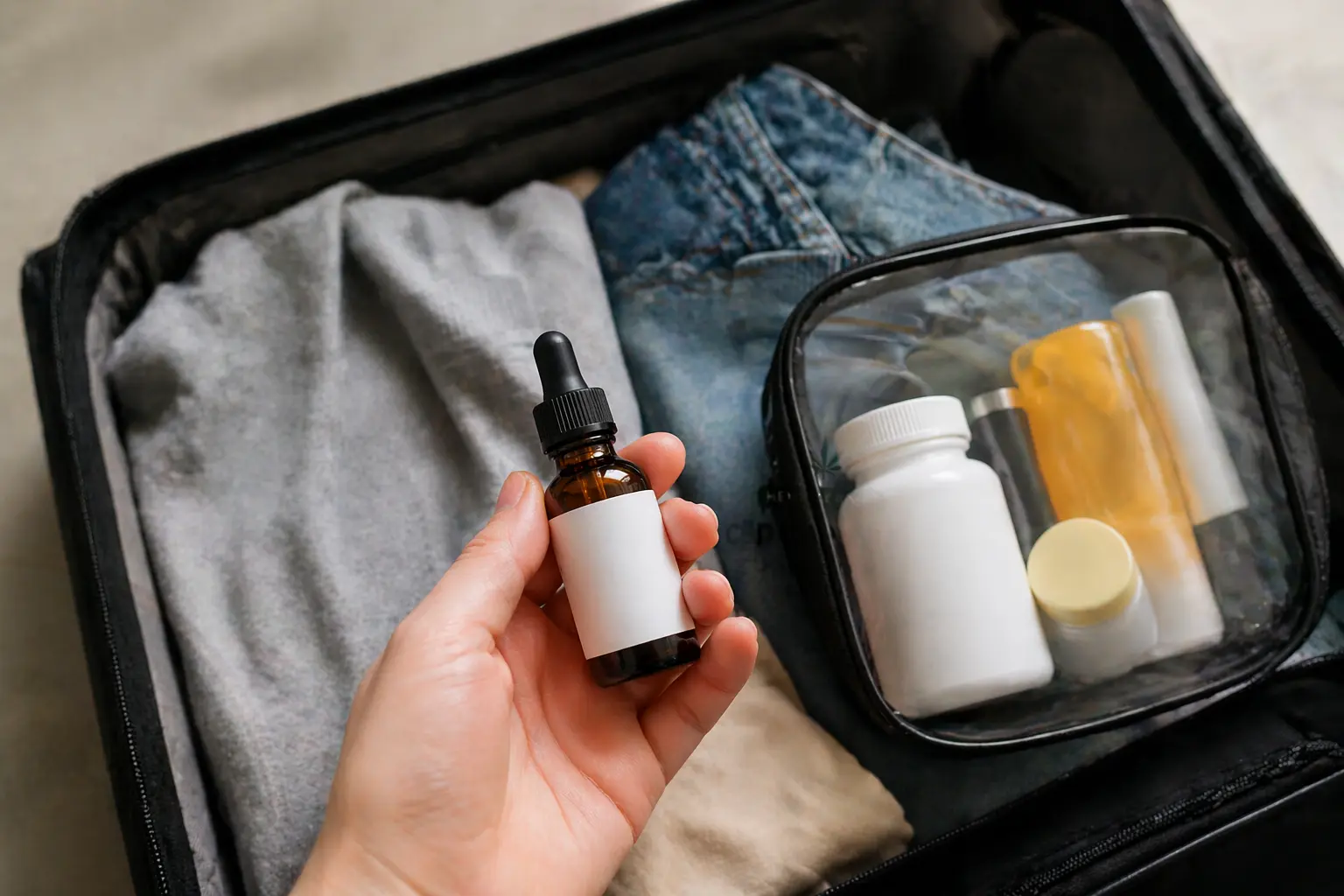
| Quick Answer | No. Marijuana is federally illegal at every US airport, regardless of state law. |
| TSA Policy | TSA does not actively search for cannabis. Finding it triggers a mandatory referral to local law enforcement. |
| Medical Card | Carries no weight at a federal security checkpoint. State-issued cards do not apply under federal jurisdiction. |
| Safe Legal Option | Hemp-derived products under 0.3% Delta-9 THC with a Certificate of Analysis (COA). Original packaging required. |
| What Determines Outcome | The state you are standing in when discovery happens, not where you flew from or where you are headed. |
Every year, millions of people pass through airports in states where cannabis is fully legal, and questions about flying with weed keep coming in. It is not hard to see why. You bought it legally. You are heading somewhere it is also legal. What is the actual problem?
The problem is that airports do not run on state law. They run on federal law, and under federal law, marijuana remains a Schedule I controlled substance. This guide covers the legal lines, what TSA actually does, which product types are affected, and exactly what happens when things go wrong.
| Advisory: This article is for informational purposes only and does not constitute legal advice. If you are stopped at a security checkpoint with cannabis products, contact a criminal defense attorney before making any statements. |
Can You Fly With Weed? The Direct Answer
No. Marijuana is federally illegal at every US airport, on every domestic flight, and in every aircraft cabin, without exception. This does not change based on your departure state, your destination state, the amount you are carrying, or whether you hold a state medical card.
TSA’s published policy is unambiguous: cannabis products remain illegal under federal law unless they contain no more than 0.3% THC on a dry weight basis or carry FDA approval. That line applies at every checkpoint from Los Angeles to Portland, Denver to New York, and every point in between.
Federal Law vs. State Law: Why the Airport Is a Different Legal Zone
More than 24 states have legalized recreational cannabis and over 38 have active medical programs as of 2026. Travelers who assume state legalization extends to the airport are operating on a legal misunderstanding that can have serious consequences.
All US airports, runways, security checkpoints, and airspace operate under federal law. A flight from Denver to Aspen is as federally governed as any international route. The aircraft, the checkpoint, and the airspace above are all under federal jurisdiction. State cannabis law ends before you reach the security line.
The Marijuana Policy Project confirms that federal jurisdiction at airports is absolute. State cannabis laws cover retail purchases, possession on state-regulated grounds, and consumption within that state. They do not extend to federal security checkpoints or aircraft cabins. Travelers who assume otherwise face the same legal exposure as those who knowingly break the law.
What TSA Actually Does at the Checkpoint
According to TSA’s own published statement, officers do not search for marijuana or other drugs. Domestic K9 units and imaging scanners are calibrated for security threats, not cannabis. What gets bags opened is not cannabis specifically. It is oversized liquids, dense packing, overlooked prohibited items, and anything the scanner flags as a security concern.
Once a bag is opened for any reason, everything inside becomes visible to the officer. That is where the sequence changes. If cannabis is found during a search opened for an unrelated reason, TSA is required to refer the matter to local law enforcement. The officer does not have discretion here. The referral is mandatory.
TravelPulse confirmed in April 2026 that TSA takes jurisdiction over airline cannabis policy and refers travelers to local authorities when cannabis is discovered during screening. What happens after the referral is entirely determined by the laws of the state where discovery occurred, not where the traveler was headed or where they flew from.
- In legal states, confiscation or disposal before boarding is the most common result for small amounts
- In prohibition states, the same situation can result in citation, detention, or criminal charges depending on quantity and local statutes
- For concentrates and edibles in prohibition states, charges can escalate to felony level depending on the weight involved
Can You Fly With Weed Gummies?
Cannabis-infused gummies are treated as marijuana products under federal law. The edible format does not change the legal classification. THC gummies purchased from a licensed dispensary are subject to the same prohibition as flower, vape cartridges, and pre-rolls at every US airport security checkpoint.
The question that matters is not whether they look harmless in your bag. It is whether they contain THC derived from marijuana. If they do, the answer is the same: not permitted under federal law at any US airport.
Hemp-derived CBD gummies containing 0.3% Delta-9 THC or less are federally legal under the 2018 Farm Bill and are generally permitted for domestic travel. The distinction requires documentation.
TSA agents cannot distinguish hemp gummies from marijuana gummies by appearance, which means original packaging showing the THC percentage and a Certificate of Analysis are both required to resolve any question at the checkpoint in your favor.
Can You Fly With a Weed Vape or Cart?
High-THC vape cartridges are illegal to transport through US airport security, exactly like flower and edibles. The THC content determines the federal classification. A vape cartridge containing marijuana-derived THC is a controlled substance under federal law regardless of its format.
There is a separate packing rule that applies regardless of THC content: vape pens and e-cigarettes must be packed in your carry-on, not in checked luggage. The FAA prohibits lithium battery devices in checked bags due to fire risk. This rule applies to hemp CBD vapes and marijuana vapes equally. A hemp-derived vape with under 0.3% THC still cannot go in your checked bag.
For travelers who use vape pens for hemp CBD, keep the device in your carry-on, carry the COA for the cartridge, and ensure the label shows the THC percentage clearly. Hemp-compliant vapes with proper documentation are generally allowed through domestic security.
What Happens If You Get Caught Flying With Weed?
The sequence is more predictable than most travelers expect. TSA finds cannabis during a bag search opened for any reason. The officer does not have the option to look the other way. A mandatory referral to local law enforcement follows immediately.
From that point, local police determine what happens next. The outcome varies considerably based on jurisdiction:
- Legal states with relaxed enforcement (California, Colorado, Oregon): Small amounts typically result in confiscation and disposal at the airport. The traveler misses their flight in some cases but does not face criminal charges.
- Legal states with stricter airport policies: Some airports in legal states still enforce state possession limits strictly. Being over the legal possession amount even in a legal state can trigger citation or arrest.
- Prohibition states (Texas, Florida, Georgia): Discovery at a prohibition-state airport is a criminal matter. Amounts that would result in confiscation in California can result in misdemeanor or felony charges in Texas depending on weight.
- Concentrates and edibles in prohibition states: These are frequently charged at a higher offense level than flower due to weight calculation methods used in some jurisdictions.
The risk is not symmetrical across the country. Flying through a connecting airport in a prohibition state with cannabis adds a separate layer of exposure even if you are traveling between two legal states.
Flying With Medical Marijuana: What Patients Need to Know
Medical cannabis patients face the sharpest gap between what state law permits and what federal law enforces at the checkpoint. A medical marijuana card is issued under state law. TSA operates under federal law. The two systems do not interact at the security line, and a card gives a TSA officer no legal basis to overlook what was found.
Florida is a clear example. Despite having an active medical program, a Florida medical card provides zero protection at a Florida TSA checkpoint. State criminal exposure sits on top of federal exposure in that situation. A recreational traveler can leave their cannabis at home. A patient managing a chronic condition needs a plan that does not rely on the card.
Before booking, check whether the destination state has a medical reciprocity program for out-of-state patients. Possession limits and registration requirements vary significantly by state. The practical guidance for most medical patients is to buy at the destination if state law permits, rather than attempt to transport across the checkpoint.
Edibles, CBD Products, and What Is Actually Allowed
Not every cannabis-adjacent product is prohibited. The 2018 Farm Bill established a federal legal category for hemp-derived products containing 0.3% Delta-9 THC or less. Products that meet this standard with proper documentation are generally permitted at domestic security checkpoints.
TSA agents do not test products on-site. A Certificate of Analysis from a third-party lab is the only tool that resolves a compliance question in your favor at the checkpoint. Carry it for every hemp-derived product in your bag.
Products generally compliant with federal regulations for domestic air travel include:
- Hemp-derived CBD gummies and capsules: Under 0.3% Delta-9 THC. Original packaging with THC percentage visible. COA required.
- Hemp-derived tinctures and oils: Under 0.3% THC. Label must show THC content clearly. Subject to the TSA 3.4 oz liquid rule in carry-on.
- Hemp topicals (lotions, balms): Under 0.3% THC. Original packaging required.
- Hemp-infused beverages: Under 0.3% Delta-9 THC. Liquid volume rules apply in carry-on.
- Delta-8 and Delta-10 products: Federally compliant under the Farm Bill when derived from hemp. Check destination state restrictions before traveling, as several states have banned Delta-8 specifically.
- FDA-approved medications: Dronabinol, Nabilone, and Epidiolex are permitted in original pharmacy packaging with your name on the label.
- CBD pet products: Oils, treats, and capsules under 0.3% THC. Proper labeling required.
Can You Fly Internationally With Cannabis?
No, and the consequences are far more severe than anything you face domestically. The US Farm Bill’s 0.3% THC standard has no legal standing outside the United States. Every country enforces its own laws, and most are significantly stricter than US federal law.
According to the Association of Americans Resident Overseas, cannabis possession penalties vary dramatically worldwide:
| Country | Penalty for Cannabis Possession |
| UAE | Minimum 4-year prison sentence |
| Japan | Minimum 5-year sentence, first offense |
| Singapore | Severe criminal penalties including caning |
| Indonesia | Severe criminal penalties; potential imprisonment for years |
| Saudi Arabia | Severe criminal penalties; deportation for foreigners |
| Canada | Cross-border transport is a criminal offense even though cannabis is legal domestically |
Countries with domestic legalization still impose harsh criminal penalties for cross-border cannabis transport. Canada is legal to consume within its borders, but crossing from the US into Canada with any cannabis product is a criminal act under Canadian border law.
Pre-Flight Compliance Checklist
Most travelers who run into problems at the airport are not uninformed about the law. They are underprepared for the practice. The gap between knowing the rules and applying them correctly at a checkpoint is where most avoidable situations happen.
| Do | Don’t |
| Keep hemp products in original packaging with THC percentage visible | Fly with dispensary weed, cannabis edibles, vape carts, or pre-rolls |
| Carry a Certificate of Analysis for every hemp product | Assume a medical card provides any federal protection |
| Research the destination state’s cannabis laws before departure | Put cannabis in checked luggage thinking it is safer than carry-on |
| Buy cannabis products at your destination if state law permits | Fly internationally with any THC product |
| Remove all unrelated prohibited items from your bag before packing | Use smell-proof packaging as a strategy to conceal non-compliant products |
| Present your COA immediately if stopped at the checkpoint | Make statements about your cannabis without an attorney present |
If TSA Flags Your Bag: What to Do in the First 60 Seconds
Getting flagged does not have to escalate. How you respond in the first thirty seconds determines how the referral to local law enforcement proceeds.
- Stay calm. Do not touch, conceal, or remove the product from the officer’s view
- For hemp products, show your Certificate of Analysis and original packaging immediately. Confirm the product contains less than 0.3% Delta-9 THC and is covered under the 2018 Farm Bill
- For dispensary cannabis, cooperate and show your ID. Do not make statements about the product beyond what is directly asked
- Contact a criminal defense attorney before making any further statements, regardless of the amount involved
- The referral to local law enforcement is not within your control. What is within your control is how you conduct yourself in the sixty seconds before it happens
Frequently Asked Questions
Can you fly with weed if it is legal in both states?
No. Federal law governs every US airport regardless of state legalization at departure or at the destination. Flying between two legal states, including a short domestic route from Denver to Aspen, does not change the federal classification of marijuana at the security checkpoint. The aircraft, the airspace, and the checkpoint all operate under federal jurisdiction.
Can you fly with weed gummies?
Cannabis gummies containing marijuana-derived THC are federally illegal at every US airport, the same as flower and vape cartridges. Hemp-derived CBD gummies with 0.3% Delta-9 THC or less are federally legal under the 2018 Farm Bill and are generally allowed through domestic security with original packaging and a Certificate of Analysis. TSA agents cannot distinguish them by sight, so documentation is required.
Can you fly with a weed vape or cart?
No. High-THC vape cartridges are prohibited under the same federal rules as other marijuana products. There is a separate packing rule that applies to all vape devices regardless of THC content: the FAA requires vape pens and e-cigarettes to travel in carry-on luggage, not checked bags, due to lithium battery fire risk. Hemp-compliant vapes with under 0.3% THC and proper documentation may be carried in your carry-on.
What is the penalty for flying with weed?
In legal states, confiscation or disposal before boarding is the most common outcome for small amounts. In prohibition states, penalties range from misdemeanors to felonies for concentrates and edibles depending on quantity and local statutes. The outcome is entirely determined by the laws of the state where TSA discovery occurs, not the departure or destination state.
Can you fly with medical marijuana on Delta or other major airlines?
No. Delta and all major US carriers prohibit cannabis on board. No major airline has a medical exemption policy for any cannabis product, including products from state-licensed medical programs. Airline policy follows federal law, which does not recognize state medical programs as a basis for permitting cannabis on aircraft.
Does TSA search specifically for cannabis?
TSA’s published policy states that officers do not search for marijuana or other illegal drugs. Screening procedures are focused on security threats, not controlled substances. However, TSA is required to refer any illegal substance found during a security screening to local law enforcement, regardless of how it was discovered. Cannabis found incidentally during a search opened for another reason follows the same referral process.
Is it safer to put cannabis in checked luggage than carry-on?
No. Checked bags are also screened, and discovery in checked luggage results in the same mandatory referral to local law enforcement as discovery in carry-on. There is no meaningful safety differential between the two. Both are subject to federal security screening, and both fall under federal jurisdiction from the moment they are submitted at the check-in counter.
Can you fly with Delta-8 THC?
Delta-8 THC derived from hemp is federally compliant under the 2018 Farm Bill, but this picture is complicated by destination state law. Several states, including Colorado, New York, and others, have specifically banned Delta-8 products. Flying with Delta-8 to a state where it is prohibited creates state-level legal exposure even if the product clears federal security. Always check the destination state’s specific laws on Delta-8 before traveling with it.
Sources
David Chen reviewed the following sources for this article.
- Transportation Security Administration, “Medical Marijuana,” TSA.gov. https://www.tsa.gov/travel/security-screening/whatcanibring/items/medical-marijuana
- Marijuana Policy Project, “Can I Travel on an Airplane With Marijuana?” mpp.org. https://www.mpp.org/policy/federal/can-i-travel-on-an-airplane-with-marijuana/
- TravelPulse, “Flying With Weed: TSA Marijuana Rules Explained,” April 2026. https://www.travelpulse.com/news/airlines-airports/flying-with-weed-tsa-marijuana-rules-explained
- Half Bakd, “TSA Rules for THC-A Products.” https://half-bakd.com/blogs/learn/tsa-rules-thc-a-products
- Association of Americans Resident Overseas, “The Dos and Don’ts of Flying With Cannabis Products.” https://aaro.org/living-abroad/travel-to-from-us/flying-with-cannabis-products