| Type | Indica-dominant hybrid (80% indica / 20% sativa) |
| THC Range | 18 to 24% |
| Dominant Terpenes | Myrcene, Caryophyllene, Limonene, Pinene |
| Lineage | Granddaddy Purple x Durban Poison |
| Best For | Afternoon and evening use; stress, tension, and sleep support |
| Beginner Friendly | Yes, at moderate doses |
Cherry Pie has been a consistent fixture on Bay Area dispensary menus since it first appeared in California, and after watching hundreds of customers reach for it over the years, I understand exactly why. It is not the loudest strain on the shelf. It is the one that keeps showing up in people’s rotation because it works.
The cross of Ken Estes’ Granddaddy Purple with the classic South African landrace Durban Poison gave breeders a strain that hits a narrow sweet spot: calm body effects without total mental shutdown, and a flavor that is immediately recognizable.
The cherry pie weed strain also tends to be one of the more forgiving options for people still dialing in their tolerance, which keeps it relevant well beyond its California origins.
Below, I will cover everything that actually matters when you are deciding whether to pick this up: genetics, terpenes, effects, flavor, what users consistently report, how it compares to similar strains, growing basics, and who this is and is not a good fit for.
What is the Cherry Pie Strain?
The cherry pie strain is an indica-dominant hybrid with a well-documented lineage and a flavor profile built around sweet, slightly tart cherry notes. It is not a broad category name in the way “purple strain” might be.
When dispensaries label something Cherry Pie, they are typically referring to a specific cross, even if quality and phenotype expression vary by grower.
As an 80/20 indica-dominant hybrid, it leans physically calming without fully committing to the sedating weight of a pure indica. Users report a mental component that stays present long enough to keep the experience social or creative, especially at lower doses. That balance is directly traceable to its genetics.
| Category | Details |
|---|---|
| Type | Indica-Dominant Hybrid (80/20) |
| Parent Strains | Granddaddy Purple x Durban Poison |
| THC / CBD | 18 to 24% / 1 to 2% |
| Flavor | Sweet cherry, light sour, earthy |
| Effects | Relaxed, happy, calm |
| Best For | Stress, tension, and sleep support |
Cherry Pie Strain: Origin and Genetics

Cherry Pie is a cross of two well-established parent strains, each contributing a distinct side of its character. Understanding the parents explains why this hybrid behaves the way it does instead of leaning fully into indica sedation.
Parent Strains Explained
Knowing the genetic background helps set realistic expectations for how a strain will feel. Cherry Pie comes from two parents that have been widely used in California breeding programs since the early 2000s.
Granddaddy Purple, bred by Ken Estes and released in 2003, is one of the most influential indica genetics in the American market. It contributes to the deep body relaxation and purple pigmentation that Cherry Pie expresses in cool-temperature grows.
Durban Poison, a South African sativa landrace, adds the mental lift that keeps Cherry Pie from feeling purely sedating. Durban Poison is known for a clear, focused quality that bridges well with heavier indica genetics.
Together, they create a strain that users consistently describe as calm but present: not a couch-lock strain, but also not one you would take before a meeting.
Is Cherry Pie Strain Sativa or Indica?
Cherry Pie is classified as an indica-dominant hybrid, approximately 80% indica and 20% sativa. The indica side (Granddaddy Purple) drives the physical effects, while the sativa side (Durban Poison) keeps a mild mental lift in the opening phase of the experience.
For practical purposes, it behaves more like an indica than a balanced hybrid, especially at higher doses, but it does not carry the complete mental fog that some pure indicas produce. Most users report it as best suited to afternoon or evening use rather than daytime.
Understanding the Terpenes in Cherry Pie
Terpenes shape both the aroma of a strain and the character of its effects, working alongside THC in what researchers call the entourage effect. Cherry Pie’s terpene profile is directly responsible for its sweet cherry flavor and the layered way its effects develop.
| Terpene | Scent / Flavor Note | Effect Association |
|---|---|---|
| Myrcene | Earthy, musky | Body relaxation; deepens calm at higher doses |
| Limonene | Sweet, citrus | Mood lift and stress ease early in the experience |
| Caryophyllene | Spicy, peppery | Body comfort; interacts with CB2 receptors |
| Pinene | Fresh, pine | Supports mental clarity and light focus |
Limonene and pinene explain the clear, slightly uplifted feeling users report at the start of the session. As the experience settles, caryophyllene adds body comfort, and myrcene deepens the relaxation without always pushing toward full sedation.
This staggered terpene interaction is why Cherry Pie feels like it builds in stages rather than hitting all at once.
If you enjoy fruity strain profiles driven by similar terpene combinations, the Zkittlez strain offers another myrcene and limonene-forward profile worth comparing.
Cherry Pie Strain Effects: What You Will Feel
Cherry Pie offers a balanced mix of mental and physical effects that build gradually rather than arriving all at once. The experience typically starts light and settles into a calm, steady state that most users describe as manageable across a range of dose levels.
1. Mental Effects
Users consistently report a gentle mood lift in the opening phase, accompanied by a light-headed buzz that builds slowly. Most describe this stage as clear rather than hazy, with a mild increase in positive mood that does not feel forced or overwhelming.
At lower doses, some users report a light increase in focus. At higher amounts, thoughts tend to slow, and the mental clarity fades as the physical effects become more dominant.
Duration: Mental effects typically begin within minutes and users report they last around one to two hours before gradually fading.
2. Physical Effects
Body relaxation is the defining characteristic of the Cherry Pie experience, consistent with its indica-dominant genetics. Users report a warm, calming sensation spreading through the body that eases physical tension.
At moderate doses, most people remain functional and comfortable. Higher doses commonly produce a heavier feeling, making sitting or lying down the natural choice.
Duration: Physical effects tend to outlast the mental component by an hour or more. Users report the body relaxation lasting two to three hours in most cases.
3. Side Effects
Dry mouth and dry eyes are the most commonly reported side effects, especially at higher doses. Some users report mild dizziness or a brief anxious feeling if the dose is too strong relative to their tolerance.
These effects are more common in inexperienced users or those who increase the dose too quickly. Starting low and waiting 15 to 20 minutes before taking more is the consistent advice from experienced users of this strain.
Flavor, Aroma, and Appearance of Cherry Pie Strain

Cherry Pie is one of the more distinctive strains on a dispensary menu because the name and the flavor actually match. That is rarer than it should be. Here is what to expect across all three sensory dimensions.
- Flavor: The inhale delivers a sweet, slightly sugary cherry note that users almost universally recognize on first taste. A light sour edge follows, adding brightness and preventing the sweetness from becoming flat. There is also a mild earthy undertone on the exhale that grounds the flavor and keeps it from reading as candy rather than cannabis.
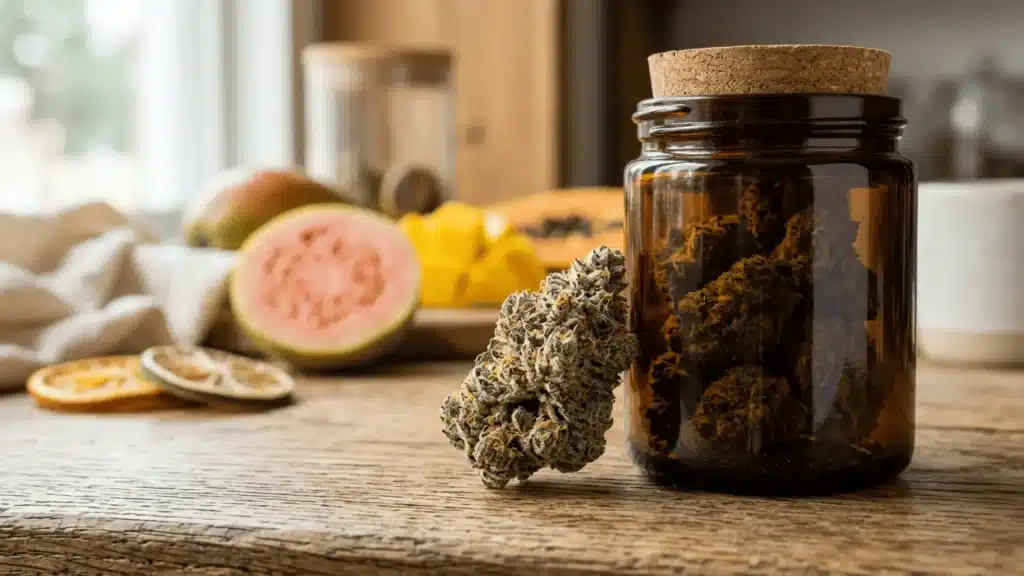
- Aroma: Fruity and herbal, with a fresh tartness that carries from the jar into the room. Some users pick up a subtle spice note in the background from the caryophyllene content. The scent is distinctive without being overpowering, which makes it recognizable but not intrusive in shared spaces.
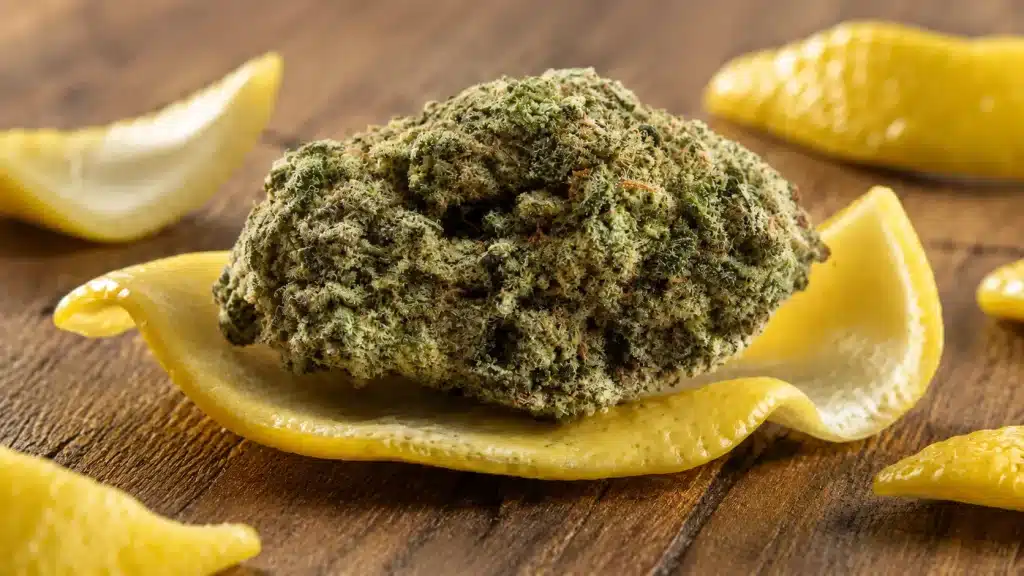
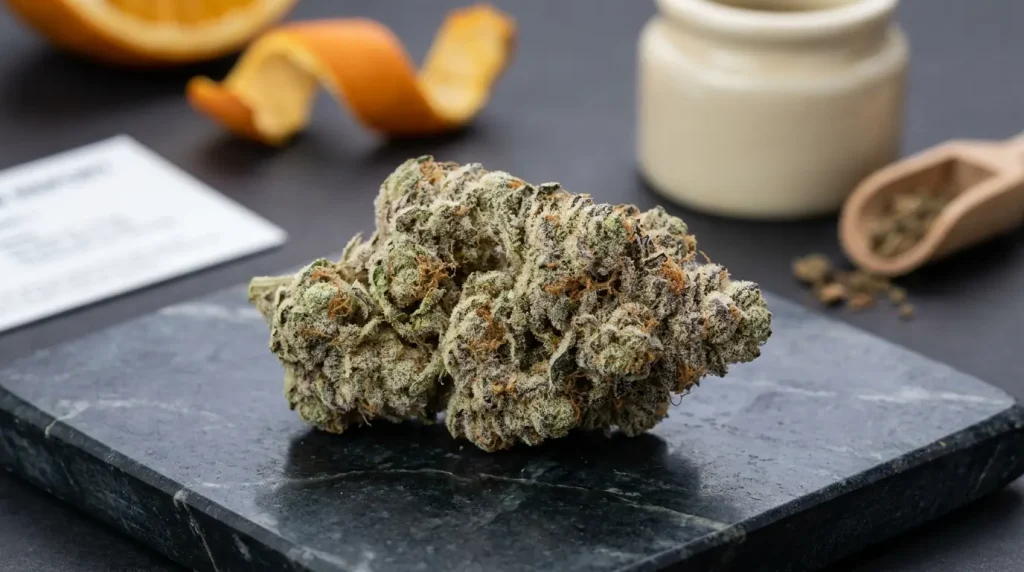
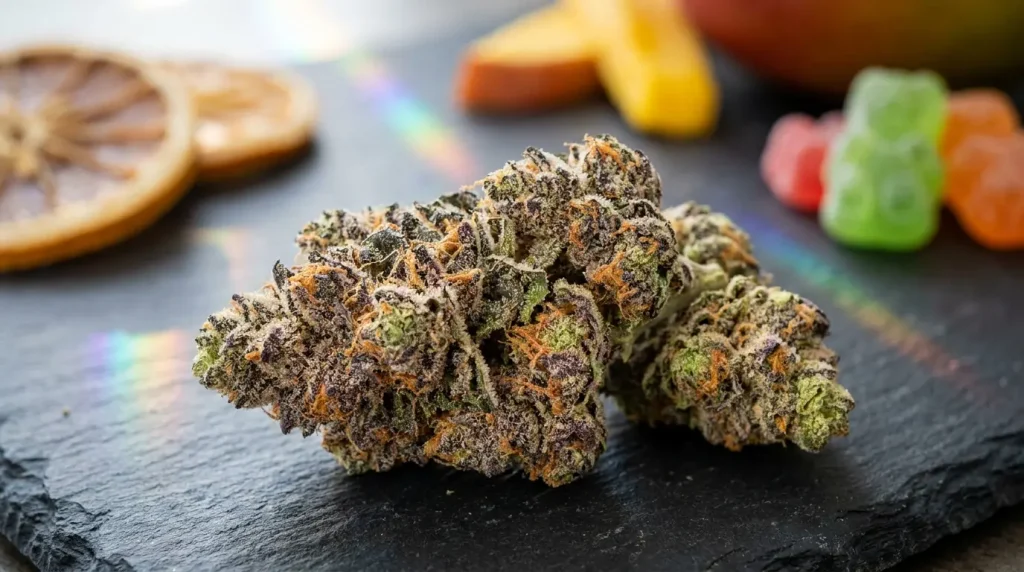
- Appearance: Cherry Pie buds are dense and visually striking. The deep green base is frequently broken by purple hues, especially in phenotypes grown at cooler temperatures. Bright orange pistils thread through the bud structure, and a thick layer of frosty trichomes gives the flower a slightly shiny, resinous finish.
Dosing Guide: How Much Cherry Pie Is Right?
Cherry Pie typically tests between 18 and 24% THC, which makes it more accessible than the highest-potency strains on the market while still carrying enough strength to catch newer users off guard if they move too fast. Effects build gradually, so pacing matters more than you might expect at this THC range.
| Experience Level | Suggested Dose | Wait Time | Form | Notes |
|---|---|---|---|---|
| Beginner | 1 small hit | 15 to 20 min | 2 to 5 mg gummy or infused drink | Smooth onset; avoid redosing too soon |
| Intermediate | 2 to 3 hits | 10 to 15 min | 5 to 10 mg gummy or oil drops | Balanced effects, well-suited to relaxed sessions |
| Experienced | Standard session | 10 min | 10 to 20 mg edibles, capsules, or tincture | Comfortable for those accustomed to moderate THC |
Taking more too early is the single most common mistake users make with Cherry Pie. The effects build across 20 to 30 minutes. Giving the first dose time to settle before reassessing is how most users find the experience they were looking for without overshooting it.
What Users Commonly Report
Cherry Pie is frequently chosen by people looking for support with daily stress and physical discomfort. Its balanced effect profile makes it useful across a range of needs without producing the intensity that heavier strains bring. The following reflects what users consistently describe across dispensary reviews and community feedback.
Stress and Daily Tension
Users most commonly report Cherry Pie for its ability to ease the mental edge that builds through the day. The mood lift from the opening phase allows users to feel more at ease, while the body effects that follow reduce the physical tension that often accompanies stress. Most describe this as a calming effect rather than a numbing one, with mental engagement still present at moderate doses.
Physical Discomfort and Muscle Tension
The Granddaddy Purple genetics contribute meaningfully to Cherry Pie’s physical profile. Users report relief from tight muscles and general body tension, particularly in the two to three-hour window after a session.
The strain is frequently mentioned in reviews related to end-of-day physical fatigue and soreness from physical work. For a comparison on how other indica-dominant strains handle body effects, the Oreoz profile offers a useful reference point.
Sleep Support
At higher doses, Cherry Pie’s myrcene content and indica dominance combine to produce effects that users describe as conducive to sleep onset.
Most reports describe this as a progressive physical wind-down rather than a sudden sedation. Users who experience restlessness or difficulty quieting the body before bed most commonly report positive outcomes at the intermediate to higher end of the dose range.
Appetite
A moderate appetite-stimulating effect is commonly reported, consistent with the strain’s myrcene and indica genetics. Users who find mealtime difficult, whether from stress or other reasons, sometimes find this effect useful as a secondary benefit of an evening session.
| Advisory: This article is for informational purposes only and does not constitute medical advice. Cannabis laws vary by location. Verify legality in your area before purchasing or using. Consult a healthcare provider before using cannabis for any health-related purpose. Individual results vary. |
Cherry Pie vs. Similar Strains

Cherry Pie is frequently compared to Girl Scout Cookies and Granddaddy Purple because of shared genetics and overlapping effect profiles. The comparison table below shows where Cherry Pie fits in practical terms.
| Feature | Cherry Pie | Girl Scout Cookies (GSC) | Granddaddy Purple (GDP) |
|---|---|---|---|
| Type | Indica-dominant hybrid | Hybrid (indica-leaning) | Indica-dominant |
| Parents | GDP x Durban Poison | OG Kush x Durban Poison | Purple Urkle x Big Bud |
| THC | 18 to 24% | 20 to 28% | 17 to 23% |
| Effects | Balanced, calm, uplift | Strong, euphoric, relaxed | Deep relaxation |
| Mental Feel | Clear, mild uplift | Heavy euphoria | Calm, dreamy |
| Body Effects | Relaxing, not heavy | Can feel heavy | Strong body high |
| Flavor | Sweet cherry, sour, earthy | Sweet, earthy, minty | Grape, berry |
| Best Time | Afternoon, evening | Evening | Night |
| Beginner Friendly | Yes, at moderate doses | Less beginner-friendly | Better for experienced users |
Cherry Pie sits between GDP and GSC in intensity. It does not sedate as completely as Granddaddy Purple, and it does not carry the heavy euphoria of GSC.
If those two options feel too strong or too sedating for your current needs, Cherry Pie is the logical middle point. For a fruity strain comparison on the lighter end, the Cherry Poppers strain offers a sativa-leaning cherry profile that differs significantly in energy and intensity.
Cherry Pie Strain Reviews: What People Actually Experience

Across dispensary review platforms and community boards, Cherry Pie reviews follow a consistent pattern. Users describe the experience as building in stages rather than arriving all at once, which most consider a feature rather than a limitation.
The opening mood lift is frequently mentioned as one of the strain’s most useful qualities, with the physical relaxation that follows described as smooth rather than abrupt.
The flavor earns consistent attention in reviews. Users specifically call out the sweet cherry taste on the inhale and the earthy finish, noting that it matches the name in a way that many strains do not.
The combination of reliable onset, balanced effects, and flavor consistency is what keeps Cherry Pie in regular rotations for users who have moved through dozens of other strains. It is not the most potent option or the most exotic, but it produces a predictable experience that experienced users value and newer users find approachable.
Growing the Cherry Pie Strain
Cherry Pie can be grown indoors or outdoors, but performs best in a controlled indoor environment where temperature and humidity can be managed precisely. It is a moderately demanding grow, suitable for intermediate growers who are comfortable managing a bushy, branchy plant structure.
Key growing details that users and cultivators report: the plant tends to produce dense, resinous buds with vibrant purple coloration when nighttime temperatures are dropped to around 60 to 65 degrees Fahrenheit during the final weeks of flower.
Flowering time runs approximately 8 to 9 weeks indoors. Yields are moderate, typically in the 14 to 16 ounce per square meter range indoors under optimized conditions.
The original Cherry Pie cut circulates primarily as a clone rather than seed stock. Seed banks that carry Cherry Pie genetics often sell crosses or phenotype-adjacent versions rather than the original cut, so verifying the source matters when growing for a specific flavor or effect target.
The Leafly strain profile for Cherry Pie aggregates grow reviews that are useful for setting realistic expectations by climate and setup.
Where to Find the Cherry Pie Strain
Cherry Pie is available in licensed dispensaries across California, Colorado, Oregon, Washington, and most other states with regulated adult-use markets. Availability varies by region and season. The most reliable way to confirm current stock is to check dispensary menus on Leafly or Weedmaps filtered to your area before making a trip.
In dispensaries, it commonly appears as flower, pre-rolls, and vape products. Extract and concentrate versions exist but are less common than the flower format. Quality varies by grower, which is why longtime Cherry Pie users tend to have a preferred cultivator rather than just a preferred strain name.
For home growers, clone access through established dispensaries in legal states is more reliable than seed purchases. Always verify the legal status of purchase and cultivation in your specific location before moving forward. The NIDA cannabis overview provides accurate information on current federal classification and state-level variation.
Should You Buy Cherry Pie?
If you are looking for a strain that delivers consistent, balanced effects without requiring a high tolerance to enjoy, Cherry Pie is a strong option. It is one of the few strains at this THC range that manages both the mental and physical sides of the experience without either dominating completely. That makes it practical across a broader set of situations than a pure indica or a high-THC heavy hitter.
The clearest case for Cherry Pie is the afternoon-to-evening user who wants to decompress without committing to a full night on the couch. It is also a reliable choice for people who have found other strains in this category either too stimulating or too sedating. If you want something with more cherry flavor complexity and a different effect character, the Super Boof strain, which carries notable cherry and citrus terpene notes alongside a more energized opening, is worth comparing directly.
Skip Cherry Pie if your priority is maximum potency, a purely euphoric mental high, or a strain that works well in the morning. For any of those needs, a different cultivar will serve you better.
Frequently Asked Questions
Is Cherry Pie strain sativa or indica?
Cherry Pie is an indica-dominant hybrid, classified approximately 80% indica and 20% sativa. The indica genetics from Granddaddy Purple drive the body effects and overall calming character.
The sativa contribution from Durban Poison provides a mild mental lift in the opening phase of the experience. In practical terms, most users treat it as an evening strain rather than a daytime one, though lower doses can work for afternoon use.
Is Cherry Pie strain strong?
Cherry Pie is moderately strong, with THC levels typically between 18 and 24%. That range is noticeable but not at the ceiling of what the current market produces.
For users new to cannabis or returning after a break, even the lower end of that range can feel significant, especially if the dose is not carefully managed. Starting with one small hit and waiting 20 minutes before reassessing is the consistent advice from experienced users.
Does Cherry Pie make you sleepy?
At lower and moderate doses, Cherry Pie produces relaxation rather than outright sleepiness. At higher doses, the myrcene-heavy terpene profile and indica dominance combine to produce a heavier physical effect that many users describe as sleep-supportive. Most experienced users report it as their preferred pre-sleep strain at higher doses, but functional at lighter amounts earlier in the evening.
Is Cherry Pie good for anxiety?
Users frequently report Cherry Pie as helpful for daily stress and tension, but results with anxiety are more variable. The limonene content is associated with mood lift, and the overall calming effect profile is consistent with what users seek for stress relief.
However, at higher doses, any strain in the 18 to 24% THC range has the potential to amplify anxiety rather than reduce it. Keeping doses low to moderate and working up gradually is the practical advice for anxiety-sensitive users. Published research on cannabis and mental health from the National Academies covers the nuance of this relationship in detail.
What is the lemon cherry pie strain?
Lemon cherry pie strain refers to cultivars that combine cherry pie genetics or terpene characteristics with citrus-forward breeding, typically through crosses involving lemon-heavy parents. These are distinct from the original Cherry Pie cross and vary significantly by breeder.
They generally carry a brighter, more citrus-dominant flavor than classic Cherry Pie while retaining some of the body-relaxing character of the indica-dominant base. If you see this listed at a dispensary, ask for a terpene profile to understand what you are actually getting, since the name is not standardized across cultivators.
Why is Cherry Pie hard to find?
The original Cherry Pie cut circulates primarily as a clone, not as commercial seed stock. This means availability depends entirely on which dispensaries have relationships with cultivators holding that specific phenotype. Many versions sold as Cherry Pie are phenotype-adjacent crosses or interpretations rather than the original Bay Area cut.
The result is meaningful variation in flavor and effect from dispensary to dispensary, which is why longtime Cherry Pie users tend to track the specific cultivator rather than just the strain name.
Sources
- Leafly, “Cherry Pie Weed Strain Information,” Leafly.com. Available at leafly.com/strains/cherry-pie.
- National Institute on Drug Abuse, “Cannabis (Marijuana) DrugFacts,” NIDA, 2023. Available at nida.nih.gov.
- National Academies of Sciences, Engineering, and Medicine, “The Health Effects of Cannabis and Cannabinoids,” National Academies Press, 2017. Available at ncbi.nlm.nih.gov/books/NBK425767.
- AllBud, “Cherry Pie Marijuana Strain Information and Reviews,” AllBud.com. Available at allbud.com.