
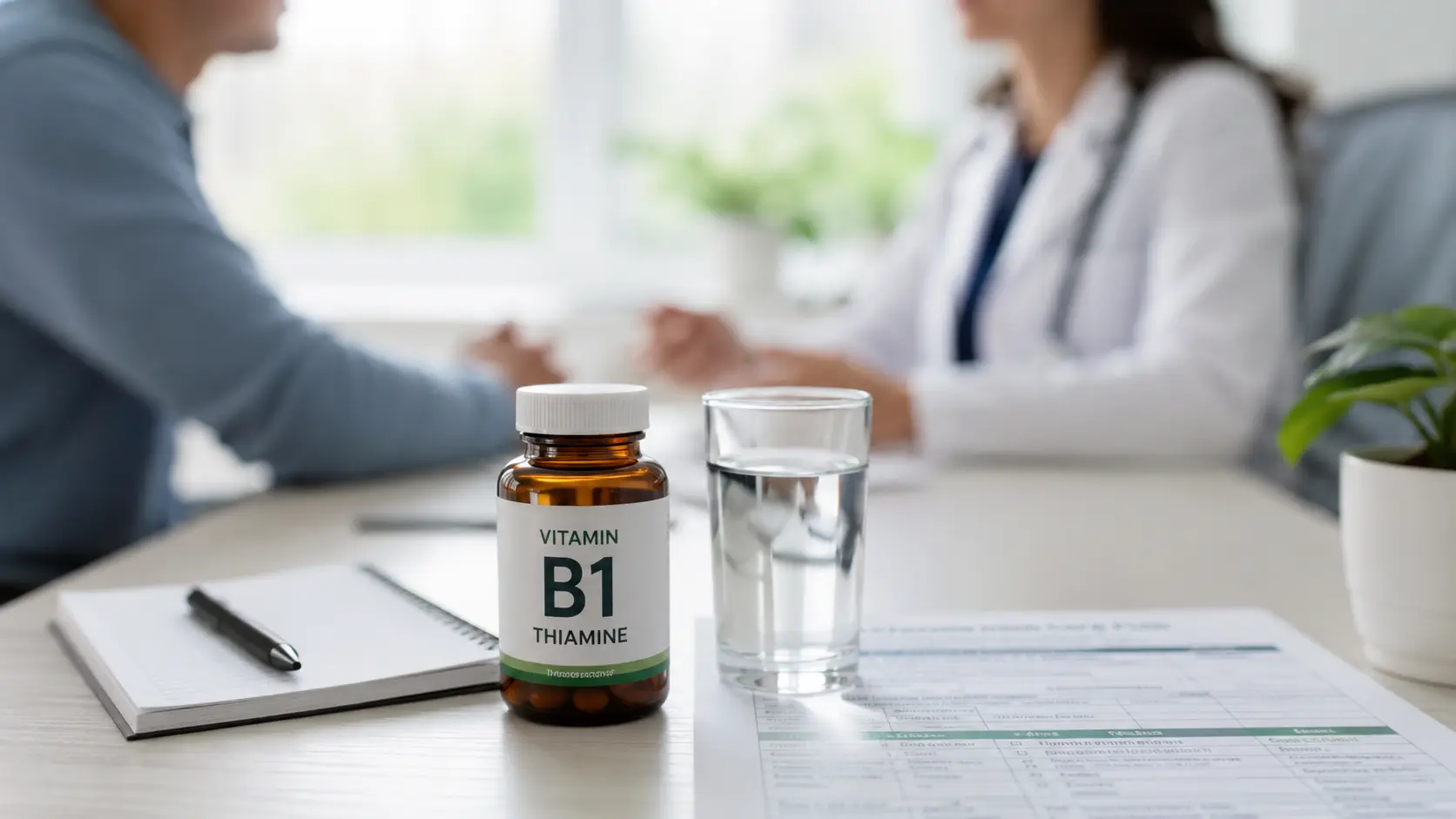
Alcohol withdrawal is not only about shaking, sweating, or cravings. For some people, the bigger danger starts with a quiet vitamin B1 shortage.
Thiamine for alcohol withdrawal matters because heavy drinking can drain vitamin B1 through poor food intake, poor absorption, and reduced body stores. That matters for the brain. Thiamine helps brain cells and nerves use energy, and low levels can raise the risk of Wernicke’s encephalopathy.
If you are checking vitamin B1 dosage for adults, daily nutrition needs are small, but medical doses during withdrawal can be much higher and should be guided by a clinician.
Warning: Alcohol withdrawal can become dangerous. Get urgent medical care if you have confusion, seizures, hallucinations, severe shaking, fever, chest pain, fainting, repeated vomiting, trouble walking, or vision changes. If you feel unsafe or might hurt yourself, call or text 988. For alcohol treatment referrals in the United States, contact SAMHSA at 1-800-662-HELP. If there is immediate danger, call 911.
Quick Reference: Thiamine in Alcohol Withdrawal
| Topic | Key Point |
|---|---|
| What it is | Vitamin B1 (thiamine), essential for brain and nerve energy production |
| Why does it run low with alcohol use | Poor diet, reduced gut absorption, impaired liver storage |
| The main risk it prevents | Wernicke’s encephalopathy and Korsakoff syndrome |
| Normal adult daily need | 1.1–1.2 mg (1.4 mg during pregnancy) |
| Medical dose during withdrawal | ASAM recommends 100 mg IV or IM daily for 3–5 days in hospital settings |
| Delivery routes | Oral, IV (vein), IM (muscle), route depends on risk level and absorption |
| Does it stop withdrawal symptoms? | No. It prevents deficiency-related brain damage. It does not stop shaking, seizures, or delirium tremens. |
| Who needs urgent assessment? | Anyone with confusion, balance problems, eye changes, vomiting, or long-term heavy drinking |
Why Alcohol Makes Vitamin B1 Run Low?
Thiamine , also called vitamin B1 , helps the body turn food into energy. That sounds simple, but it affects nearly every system that matters during alcohol withdrawal. The brain, nerves, heart, and muscles all need steady energy to work well. When thiamine drops too low, those systems can start to show strain.
Heavy drinking makes that more likely in a few ways. It can replace meals, reduce appetite, cause vomiting, and lead to poor food choices. Alcohol can also reduce thiamine absorption in the gut and interfere with how the body stores and uses it.
That means a person can be low in vitamin B1 before withdrawal even starts. Fatigue, weakness, poor appetite, tingling, mild balance trouble, or brain fog can be easy to blame on drinking, stress, poor sleep, or dehydration.
The concern grows when symptoms move toward confusion, trouble walking, poor coordination, abnormal eye movement, or vision changes. Those signs should be treated as urgent because they may point to a serious thiamine-related brain problem, not just a rough withdrawal day.
This is also why someone going through alcohol and cannabis at the same time may have more layered nutritional depletion than they realize, since poor eating habits during heavy use compound over time regardless of the substances involved.
What Thiamine Actually Does During Withdrawal

When someone stops drinking after heavy or long-term use, the nervous system has to adjust quickly. Sleep, heart rate, blood pressure, mood, appetite, and thinking can all feel unstable. If vitamin B1 is already low, the brain has less support during that shift.
Thiamine does not “treat withdrawal” in the same way withdrawal medications do. Its job is different. It helps protect the body from a deficiency that can become dangerous during alcohol withdrawal.
1. It Helps Brain Cells Make Energy
Thiamine helps brain cells turn nutrients into usable energy. The body stores thiamine in only small amounts, so the brain depends on a steady supply. During withdrawal, that support matters because the body is trying to reset while stress hormones, sleep changes, and nervous system symptoms are rising.
When vitamin B1 is low, the brain can struggle to keep up. That is one reason why confusion, memory changes, poor balance, and unusual eye movement are taken seriously in people who drink heavily.
2. It Supports Nerve Function
Vitamin B1 also helps nerves send signals accurately. When levels drop, tingling, weakness, and coordination problems can appear, symptoms that are easy to mistake for intoxication or general withdrawal fatigue.
During a withdrawal period that already taxes the nervous system, uncorrected B1 deficiency adds another layer of vulnerability.
For context, similar nervous system strain shows up in other substance withdrawal situations too. Anyone who has read about Adderall withdrawal symptoms and timeline will recognize how differently the brain responds when a substance is removed after prolonged use. The mechanisms differ, but the principle of nutritional support during that reset period applies broadly.
3. It Helps Protect Memory and Thinking
Low thiamine can affect areas of the brain involved in memory, learning, and attention. That is why confusion or memory problems during heavy alcohol use should not be brushed off as “just detox.”
This is also why doctors may give thiamine before every detail is confirmed. If the brain is already short on vitamin B1, waiting too long can raise the chance of lasting problems.
4. It Helps Prevent Serious Brain Complications
One of the main reasons thiamine is used in alcohol withdrawal care is to lower the risk of serious brain problems linked to vitamin B1 deficiency.
The most important one is Wernicke’s encephalopathy, a serious condition whose warning signs can be easy to miss.
5. It May Be Given Before Symptoms Are Obvious
Clinicians may give thiamine early when someone has been drinking heavily, eating poorly, vomiting, losing weight, or showing confusion. That early use is not random. It is meant to lower a known risk before it becomes harder to treat.
Thiamine is often given before clear deficiency symptoms appear because prevention is safer than waiting for brain-related signs to show up. This matters in alcohol withdrawal because confusion, balance problems, or eye movement changes can be subtle or mistaken for intoxication.
6. It Works with Nutrition, Fluids, and Medical Care
Thiamine is usually one part of a broader withdrawal plan. A person may also need fluids, electrolyte checks, magnesium, food support, monitoring, or withdrawal medication depending on symptoms and risk.
That does not make thiamine less important. It means vitamin B1 works best when the full care plan is handled safely.
7. It Does Not Replace Medical Detox
Thiamine can help prevent deficiency-related harm, but it does not directly calm the nervous system, stop seizures, treat hallucinations, or prevent delirium tremens.
If someone has severe withdrawal symptoms or a history of complicated withdrawal, vitamin B1 is not enough. Medical care is still needed.
Wernicke-Korsakoff Syndrome: The Brain Risk Thiamine Helps Prevent
The biggest reason thiamine gets urgent attention is Wernicke’s encephalopathy. This is a medical emergency caused by thiamine deficiency. It can affect thinking, walking, balance, and eye movement.
Wernicke’s encephalopathy is the early, urgent stage. Korsakoff syndrome is the long-term memory disorder that can occur if the early problem is missed or not treated fast enough. Together, they are often discussed as Wernicke-Korsakoff syndrome.
The warning signs are not always neat. A person may not show the full classic pattern. They may seem confused, unsteady, very weak, forgetful, or different from their usual self. That can get mistaken for intoxication, exhaustion, or ordinary withdrawal.
Common warning signs include confusion, poor coordination, trouble walking, abnormal eye movements, double vision, drooping eyelid, memory problems, low body temperature, low blood pressure, and severe fatigue.
New confusion, walking problems, or vision changes during heavy alcohol use or withdrawal should be treated as urgent. Waiting to see whether tablets help can cost time the brain may not have.
Vitamin B1 Dosage for Adults

The normal daily need for vitamin B1 is small. The National Institutes of Health lists the recommended intake as 1.2 mg per day for adult men, 1.1 mg per day for adult women, and 1.4 mg per day during pregnancy or lactation.
That is regular nutrition. Alcohol withdrawal care is different. In that setting, clinicians may be trying to correct a deficiency, prevent Wernicke’s encephalopathy, or treat a suspected brain-related emergency.
| Situation | Reference Point |
|---|---|
| Healthy adult men | 1.2 mg daily |
| Healthy adult women | 1.1 mg daily |
| Pregnancy or lactation | 1.4 mg daily |
| General deficiency concern | Dose depends on symptoms, nutrition, absorption, and clinician judgment |
| Hospital alcohol withdrawal care | ASAM lists 100 mg IV or IM daily for 3 to 5 days |
| Wernicke-Korsakoff treatment label example | DailyMed lists 100 mg IV first, followed by 50 to 100 mg IM daily until regular balanced eating returns |
A standard multivitamin should not be treated like alcohol withdrawal care. It may support general intake, but it is not the same as medically directed thiamine when the risk of deficiency is high.
There is also no single dose that fits every case. Risk level, vomiting, nutrition, mental status, absorption, and signs of Wernicke’s encephalopathy all matter. If you are comparing doses online, remember that the number only makes sense when the clinical situation is clear.
Oral, IV, or IM Thiamine: Why the Route Matters
Thiamine can be taken as a tablet or given as an injection. The route matters during alcohol withdrawal because vomiting, poor nutrition, and gut absorption problems can make tablets less reliable for some people.
Oral thiamine may be used for lower-risk prevention or follow-up care. It fits best when someone is stable, thinking clearly, eating, and able to keep tablets down.
IV or IM thiamine may be used when clinicians are worried about severe deficiency, poor absorption, malnutrition, repeated vomiting, or possible brain involvement. These routes do not depend on the stomach in the same way tablets do.
| Route | What It Means | When It May Be Used |
|---|---|---|
| Oral | Tablet or capsule | Lower-risk prevention or follow-up care |
| IV | Into a vein | Hospital care, severe deficiency concern, or suspected brain involvement |
| IM | Into a muscle | When an injection is needed, and IV is not the chosen route |
The route is about risk, not strength. A person eating well and thinking clearly is not in the same situation as someone confused, vomiting, malnourished, or medically unstable.
IV or IM thiamine should be given under medical supervision because injectable forms can rarely cause serious allergic reactions.
Who Is More Likely to Need Medical Thiamine?
Not everyone who stops drinking has the same risk. Some people are more likely to need urgent assessment, higher-dose thiamine, or IV or IM treatment.
| Risk Factor | Why It Matters |
|---|---|
| Long-term heavy drinking | More time for low intake, poor absorption, and low stores to build |
| Poor diet | Less vitamin B1 is coming in from food |
| Repeated vomiting | Less nutrition stays down |
| Weight loss | Can signal a broader deficiency and poor intake |
| Liver disease | Storage and nutrient handling may be affected |
| Food insecurity | Regular meals may be harder to maintain |
| Prior withdrawal seizures or delirium | Signals a higher-risk withdrawal overall |
| Confusion, poor balance, or eye symptoms | May suggest brain involvement already |
Having one or more of these factors does not guarantee a bad outcome, but it does mean that guessing is more dangerous. Home withdrawal without medical input becomes a riskier choice when these factors are present. For anyone with a history of seizures, prior DTs, or obvious cognitive changes, the conversation with a clinician needs to happen before the last drink, not after.
This risk profile is relevant beyond alcohol, too.
Similar considerations around nervous system vulnerability and prior seizure history come up across substance use situations, including cases like methamphetamine withdrawal, where brain chemistry disruption and poor nutrition often overlap.
Other Nutrients and Food After the Acute Risk Passes
Thiamine gets the most attention because of the brain risk, but alcohol withdrawal care may also include checks for magnesium, folate, phosphorus, potassium, sodium, blood sugar, hydration, and liver markers. These matters because heavy alcohol use can affect electrolytes, nutrition, and medical stability.
Food can support recovery once the urgent risk starts to settle, but it cannot replace medical thiamine when someone is confused, vomiting, at high risk, or showing signs of Wernicke’s encephalopathy.
Helpful thiamine-containing foods include fortified cereals, enriched grains, pork, fish, beans, lentils, brown rice, oatmeal, and sunflower seeds.
Practical Tips Before Starting Withdrawal
Thiamine works best as part of a safety plan, not as a last-minute fix. Before stopping alcohol, especially after heavy or daily drinking, prepare with medical guidance.
- Call a doctor, detox provider, or treatment center before the last drink when possible.
- Ask if home withdrawal is safe for your situation.
- Share any history of seizures, hallucinations, delirium tremens, falls, or hospital visits.
- Ask whether oral, IV, or IM thiamine fits your risk level.
- Ask how long to continue thiamine after withdrawal starts.
- Bring your medication and supplement list.
- Write down your last drink, usual intake, food intake, vomiting, confusion, falls, and seizure history.
- Avoid unplanned sedatives, other substances, or extra alcohol.
- Keep 988, SAMHSA, local detox contacts, and emergency services easy to access.
- Have someone check in if outpatient withdrawal is approved.
Preparation does not make withdrawal risk disappear, but it gives you fewer blind spots. That matters when symptoms can shift fast.
When to Seek Emergency Care
⚠️ Get medical help immediately if any of these occur:
A history of delirium tremens or withdrawal seizures is a major warning sign. Heavy daily drinking for an extended period raises the risk even more. Call 911 for immediate danger. For treatment referrals, contact SAMHSA at 1-800-662-4357 or visit FindTreatment.gov. |
The consequences of delayed care during alcohol withdrawal are not theoretical. Amy Winehouse’s death, widely covered in harm reduction discussions, illustrates how quickly alcohol-related withdrawal complications can become fatal without proper medical intervention in place.
Frequently Asked Questions
Why is this given during detox?
It is given because heavy drinking can lower B1 levels and raise the risk of brain and nerve problems. During withdrawal care, it helps prevent or treat deficiency, especially when nutrition has been poor or vomiting is present.
Can it stop shaking or seizures?
No. It helps prevent or treat deficiency, but it does not directly control dangerous withdrawal symptoms. Severe shaking, seizures, hallucinations, confusion, or delirium need urgent medical care, not just vitamins, fluids, food, or rest alone.
Is 100 mg too much?
That amount is far above normal daily nutrition needs, but it is commonly used in medical care when deficiency risk is present. The right dose depends on symptoms, nutrition, route, absorption, and the clinician’s judgment on a case-by-case basis.
Do tablets work, or is an injection needed?
Tablets may be used for lower-risk prevention or follow-up care. IV or IM dosing is often preferred when someone is malnourished, vomiting, hospitalized, unable to absorb well, or showing possible brain-related warning signs during withdrawal.
What symptoms need urgent care?
Confusion, poor balance, abnormal eye movement, double vision, seizure, hallucinations, fever, fainting, chest pain, severe vomiting, or dehydration need urgent care. These symptoms can point to dangerous withdrawal, vitamin deficiency, or both, and need timely assessment.
How long is this usually taken after withdrawal starts?
The length depends on nutrition, symptoms, risk level, and whether a deficiency is suspected. Some people may take oral thiamine during follow-up care, while higher-risk cases may need short-term IV or IM treatment under medical supervision.
Should other nutrients be checked?
Yes. Clinicians often check magnesium, folate, phosphorus, potassium, sodium, blood sugar, hydration, and liver markers. Guessing with multiple supplements during withdrawal can be risky because electrolyte problems can affect the heart, brain, and safety quickly.
Final Takeaway
Thiamine for alcohol withdrawal is not a shortcut through detox, but it can protect the brain when the risk is high. Heavy drinking can lower vitamin B1 before clear symptoms appear, and that shortage can affect memory, balance, eye movement, and nerve function.
Daily vitamin B1 dosage for adults is small, yet withdrawal care may require higher oral, IV, or IM thiamine based on nutrition, symptoms, and risk for Wernicke’s encephalopathy. Do not use supplements as a stand-in for medical care.
Talk with a clinician before stopping alcohol, ask what thiamine form fits your situation, and use SAMHSA or FindTreatment.gov to find safe care before symptoms escalate or become harder to manage safely.
Sources
- National Institutes of Health, Office of Dietary Supplements. “Thiamin Fact Sheet for Health Professionals.”
- American Society of Addiction Medicine. “The ASAM Clinical Practice Guideline on Alcohol Withdrawal Management.”
- American Society of Addiction Medicine. “Alcohol Withdrawal Management.” ASAM Pocket Guide via Guideline Central.
- National Institute on Alcohol Abuse and Alcoholism. “Wernicke-Korsakoff Syndrome.”
- U.S. National Library of Medicine. “Thiamine Hydrochloride Injection.” DailyMed drug label.
- Substance Abuse and Mental Health Services Administration. “National Helpline.”
- 988 Suicide & Crisis Lifeline. “988 Lifeline.”
- Substance Abuse and Mental Health Services Administration. “Find Treatment.” Official U.S. treatment locator.


