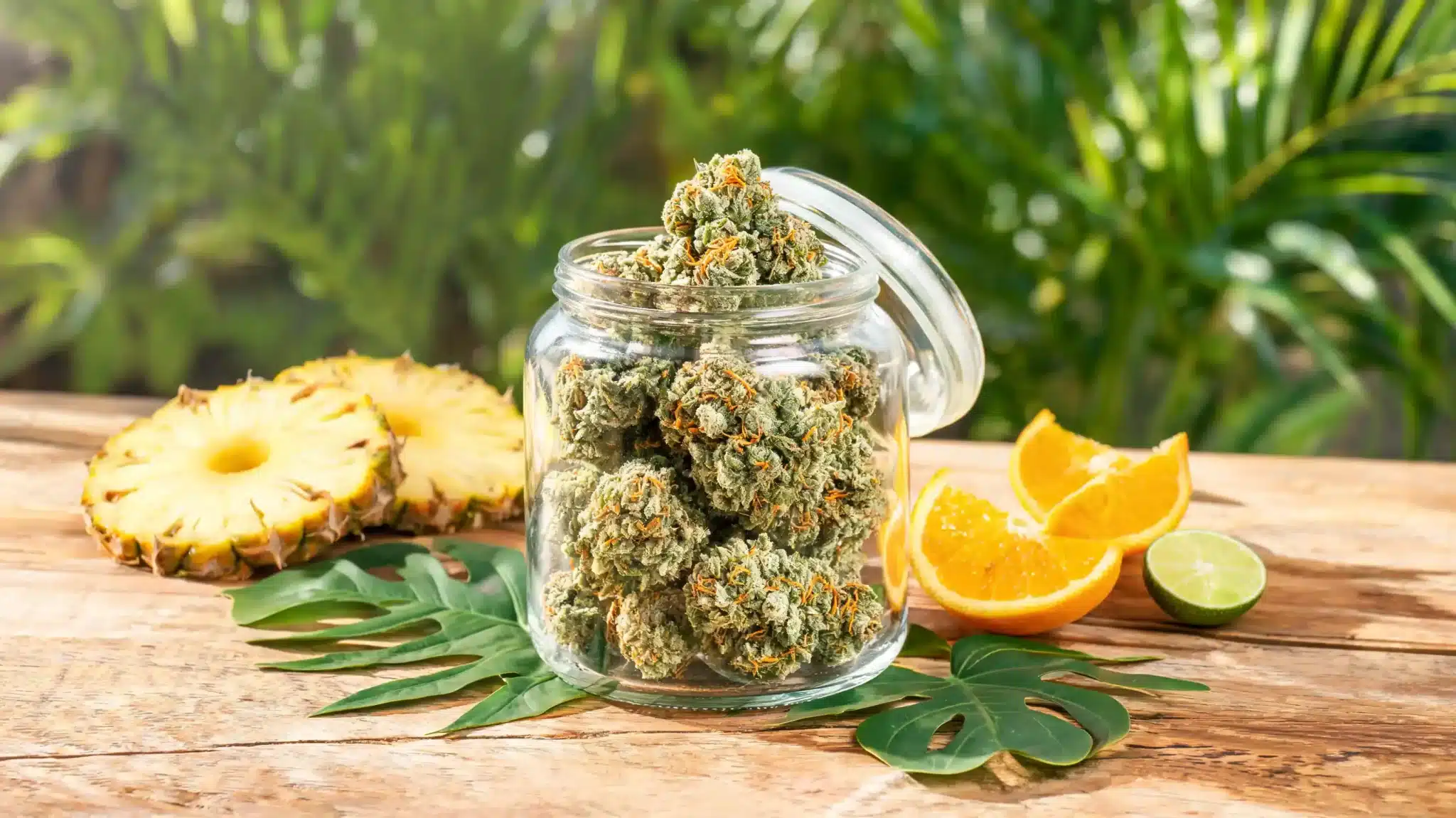
| Type | Sativa-dominant (80% Sativa / 20% Indica) |
| THC Range | 20–28% |
| Dominant Terpenes | Myrcene, Pinene, Caryophyllene |
| Best For | Daytime use, social settings, creative sessions, active outdoor activities |
| Origin | Hawaiian landrace; documented in the Leafly strain database as a classic heritage variety |
Maui Wowie Strain: What You’re Actually Getting
Maui Wowie is one of those strains I get asked about regularly on the floor, and for good reason. It has a name people remember, a reputation that goes back decades, and a flavor profile that holds up when you open the jar.
Leafly classifies it as a classic sativa-dominant variety with documented Hawaiian landrace heritage, and users consistently land on it when they want daytime energy without the anxious edge that some high-THC sativas can bring.
The short version: expect a pineapple and citrus forward smoke, a lighter body feel, and a head effect that leans upbeat and social. THC typically runs 20–28% depending on the grower and batch, so this is not a strain to underestimate. If you want a deeper breakdown of how sativa-dominant hybrids compare structurally before reading further, that context helps.
The rest of this guide covers meaning, history, potency, terpenes, effects, dosage, and growing. I will also flag where the experience can go sideways and what to check on a product label before you buy.
What Does Maui Wowie Mean?
The name answers a question that gets searched over 13,000 times a month, and the answer is simpler than most people expect. Maui refers to the second-largest island in Hawaii, where this strain was originally cultivated in volcanic soil during the 1960s and early 1970s.
Wowie is an old-school slang exclamation for amazement or surprise, essentially the verbal reaction early users had when they encountered cannabis this flavorful and potent compared to the imported Mexican and Colombian product common on the US mainland at the time.
Combined, Maui Wowie translates roughly to “the amazing thing from Maui.” The name was not coined by a breeder or a brand. It spread organically through surfer culture and the counterculture network that carried Hawaiian cannabis back to the mainland. You will also see it written as Maui Waui and Mowie Wowie on dispensary menus. These are phonetic variations of the same name, not different strains. All three refer to the same Hawaiian sativa family.
The History and Origins of Maui Wowie
Maui Wowie did not come out of a seed company catalogue. It came from the land. The Hawaiian islands offered a growing environment that was genuinely difficult to replicate: rich volcanic soil, consistent warmth, strong equatorial sunlight, natural humidity, and no frost risk at lower elevations.
Local growers in Maui and on the Big Island cultivated cannabis that grew tall and developed a distinctive terpene profile shaped by that specific environment.
By the late 1960s and early 1970s, the strain had a regional reputation. Travelers, surfers, and counterculture networks brought it to the mainland, where it stood apart from the compressed brick weed that dominated the black market. That comparison is important context. Maui Wowie’s reputation for potency and flavor was built against a very different baseline than today’s market, which makes the fact that it still draws attention in a dispensary full of 30%+ modern cultivars worth noting.
The genetics are partly undocumented, which is typical of older landrace-adjacent strains. Most sources tie it to Hawaiian sativa lineage, with the other parent listed as unknown. No single commercial breeder owns the Maui Wowie name, which also explains the variation in quality between different producers using the label.
Is Maui Wowie Indica or Sativa?
Maui Wowie is sativa-dominant. The most commonly cited ratio is 80% sativa and 20% indica, though that number varies by grower and by how a particular batch was cultivated and phenotype-selected.
The practical meaning of that ratio is a lighter body feel, a more upbeat head effect, and a daytime-leaning profile rather than the couch-heavy sedation associated with indica-dominant strains.
If you have had experiences with heavy indica strains and found them too sedating during the day, Maui Wowie sits on the opposite end of that spectrum for most users. The 20% indica component tends to show up as a mild body ease rather than any real heaviness. At higher THC batches (24–28%), the sativa intensity is the thing to manage, not sedation.
THC Content and Potency
Potency varies by batch. The table below gives a practical read on what different THC ranges feel like for Maui Wowie specifically, rather than cannabis in general.
| Potency Level | THC Range | Experience Level | Expected Intensity |
| Lower End | 16% to 19% | Beginner to Intermediate | Clear, lighter uplift with mild body ease |
| Mid Range | 20% to 23% | Intermediate | Stronger mood lift, sharper head high, more noticeable energy |
| Higher End | 24% to 28% | Experienced | Intense sativa-style high; may feel too stimulating for newer users |
CBD is consistently very low in Maui Wowie, typically around 0.1%. That means there is no meaningful natural buffer against THC’s intensity. Always check the COA on the product label before buying, not just the strain name.
Flavor, Aroma, and Appearance Profile
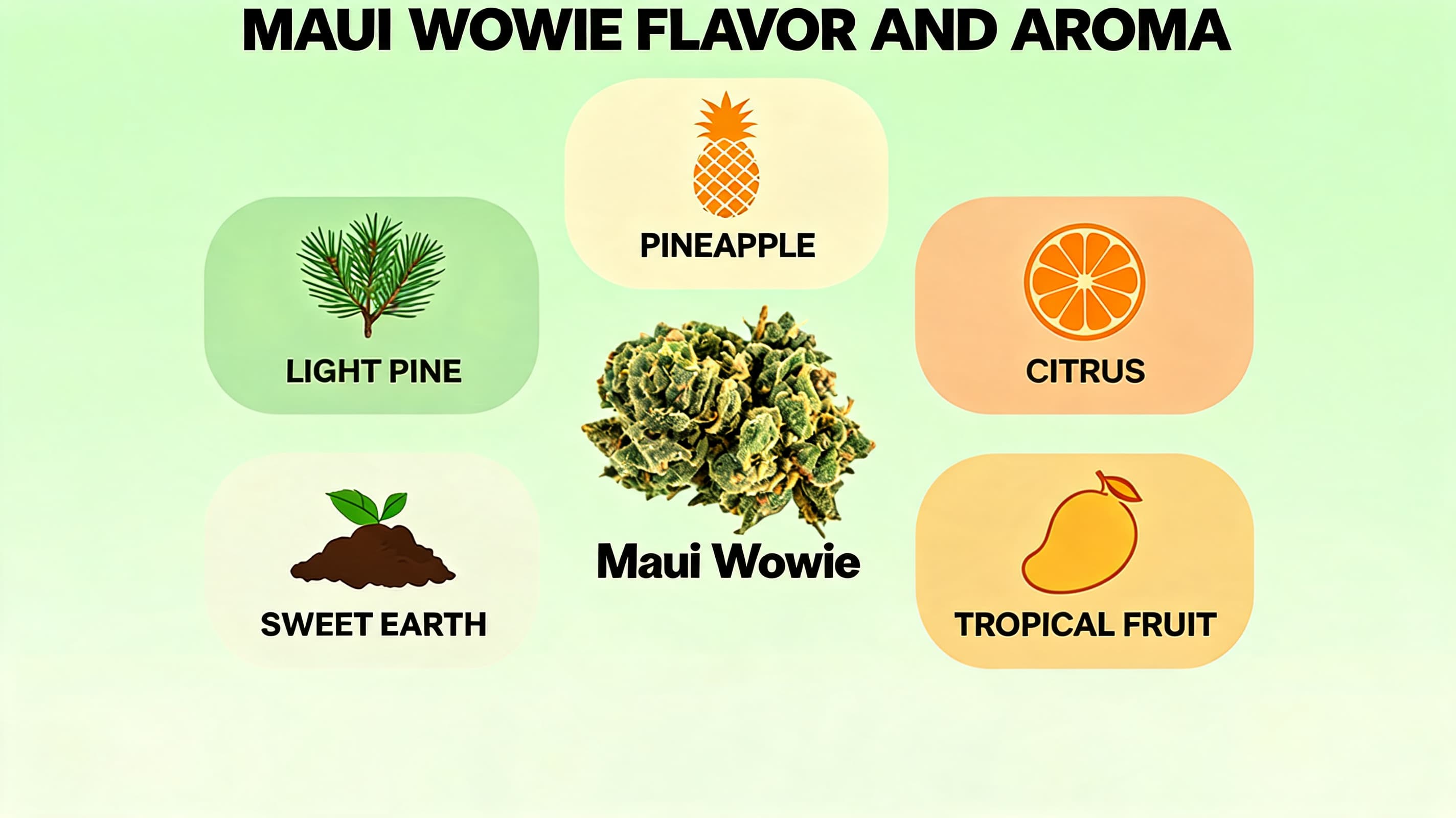
The flavor is one of Maui Wowie’s most consistent calling cards. Most batches lead with pineapple and citrus, with some adding a mild pine or herbal finish.
The smoke is generally described as bright and clean rather than heavy. Think tropical fruit forward with a soft earthy close, not the dank, fuel-heavy profile of OG or Diesel genetics. Some batches bring a sweeter, almost mango-adjacent note depending on how myrcene expresses in that particular grow.
The aroma follows the same pattern: sweet, fruity, earthy, and lightly pine-like when the flower is fresh. If you open a jar and it smells flat, hay-like, or muted, the flower is likely over-dried, poorly cured, or old. Good Maui Wowie should smell like ripe tropical fruit with a green herbal base. That aroma quality is a real purchase signal at the dispensary.
Visually, Maui Wowie buds tend to be light green and airy rather than the dense, tightly packed nuggets you see from heavier indica lines. Expect orange pistils, visible trichome coverage, and a slightly fluffy, elongated sativa structure. Properly trimmed, fresh flower should look resinous and bright, not brown, brittle, or compressed.
Genetics, Lineage, and Terpenes
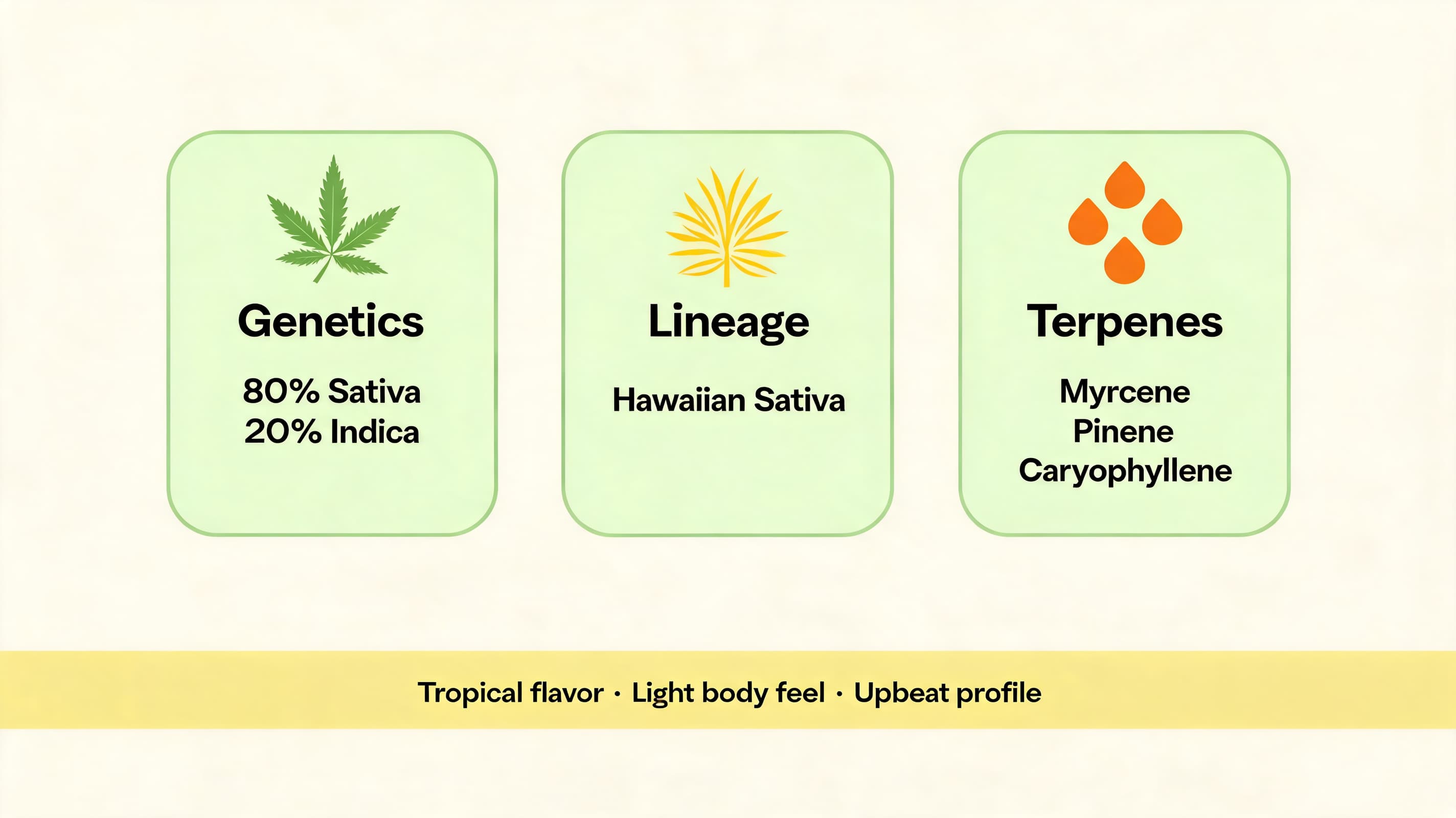
Maui Wowie’s genetics trace back to Hawaiian sativa landrace stock. The second parent is undocumented, which is common for strains that predate modern seed banking.
The documented Hawaiian side explains the plant’s tendency to grow tall, the tropical terpene expression, and the lighter, more cerebral effect profile compared to indica-heavy hybrids.
Three terpenes dominate most analyzed batches, and understanding them is more useful than the strain name alone when you are reading a dispensary label. For a broader look at how terpenes shape effects across different cultivars, the guide on fruity daytime strains covers the full terpene-to-effect map worth reading alongside this one.
| Terpene | Aroma and Flavor Note | Common Influence |
| Myrcene | Sweet, herbal, earthy | Users report a calm body feel alongside the soft tropical fruit notes |
| Pinene | Fresh pine, crisp herbal | Commonly described as contributing a cleaner, lighter head feel |
| Caryophyllene | Peppery, spicy, warm | Users commonly note added depth to the flavor and a mild soothing physical quality |
Two batches of Maui Wowie from different growers can feel noticeably different if the terpene ratios shift. A myrcene-heavy batch will feel softer and more relaxing. A pinene-dominant expression tends to feel crisper and more alert. This is why checking the terpene section of a lab report, not just the THC number, is worth the 30 seconds it takes at the counter.
What Users Commonly Report
| Advisory: The following reflects what users commonly report and does not constitute medical advice. Cannabis affects individuals differently based on tolerance, dose, and individual biology. Consult a qualified healthcare professional before using cannabis for any health-related purpose. |

Users consistently describe the mental experience as bright and upbeat. The mood lift tends to come on faster than with indica-dominant strains, and users frequently report heightened sociability, more free-flowing creative thinking, and a clear-headed alertness rather than cognitive fog. Reviewers on AllBud describe the experience as energizing without feeling edgy, with music and outdoor settings cited as common contexts where it performs well.
On the physical side, users report a lighter body feel with mild ease rather than any real heaviness or sedation. This is consistent with the sativa-dominant profile. The experience is generally described as functional, meaning most users report staying active and mentally present rather than couch-locked.
Side effects are the standard THC-related profile: dry mouth and dry eyes are the most common reports. At higher-THC batches, some users describe racing thoughts, mild anxiety, or a stimulation that feels like too much if they are sensitive to sativa-style highs or took more than they intended. If this strain has caused anxiety for you in the past, a lower-THC batch or fewer puffs is the right adjustment before abandoning it entirely. The section below on cannabis for focus covers how to manage dosage for stimulating strains more broadly.
Maui Wowie Dosage Guide
| User Type | Suggested Starting Dose | Method | What to Expect |
| First-time user | 1 to 2 puffs | Flower or vape | Light mood lift, mild head effect, possible dry mouth |
| Occasional user | 2 to 3 puffs | Flower or vape | Clearer uplift, social feel, stronger daytime energy |
| Regular user | 3 to 5 puffs or more | Flower, vape, or concentrate | Stronger head high, sharper effects, possible overstimulation at high doses |
| Edible or tincture user | 2.5 mg to 5 mg THC | Oral | Slower onset, longer-lasting effects, stronger body response |
Start low, check THC strength on the label first, and wait before adding more. Edibles in particular have a delayed onset that catches a lot of people out. The strain name alone does not tell you the potency of that specific product.
Growing the Maui Wowie Strain
Maui Wowie is a moderate-difficulty grow. It performs best in warm, sunny conditions that approximate its Hawaiian origin environment, which means good airflow, controlled humidity, and plenty of light. Outdoor growing in tropical or Mediterranean climates is where the plant naturally thrives, but indoor grows are workable if you manage height early.
Indoors, the plant can reach around 6 feet and produce approximately 14 ounces per square meter under strong care. Outdoors, it can push past 10 feet with yields near 16 ounces per plant. Flowering time runs 9 to 11 weeks, with outdoor harvest typically falling around late October. The tall, stretchy sativa growth pattern means early training is not optional for indoor setups. Low-stress training (LST) or topping early in veg will save you space and improve light penetration across the canopy.
| Note: Maui Wowie can grow tall indoors and very tall outdoors. Plan your space before the plant outgrows it. Always check local cannabis cultivation laws before planting. |
How Maui Wowie Compares to Similar Strains
Maui Wowie shares the fruity-sativa space with several well-known cultivars. The differences are in the specific flavor expression, the type of head effect, and where each sits on the potency scale. The comparison below helps clarify those differences without leaning on generic descriptions.
| Strain | Type | THC Range | Flavor | Best For |
| Maui Wowie | Sativa-dominant (80/20) | 16% to 28% | Pineapple, citrus, tropical fruit, pine | Daytime use, mood lift, social and outdoor settings |
| Pineapple Express | Sativa-dominant hybrid (60/40) | 17% to 24% | Pineapple, cedar, fresh mango | Daytime energy; slightly more grounded body feel |
| Green Crack | Sativa-dominant hybrid | 15% to 25% | Citrus, mango, earthy | Sharp energy and focus; faster onset than Maui Wowie |
| Super Lemon Haze | Sativa-dominant hybrid | 16% to 25% | Lemon, citrus, sweet | Energy and uplifting sessions; more zesty, less tropical |
| Tangie | Sativa | 19% to 22% | Tangerine, tropical | Daytime creativity; narrower citrus profile vs Maui Wowie’s broader tropical range |
| Mimosa | Sativa-dominant hybrid | 19% to 27% | Citrus, orange, berry | Creativity and focus; slightly more balanced body-head effect |
The main thing that separates Maui Wowie from most of these is the breadth of the tropical flavor profile and the heritage lineage. Pineapple Express is the closest comparison, but users typically describe Maui Wowie as lighter and less physically grounding. Green Crack is sharper and more stimulating. If you want the tropical flavor without the intensity of a pure sativa, Maui Wowie in the 20–22% range is where I would start.
Where to Find Maui Wowie
Maui Wowie is widely available in legal US cannabis markets, though availability varies by state and changes seasonally as growers rotate their catalogue. It shows up regularly as flower, pre-rolls, and vape cartridges. Live resin and concentrate formats do exist but are less common than for newer premium strains.
What to check on the label before buying: THC percentage with a batch-specific COA, visible trichome coverage if you can see the flower, and that pineapple-forward aroma if the dispensary allows jar opens. Light green, airy bud structure is the visual tell for this strain. If the bud looks dark brown, compressed, or smells like hay, it has been poorly stored or over-dried. The Leafly strain database maintains a current list of dispensaries carrying Maui Wowie by region if you need a starting point for local availability.
| Note: Cannabis laws vary by state and municipality. Purchase only from licensed, legal dispensaries where applicable. Possession and use laws differ significantly across US states. |
Should You Try Maui Wowie?
If you are looking for a daytime strain with tropical flavor, an upbeat head effect, and a lighter body feel, Maui Wowie is a well-documented choice that has held its reputation for over 50 years. Users who enjoy it most tend to reach for it during creative sessions, outdoor activities, social settings, or morning to early-afternoon windows when they want to stay functional. The pineapple and citrus profile also makes it one of the more approachable strains for people who find earthy or fuel-heavy flavors off-putting.
It is not the right choice if you are new to cannabis and looking for something gentle, because THC levels in the 24–28% range can feel intense. Start at the lower end of the potency spectrum, check the lab data, and give yourself time between doses before deciding whether to add more.
Frequently Asked Questions
What does Maui Wowie mean?
Maui refers to the Hawaiian island where this strain was originally grown in volcanic soil during the 1960s and 1970s. Wowie is an old-school slang exclamation of amazement, reflecting the reaction users reportedly had when they encountered cannabis this flavorful and potent compared to what was available on the mainland at the time. The name spread organically through surfer culture and is also written as Maui Waui and Mowie Wowie, all referring to the same strain family.
Is Maui Wowie indica or sativa?
Maui Wowie is sativa-dominant. The most commonly cited ratio is 80% sativa and 20% indica, though this varies by grower and phenotype. In practice, users describe a lighter body effect, an upbeat and social head high, and a profile suited to daytime rather than evening use. The 20% indica component tends to show as mild body ease rather than sedation.
How long do the effects of Maui Wowie last?
Users report effects lasting around two to four hours when smoking or vaping, depending on tolerance, the THC percentage of that specific batch, and how much was consumed. Edibles last significantly longer because THC is processed through digestion rather than absorption through the lungs. Avoid redosing edibles out of impatience; the delayed onset is not a sign it has not worked.
What is the difference between Maui Wowie, Maui Waui, and Mowie Wowie?
There is no meaningful difference. All three names are phonetic variations of the same strain name that circulated as the strain spread beyond Hawaii in the 1970s. You will see all three used interchangeably on dispensary menus. If you see a significant quality or potency difference between two products using different spellings, that is a reflection of different growers, not a different strain.
Why does Maui Wowie feel different from batch to batch?
Growing method, harvest timing, curing quality, THC percentage, and terpene ratios all shape the final experience, even when two products carry the same name. A myrcene-heavy batch will feel softer and more relaxing. A pinene-dominant expression tends to feel crisper and more alert. Storage and product age also matter. Always check the terpene breakdown on the COA when it is available, not just the THC number.
Is flower or vape better for experiencing Maui Wowie’s flavor?
Flower generally preserves more of the full terpene complexity because it is not processed through the extraction steps that vape distillates go through. Live resin cartridges come closer to the flower experience because they retain more of the original terpene profile. Standard distillate vapes can still taste fruity and clean but tend to flatten the range of tropical and herbal nuance that makes fresh Maui Wowie flower distinctive.
Can Maui Wowie cause anxiety?
It can, particularly at higher-THC batches or in users who are sensitive to sativa-style stimulation. Users who report anxiety typically describe it as racing thoughts or a sense of overstimulation rather than a heavy, sedating discomfort. Starting with 1 to 2 puffs, waiting to assess the effect before taking more, and choosing a batch in the 20–22% range rather than the higher end are the most effective ways to reduce this risk.
Sources
Leafly. “Maui Wowie.” Leafly Strain Database. Accessed May 2026. leafly.com. DR 85. Used for strain classification, terpene profile data, and heritage documentation.
AllBud. “Maui Waui Marijuana Strain Information and Reviews.” AllBud. Accessed May 2026. allbud.com. DR 77. Used for aggregated user experience reports cited in the effects section.