
| ⚠️ Warning: If you or someone you know is struggling with substance dependency, free, confidential support is available 24/7 through SAMHSA’s National Helpline at 1-800-662-4357. Call 911 immediately if someone is experiencing chest pain, seizures, loss of consciousness, or stopped breathing. |
Quick Glance: Whitney Houston’s Death
| Date of Death | February 11, 2012 |
| Location | Beverly Hilton Hotel, Beverly Hills, CA |
| Official Cause of Death | Accidental drowning |
| Contributing Factors | Atherosclerotic heart disease, chronic cocaine use |
| Substances Found in Toxicology | Cocaine, marijuana, Xanax, Flexeril, Benadryl |
| Age at Death | 48 years |
| Rehab Stints | 2004, 2005, 2011 |
The table above tells you the facts in seconds. What it cannot tell you is how a woman with one of the most extraordinary voices in music history ended up in that bathtub. That part takes longer to understand, and it is worth understanding.
If you grew up listening to Whitney Houston, you know the kind of voice that stops you mid-task and just holds you there. She was not just a singer. She was a once-in-a-generation force.
And behind that voice was a decades-long battle with Whitney Houston’s drug addiction that the world watched unfold in real time, often without knowing what it was actually looking at.
This post does not aim to reduce her to her struggles. It aims to understand them, honestly, and without judgment.
Before the Addiction: Who Whitney Houston Really Was
Whitney Houston was born in Newark, New Jersey, in 1963, into a family practically built for music. Her mother, Cissy Houston, was a gospel legend. Her cousins were Dionne and Dee Dee Warwick. Her godmother was Aretha Franklin.
Music was not just part of her upbringing. It was her entire world. Her debut album in 1985 launched her into superstardom almost immediately. Between 1985 and 1992, her first four albums sold more than 86 million copies worldwide.
Her cover of Dolly Parton’s “I Will Always Love You” spent fourteen consecutive weeks at number one. She was America’s sweetheart, pristine, powerful, and seemingly untouchable. What made her story so devastating was the contrast.
The same voice that made entire arenas go silent would eventually become a casualty of the very industry that built her. Fame celebrated her loudly, then quietly broke her.
| 📝 Note: Whitney’s rise happened during one of the most competitive eras in pop music history. The industry pressure to perform flawlessly, every single time, was relentless. That context matters when understanding how her addiction developed. |
Whitney Houston Drug Addiction: How It Really Started
The popular narrative blames Bobby Brown for Whitney’s drug use. The reality is more complicated and far more human. According to Brown himself, he first witnessed Whitney using drugs on their wedding day in 1992.
In interviews, he stated clearly that she was the more experienced user when they got together. A 2018 documentary surfaced claims that Whitney had experienced bullying and sexual assault as a child.
Unaddressed trauma, as addiction specialists consistently point out, often becomes a quiet trigger for substance use years later. The 1980s music industry was, by most accounts, a cocaine-saturated environment.
Its initial effects, confidence, energy, and a sense of invincibility, are particularly seductive for performers who live and die by their audience’s reaction. For someone already carrying Whitney’s emotional weight, that pull made a painful kind of sense.
| ⚠️ Advisory: Childhood trauma significantly raises the risk of developing substance use disorders in adulthood. This is a recognized clinical pattern, not a character judgment. Anyone carrying unaddressed trauma should speak with a mental health professional rather than waiting for a crisis. |
What Drugs Did Whitney Houston Do?
Whitney Houston’s drug use encompassed a range of substances over more than two decades. Understanding the full picture matters, because this was not a single substance story. It was a pattern of escalating polysubstance use that compounded physical and cardiovascular damage over time.
- Cocaine was the primary substance confirmed throughout her life and in her toxicology report. She admitted to regular cocaine use in her 2009 Oprah interview, and cocaine metabolites were identified by the coroner as a causal factor in her death.
- Marijuana laced with cocaine (“basing”) was described by Whitney as her drug of choice during the marriage years. In her own words on Oprah: “We were lacing our marijuana with base.” This is freebase cocaine smoked through cannabis, not crack pipe cocaine.
- Alcohol was found at the scene of her death, and cocaethylene present in her liver confirmed she had used cocaine and alcohol together. Cocaethylene is a toxic byproduct formed when both substances are metabolized simultaneously, and it places measurably more strain on the heart than cocaine alone.
- Xanax (alprazolam), Flexeril (cyclobenzaprine), and Benadryl (diphenhydramine) were found in her toxicology report as contributing but not causal substances.
The coroner was clear: cocaine was the drug most directly tied to her death, alongside her existing heart disease and drowning.
Every other substance in her system reflected the pattern of a person managing the highs, the crashes, and the anxiety that chronic cocaine use creates.
Whitney Houston Before and After Drugs: The Physical Toll
The physical changes in Whitney Houston between 1985 and 2010 are some of the most documented signs of long-term cocaine use in public life.
Her story is not meant as a cautionary display, but understanding what cocaine physically does over two decades matters for anyone trying to recognize the same pattern in someone they love.
In the 1980s and early 1990s, Whitney was known for her presence as much as her voice: full-cheeked, physically strong, radiantly composed.
By the late 1990s, photographs and television appearances showed a noticeably thinner frame, hollow features, and visible signs of fatigue that no amount of stage lighting concealed.
- Weight loss from chronic cocaine use is not incidental. The drug is a potent appetite suppressant. Users often go hours or days eating very little, and the physical depletion accumulates over years of use.
- Skin and facial changes reflect the cardiovascular strain of vasoconstriction, chronic dehydration, and interrupted sleep cycles that cocaine use produces. These show up in photographs long before most people in a user’s life are willing to name them.
- Vocal decline was the most public indicator. Cocaine causes vasoconstriction in the nasal passages and throat, destroys mucosal membranes, and triggers chronic inflammation throughout the vocal tract. For a singer, this is the equivalent of sandpapering a precision instrument from the inside. By the early 2000s, Whitney’s upper register was largely gone. A voice that once required no effort was now something she had to fight for on stage.
- Behavioral changes including missed appearances, erratic scheduling, and the canceled 1999 Newark arena show fifteen minutes before curtain, reflected the neurological and motivational disruption that chronic cocaine use creates in the brain’s reward system.
These signs are not unique to celebrity addiction. They appear in the same pattern in every person living with long-term cocaine dependency, whether they are on a stage or not.
For more on what chronic cocaine use looks like from a harm-reduction standpoint, this breakdown of cocaine dependence patterns covers what the drug does to the brain and body over time, and why stopping becomes harder the longer use continues.
Life During Addiction: What the Public Actually Saw
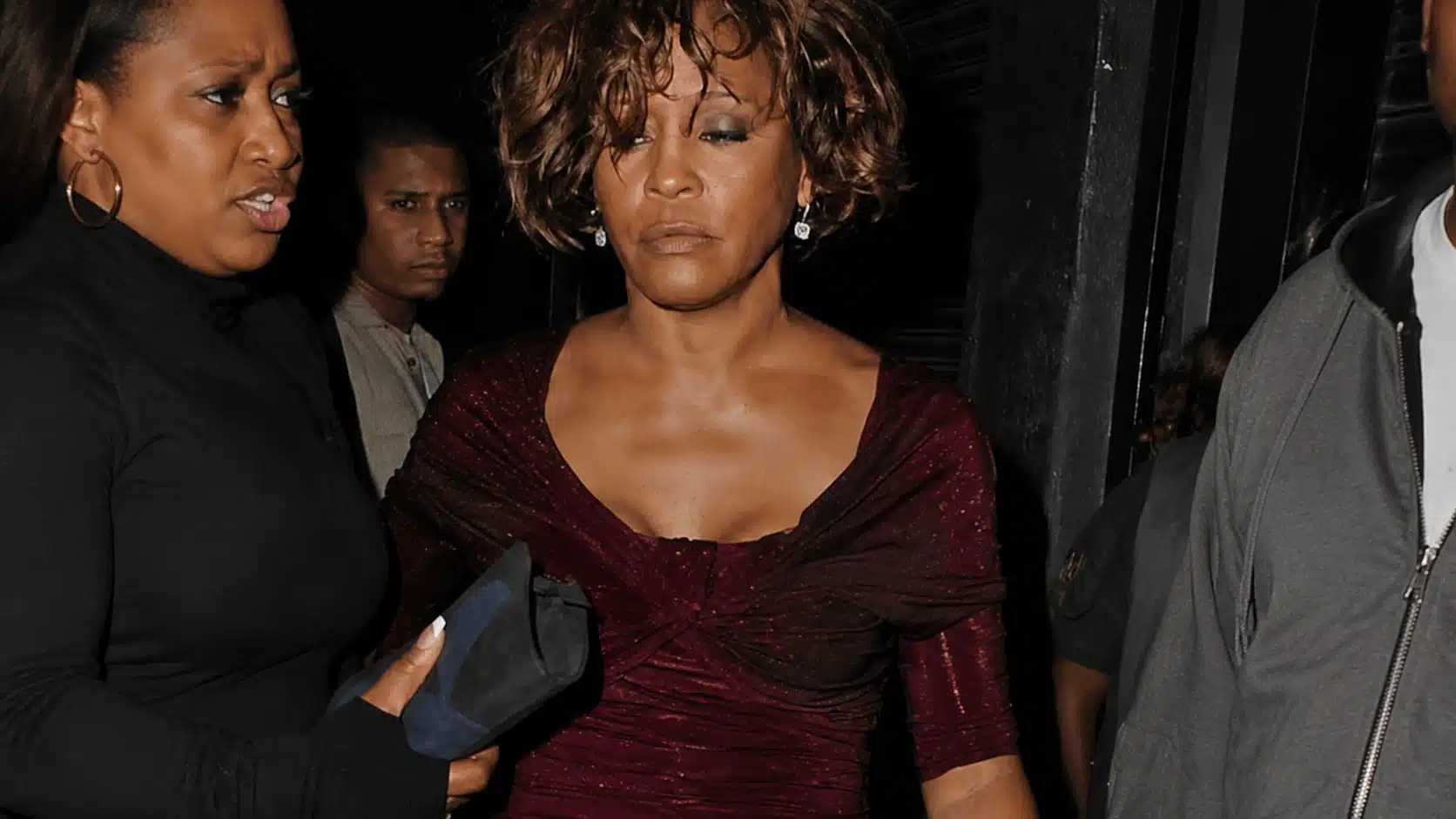
Whitney’s addiction did not stay hidden for long. The signs showed up in her voice, her body, her cancellations, and eventually on national television for everyone to see.
1. The Physical and Vocal Decline
Whitney’s voice was the most visible sign that something had gone seriously wrong. Cocaine use had already begun destroying the instrument she had built her entire career on.
- Chronic cocaine use damages the nasal passages, throat lining, and respiratory system over time, steadily stripping a singer’s ability to hit the notes that once came effortlessly.
- Visible physical decline was apparent by the late 1990s, with Whitney arriving late to commitments, losing significant weight, and becoming increasingly unreliable on professional schedules.
- Oscar ceremony firing happened in 2000 when she was reportedly let go from a planned appearance after a poor rehearsal performance, a public signal that her addiction was affecting her work directly.
- 1999 tour cancellations included five shows, among them a sold-out Newark arena event that she pulled out of just fifteen minutes before the curtain was supposed to rise.
In her 2002 Diane Sawyer interview, Whitney admitted to cocaine, marijuana, pills, and alcohol, denied crack use with “crack is whack,” and insisted she had no desire to self-destruct.
According to FHE Health’s clinical breakdown of Houston’s addiction history, that statement makes her decline all the more heartbreaking, because the addiction was doing exactly what she said she never wanted to do to herself.
2. The Bobby Brown Dynamic
Their 14-year marriage was never simply a love story gone wrong. It was two people caught in overlapping addictions, each making the other’s recovery measurably harder.
- Bobby Brown’s own admission confirmed that cocaine “became a problem in our marriage. After a while, we just lost our mind,” directly contradicting the media’s one-sided villain narrative aimed at him.
- Co-using relationships create a documented feedback loop where both partners normalize each other’s use, making individual sobriety feel like a betrayal rather than a step toward health.
- Media blame fell almost entirely on Brown, but Whitney had been using before they married. His 2017 memoir stated he first witnessed her using drugs on their actual wedding day in 1992.
- Bobbi Kristina Brown, born in 1993, grew up in this environment. The consequences of that exposure would surface years later in deeply tragic and well-documented ways.
Shared substance use does not just affect the couple involved. It shapes every life inside that household, often long after the relationship itself has ended.
The codependency cycle that forms between two people who use together is one of the most documented barriers to individual recovery in clinical addiction research.
3. The Public Spectacle
By 2005, the private chaos had become public entertainment. “Being Bobby Brown” on Bravo gave millions a front-row seat to what addiction actually looks like inside a household, and it was not flattering.
- Being Bobby Brown aired in 2005 and drew strong ratings despite heavy criticism, exposing uncomfortable moments from the couple’s daily life that no publicist could have approved.
- The show was canceled after one season, when Whitney declined to participate further, a decision that suggested some awareness that the exposure had gone far enough.
- Album sales had dropped sharply by this point. The chart-topping artist of the 1980s and 1990s was no longer a reliable commercial force in the music industry.
- Public image collapse was complete. The pristine “America’s sweetheart” persona Whitney had carefully maintained for years now belonged entirely to the tabloids, not to her.
Attempts at Recovery: Three Tries, Three Falls
Whitney entered rehabilitation for the first time in March 2004, but left after just five days. She returned in 2005. Her divorce from Bobby Brown was finalized in April 2007, and for a period, a fresh start seemed possible.
In August 2009, she released “I Look to You,” her first studio album in seven years. It debuted at number one on the Billboard 200, selling 305,000 copies in its first week.
In a 2009 Oprah interview, she declared herself clean, described Bobby Brown as “her drug,” and revealed that marijuana laced with cocaine had been their substance of choice.
But recovery is not a declaration. It is a daily discipline. By 2010, her world tour was already struggling. Dates were canceled. Fans noticed her voice had faded. In May 2011, she entered her third rehabilitation attempt. Less than a year later, she was gone.
| 📝 Note: Relapse is a recognized part of the recovery process for many people. The National Institute on Drug Abuse reports that 40 to 60 percent of people in recovery experience at least one relapse. What matters is continued access to honest support and professional treatment, not the absence of setbacks. |
How Whitney Houston Died: The Facts From February 2012
The final days of Whitney Houston’s life unfolded over just 48 hours at a Beverly Hills hotel, ending in a way that shocked the world but surprised very few who had followed her closely.
| Arrival at Hotel | February 9, 2012, Beverly Hilton Hotel, ahead of Clive Davis’s annual pre-Grammy gala |
| Found Unresponsive | February 11, 2012, submerged in the bathtub of her suite and discovered by her bodyguard |
| Official Cause of Death | Accidental drowning, ruled by the Los Angeles County Coroner |
| Contributing Factors | Atherosclerotic heart disease and chronic cocaine use |
| Substances in Toxicology Report | Cocaine metabolites (causal), plus marijuana, Xanax, Flexeril, and Benadryl (present, not causal) |
| Arterial Occlusion | Approximately 60 percent, confirmed by the coroner’s office |
| Cocaethylene Finding | Found in her liver, a substance the body produces when cocaine and alcohol are metabolized together |
| Scene in Hotel Room | Drug paraphernalia, open beers, and an open bottle of champagne were found inside the room |
According to CBS News’s coverage of the autopsy findings, Dr. Michael Fishbein of UCLA compared cocaine’s effect on the heart to cutting a power cord. With 60 percent arterial occlusion already in place, her heart had very little margin left.
| 📝 Note: Cocaine constricts blood vessels, raises blood pressure, and disrupts heart rhythm. For chronic users with pre-existing heart disease, cumulative cardiovascular damage is often irreversible. Speak with a doctor if you or someone you know is using cocaine regularly, even if they feel physically fine. |
When to Seek Emergency Care
⚠️ Emergency Warning Signs: Call 911 Immediately If You See:
Cocaine-related cardiac events can occur suddenly, even in people who have used the drug many times before without incident. Do not wait and see. Call 911. |
What Cocaine Did to Whitney’s Voice
Whitney’s vocal decline was not vague. It was measurable and documented. Cocaine causes vasoconstriction, narrowing of blood vessels, and restriction of circulation.
It also damages mucosal membranes in the nasal passages and causes chronic inflammation throughout the throat. For a vocalist, that is the equivalent of destroying a precision instrument from the inside.
By the early 2000s, her upper register was largely gone. Yet her last studio album, “I Look to You,” debuted at number one in 2009.
Her final acting role was in “Sparkle,” released in August 2012. Her last recorded song, Celebrate, came out in May 2012, three months after her death. Addiction never made her stop working.
Whitney’s Daughter: The Addiction’s Longest Shadow
The most painful part of Whitney’s story is what happened to Bobbi Kristina Brown. Whitney’s only child, raised in a household where both parents were actively using, began showing signs of substance use as she got older.
On January 31, 2015, just three years after her mother’s death, Bobbi Kristina was found unresponsive in a bathtub under circumstances almost identical to how Whitney died. She was 22 years old.
She never regained consciousness and passed away six months later. Generational addiction is not a moral failure. It is a documented clinical reality. Children raised around active substance use face a significantly elevated risk of developing addiction themselves.
That risk grows further when grief, trauma, and loss arrive before the brain is fully developed. The environment shapes outcomes far more than most people realize. Understanding how substance use patterns transmit across households is a critical piece of why early, honest family conversations about drugs matter so much.
For broader context on the substances involved in Whitney and Bobbi Kristina’s stories, this guide covers what crack cocaine looks and smells like, written specifically to help people identify use in someone close to them.
| 📝 Note: Growing up around a parent with a substance use disorder raises your own risk significantly. Talking to a counselor early, before any problem appears, helps. SAMHSA’s helpline (1-800-662-4357) connects callers with family support services, not just individual treatment. |
The Broader Pattern: Fame and Substance Use
Whitney’s story was not unique in the music industry. The conditions that feed addiction inside entertainment are well documented, and the statistics behind them are harder to dismiss than most people expect.
- SAMHSA data shows 13.7 percent of arts and entertainment workers reported past-month illicit drug use, compared to 8.6 percent across all other surveyed professions.
- Extreme stress from performing at the highest level, managing a public image, and meeting industry expectations creates conditions that are genuinely difficult to sustain without real support.
- Irregular schedules and social environments where drug use is normalized make it far easier to start using and far harder to recognize when use has become a problem.
- Childhood trauma, when left unaddressed, compounds every other risk factor. For Whitney, that trauma arrived early and was never properly treated before fame took over.
- Co-using relationships like Whitney and Bobby Brown’s create a shared cycle of dependence that makes individual recovery feel nearly impossible while both partners remain in contact.
As covered in ABC News’s medical analysis of how cocaine contributed to Houston’s heart disease, the cardiac damage that cocaine causes is not something the body quietly recovers from. Every gram adds to a running total that the heart eventually cannot absorb.
Whitney’s story sits within a much wider pattern of drug terminology, slang, and industry normalization that many people encounter without recognizing the danger. This guide on drug slang terms helps decode the language used around substances so you can recognize what you are actually looking at.
Frequently Asked Questions
What drugs did Whitney Houston do?
Whitney Houston’s drug use centered on cocaine throughout most of her adult life, confirmed in multiple interviews and in her official toxicology report.
She also used marijuana, often laced with cocaine freebase, a method she described on Oprah in 2009. Xanax, Flexeril, and Benadryl were found in her system at the time of her death, along with alcohol.
The coroner identified cocaine as the primary contributing substance, alongside pre-existing heart disease, in her accidental drowning on February 11, 2012.
What was Whitney Houston’s drug of choice?
Whitney described her drug of choice in her own words during the 2009 Oprah interview: marijuana laced with cocaine freebase.
This method, sometimes called basing, involves smoking cannabis that has been soaked in or mixed with freebase cocaine.
It is chemically distinct from crack cocaine, which is a different preparation of the same base substance. According to Whitney, this was the primary pattern of use during her marriage to Bobby Brown.
Did Whitney Houston smoke crack?
Whitney denied crack cocaine use directly during her 2002 Diane Sawyer interview, saying the phrase “crack is whack” in response to questions about her weight loss. Her denial was specific to crack pipe use.
However, freebase cocaine, the substance she admitted using in marijuana, is chemically similar to crack in that both are freebase forms of cocaine. The distinction matters pharmacologically, but both carry the same addiction and cardiac risks as powder cocaine.
The coroner’s toxicology report confirmed cocaine metabolites in her system, consistent with cocaine use in any form.
Are the Whitneys Still Rich?
Whitney Houston’s estate was reportedly worth around $20 million at the time of her death. After legal costs and debts, Bobbi Kristina inherited what remained. Following Bobbi Kristina’s death in 2015, the estate passed to Whitney’s siblings.
How Did Whitney Get So Thin?
Chronic cocaine use suppresses appetite significantly, often causing severe weight loss over time. By the late 1990s, Whitney’s physical decline was visible to the public. Poor nutrition, irregular sleep, and sustained drug use all contributed directly to her deteriorating appearance.
Who Was Whitney Houston’s Female Lover?
Whitney’s close friend and assistant, Robyn Crawford, has spoken publicly about their romantic relationship during the early years of Whitney’s career. Crawford detailed this in her 2019 memoir, describing a deep emotional and physical bond that ended before Whitney’s marriage to Bobby Brown.
How Much Did Whitney Weigh When She Died?
Whitney Houston’s exact weight at the time of her death was not publicly disclosed in official coroner reports. However, those close to her noted she had lost significant weight in her final years due to prolonged substance use and poor overall health.
Why Was Whitney Houston in Debt When She Died?
Years of declining album sales, canceled tours, legal fees, and the high cost of sustaining an addiction left Whitney financially drained. Despite earning hundreds of millions throughout her career, poor financial management and mounting personal expenses left her estate with significant outstanding debts.
What Did Kevin Costner Say When Whitney Died?
Kevin Costner delivered a deeply personal eulogy at Whitney’s funeral, recalling their bond during filming of “The Bodyguard.” He told mourners she was “just Whitney” to him, celebrated her humanity over her fame, and ended by saying she had made it safely to the other side.
Final Verdict
Whitney Houston’s drug addiction was not a character flaw, and it was not a simple story of bad choices made by a careless person. It was a disease shaped by childhood trauma, the specific pressure of extreme fame, a co-using marriage, and an industry that was not built to protect the people who made it rich.
What the cocaethylene in her liver and the 60 percent arterial occlusion in her heart actually show is that addiction is a physical illness with physical consequences that accumulate whether or not anyone is paying attention.
If someone in your life is showing signs of substance use, or if you are that person, the time to reach out for help is before the damage becomes irreversible. Her voice is still here. The lesson she left behind is worth more than the tragedy.
If you have anything to share about this tragic incident, drop it in the comments below.
| Disclaimer: This article is for informational purposes only and does not constitute medical advice. If you or someone you know is struggling with substance use, call SAMHSA’s National Helpline at 1-800-662-4357. Free, confidential, 24/7. |
Sources
- FHE Health: How Did Whitney Houston Die? Her Struggle With Drugs. FHE Health. Last reviewed March 16, 2026.
- CBS News: Whitney Houston’s Autopsy: How Can Drowning, Cocaine, and Heart Disease All Be Blamed? CBS News. Published March 22, 2012.
- ABC News: Whitney Houston Cause of Death: How Cocaine Contributes to Heart Disease. ABC News. Published March 23, 2012.
- Whitney Houston: 2009 Oprah Winfrey Interview. Oprah Winfrey Network. Published 2009.
- Whitney Houston: Celebrate (Official Music Video). Sony Music Entertainment. Released May 2012.
- FunWithDizzies: 8 Ball Drug Meaning: What It Is and Why It’s Risky. FunWithDizzies. Published 2026.