|
If you are in crisis right now Call 911 immediately if: someone is threatening to harm themselves or others, is unconscious, is experiencing a severe psychiatric emergency, or is going through alcohol or benzodiazepine withdrawal with seizures, fever, or confusion. SAMHSA National Helpline: 1-800-662-4357 — Free, confidential, available 24/7 in English and Spanish. No insurance required. Connects you directly to local treatment resources. 988 Suicide & Crisis Lifeline: Call or text 988 — For any mental health crisis, around the clock. Crisis Text Line: Text HOME to 741741 |
Quick Glance: Kandela Recovery Center
| Location | 1401 NW 9th Ave, Boca Raton, FL 33486 |
| Facility Size | 10,431 sq ft, up to 32 patients |
| Program Type | Inpatient Residential Mental Health |
| Accreditations | Joint Commission, DCF (Florida), LegitScript Certified |
| Conditions Treated | Depression, Bipolar, OCD, Anxiety, BPD, Schizophrenia, PTSD, Dual Diagnosis |
| Therapies Used | CBT, DBT, ACT, Art Therapy, Chiropractic, Yoga, Meditation, Nutritional Therapy |
| Program Length | 7 days minimum; typically 14 to 45 days based on clinical need |
| Insurance | Most private plans accepted; free verification before commitment |
| Admissions Line | (888) 874-2038, open 24/7 |
| Network | Part of Flyland Recovery Network |
Finding the right inpatient mental health treatment feels overwhelming when you are already running on empty.
I’ve spent years in peer support and recovery writing, and the question I hear most often isn’t about symptoms — it’s “how do I know if this place is actually legitimate?” That’s exactly why I put this together.
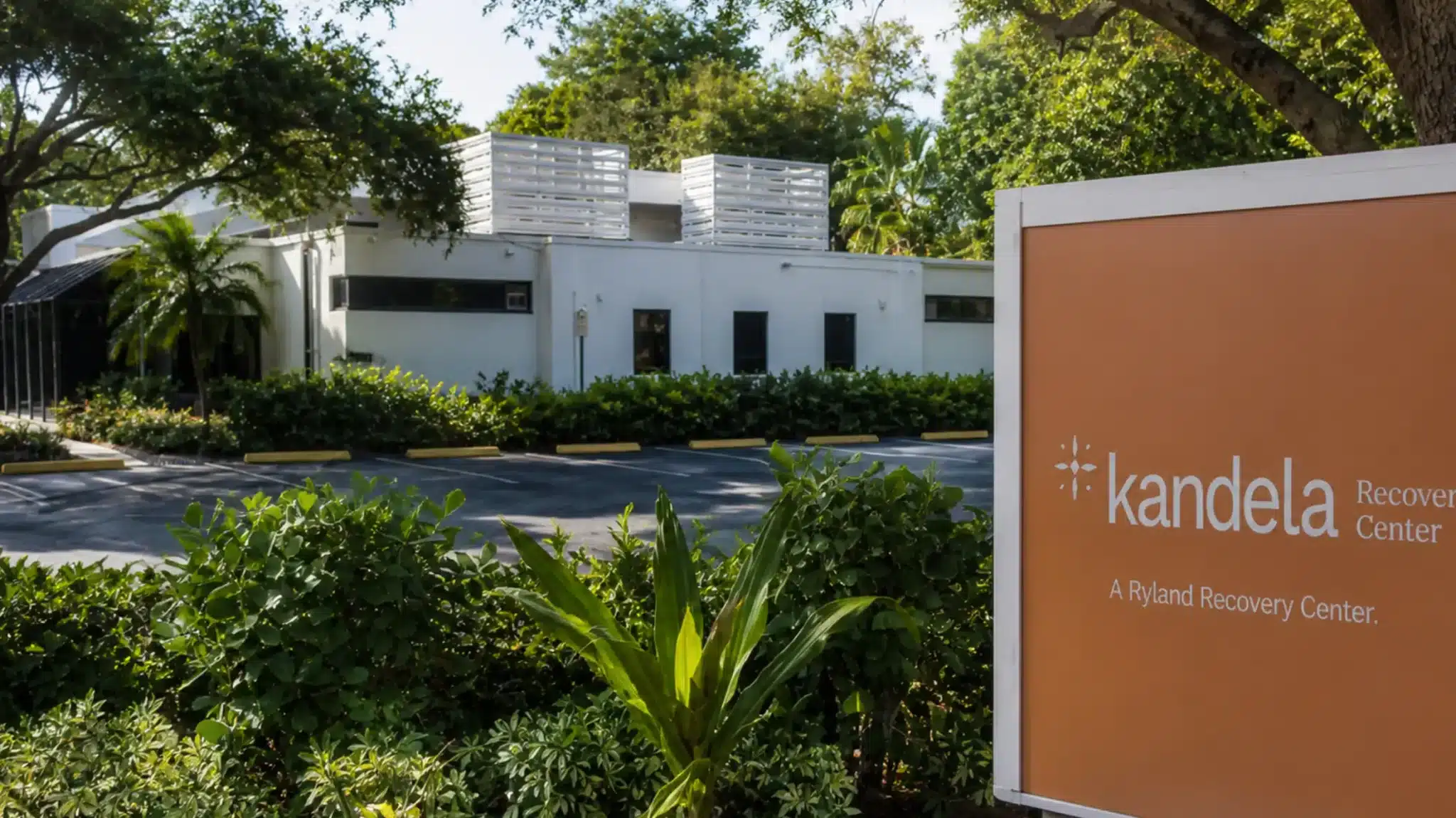
Kandela Recovery Center is a Joint Commission-accredited residential mental health facility in Boca Raton, Florida. If you’re weighing it as an option for yourself or someone you love, you deserve a straight answer about what it offers, what real patients say, and what questions to ask before you call.
Here’s everything worth knowing.
What Is Kandela Recovery Center?
Kandela Recovery Center is a Joint Commission-accredited residential mental health and inpatient rehab facility in Boca Raton, Florida, built for adults whose psychiatric conditions have not responded to outpatient care. It operates as part of the Flyland Recovery Network, a group of treatment facilities sharing a common clinical framework across the United States.
The 10,431-square-foot facility accommodates up to 32 patients at a time. That limited census is intentional: fewer patients means stronger staff-to-patient ratios, more individualized attention, and a clinical environment that feels nothing like a hospital ward.
Kandela holds dual accreditation from the Joint Commission and the Florida Department of Children and Families (DCF), plus LegitScript certification.
Joint Commission status is earned through an independent review of safety and care standards and must be maintained through ongoing evaluations — it is not granted automatically.
For people whose mental health challenges also involve alcohol use, it’s worth understanding what happens physiologically when someone stops drinking abruptly, because that context directly affects whether a medically supervised detox setting is the right starting point rather than attempting withdrawal at home.
| Note: Joint Commission accreditation is one of the strongest trust signals a treatment center can have. Facilities that lack it or rely only on state licensing deserve closer scrutiny before enrollment. |
Who Is Kandela Recovery Center For?
Kandela focuses on adults 18 and older dealing with serious psychiatric conditions — not mild situational stress, but clinical mental health disorders that are significantly disrupting daily life. If you or someone you care about has been cycling in and out of crisis despite outpatient support, that’s usually a signal the level of care needs to increase, not that the person is untreatable.
Conditions treated at Kandela include major depressive disorder, bipolar I and II, anxiety disorders and panic attacks, obsessive-compulsive disorder (OCD), borderline personality disorder (BPD), schizophrenia, PTSD and trauma-related disorders, mood disorders, and dual diagnosis — a mental health condition combined with a substance use disorder.
Clinical guidelines are clear: inpatient residential treatment is recommended when someone is experiencing extreme functional impairment, risk to their own safety, severe self-neglect, or co-occurring disorders that make outpatient management genuinely difficult. Residential care is not a last resort — it’s the appropriate level of care for the right clinical presentation.
| Caution: Never attempt to stop heavy alcohol or benzodiazepine use without medical supervision. Withdrawal from these substances can progress to life-threatening seizures. A supervised medical detox setting exists specifically for this reason. If you are currently dependent on alcohol or benzodiazepines, call (888) 874-2038 or 911 before attempting any reduction on your own. |
What Programs Does Kandela Recovery Center Offer?
Kandela Recovery Center runs a structured, multi-level program built around one goal: giving each patient the clinical support they need, at the right intensity, from day one through long-term recovery.
1. Medical Detox and Clinical Stabilization
Patients arriving in active withdrawal or acute psychiatric crisis begin with clinical stabilization before any therapeutic work starts. This includes a full medical and psychiatric assessment, 24/7 monitoring, and medication support where indicated.
The clinical team at Kandela integrates opioid dependence history and withdrawal timelines directly into the intake assessment, ensuring each person is medically stable before the residential program begins.
2. Residential Inpatient Program
The residential program is the core of Kandela’s care model. Patients follow a structured daily schedule that includes individual therapy, daily group sessions, gender-specific groups, psychoeducational groups, and family involvement components.
Private rooms come with personal bathrooms and meals prepared from scratch by an in-house chef. Program duration typically runs 14 to 45 days, determined by the clinical team based on each patient’s progress.
3. Evidence-Based Therapies
Kandela’s clinical team uses cognitive behavioral therapy (CBT), dialectical behavior therapy (DBT), and acceptance and commitment therapy (ACT) alongside traditional formats.
CBT targets unhelpful thought patterns, DBT builds distress tolerance for conditions like BPD, and ACT supports treatment-resistant anxiety and depression.
Adjunct supports including chiropractic care, auriculotherapy, and nutritional therapy address the physical dimensions of chronic stress and psychiatric conditions.
4. Healing Arts Program
Kandela’s healing arts program includes yoga, Reiki, art therapy, sound healing, guided meditation, and drum circles.
These modalities lower the barrier to engagement for patients who feel guarded in traditional talk therapy, supporting the broader clinical work without replacing it. All healing arts sessions are included in the residential program at no additional charge.
5. Psychoeducational Groups and Alumni Support
Structured psychoeducational groups teach emotional regulation, self-awareness, and relapse prevention skills that patients carry into daily life after discharge.
The alumni program, run through the Flyland Recovery Network, keeps former patients connected through ongoing online and in-person events, extending community support well beyond the residential stay.
What Therapies Are Used at Kandela Recovery Center?
Kandela’s clinical team goes beyond standard talk therapy, combining evidence-based psychological modalities with holistic and body-based supports to address the full picture of each patient’s condition.
| Therapy | What It Addresses | Format |
|---|---|---|
| Cognitive Behavioral Therapy (CBT) | Depression, anxiety, OCD, PTSD | Individual sessions |
| Dialectical Behavior Therapy (DBT) | BPD, emotional dysregulation, self-harm history | Individual and group |
| Acceptance and Commitment Therapy (ACT) | Chronic anxiety, treatment-resistant depression | Individual sessions |
| Art Therapy | Trauma processing, low verbal engagement | Group and individual |
| Yoga and Meditation | Nervous system regulation, anxiety, sleep | Group sessions |
| Nutritional Therapy | Whole-person recovery, medication support | Psychoeducation + meals |
| Chiropractic / Auriculotherapy | Physical components of chronic stress | Individual sessions |
| 12-Step Meetings | Dual diagnosis, addiction recovery | Group, as applicable |
| Gender-Specific Groups | Trauma, abuse history, identity-specific concerns | Group sessions |
Not every facility offers this range. When calling for intake, ask which modalities are actively scheduled during your expected stay, since availability can vary by program census and clinical staffing at any given time.
| Tip: When you call for intake, ask specifically about DBT availability for your condition. Not all residential programs run full DBT skills training — knowing whether Kandela offers it in the group format or only as individual techniques helps you assess fit before admission. |
A Day at Kandela Recovery Center
Understanding what daily life looks like inside a residential facility helps set realistic expectations before admission. At Kandela, the day is structured to balance clinical intensity with recovery-appropriate downtime — which is itself therapeutic, not filler.
Mornings typically begin with breakfast prepared by the in-house chef, followed by a community check-in and an individual therapy session or clinical assessment appointment.
Mid-morning and early afternoon are built around group therapy blocks: a psychoeducational session, a skills group such as DBT or relapse prevention, and sometimes a gender-specific group. Healing arts programming — yoga, guided meditation, art therapy, or sound healing — is woven into the weekly schedule rather than treated as optional add-ons.
Afternoons may include chiropractic appointments, auriculotherapy, or nutritional therapy sessions alongside free time for reflection, journaling, or recreational activities like Cornhole, Bingo, or board games.
Evenings at Kandela are intentionally communal: the clinical team encourages patients to come together for dinner, then transition into low-stimulation wind-down time. For dual diagnosis patients, evening 12-step meetings are part of the schedule where clinically appropriate.
The structure isn’t rigid to the point of being institutional. It’s consistent enough to regulate a nervous system that’s been in survival mode, while leaving room for the kind of spontaneous connection that often does more for recovery than any single session.
Does Inpatient Mental Health Treatment Actually Work?
This is the question most people don’t say out loud but are almost always thinking when they’re evaluating a residential center. The short answer: yes, when the level of care matches the person’s actual clinical need.
Research from the National Center for Biotechnology Information found that long-term residential treatment for people with persistent mental illness leads to measurable improvements in symptom recovery, independent living, employment, and reduced hospitalizations — and these outcomes held up over time, not just immediately following discharge.
That said, residential treatment works best as the beginning of a longer continuum. It’s a period of stabilization, skill-building, and clinical assessment, not a standalone cure. Expecting one residential stay to permanently resolve a serious mental health condition sets patients up for disappointment. Expecting it to create a foundation for ongoing recovery is realistic and evidence-supported.
| Note: If a treatment center promises permanent recovery after one stay, that’s a red flag. Reputable facilities like Kandela frame success as long-term management, skill development, and relapse prevention — not a one-time fix. |
How to Get Admitted to Kandela Recovery Center
The admission process is designed to remove friction for people in a difficult moment. Kandela’s team is available 24 hours a day, seven days a week. Some staff members are in recovery themselves, which changes the tone of that first call in a way that matters when you’re already overwhelmed.
The process works in five steps.
- First, you or a family member calls (888) 874-2038 — staff asks preliminary questions to understand the situation and connect you with the right level of care.
- Second, the admissions team checks your insurance coverage at no cost before any commitment is made.
- Third, a structured psychiatric and medical evaluation confirms Kandela is clinically appropriate for the person’s specific needs.
- Fourth, on arrival, a staff member escorts you to your room and introduces you to the community and facility when you’re ready.
- Fifth, Kandela arranges travel logistics for getting there, which matters more than it sounds when someone is in a fragile or distressed state.
Most people find the first call easier than expected. If you’re uncertain whether Kandela is the right fit, that conversation will help clarify it. The admissions team is there to answer questions, not pressure decisions, and getting information costs nothing.
Kandela Recovery Center Reviews: What Patients Say
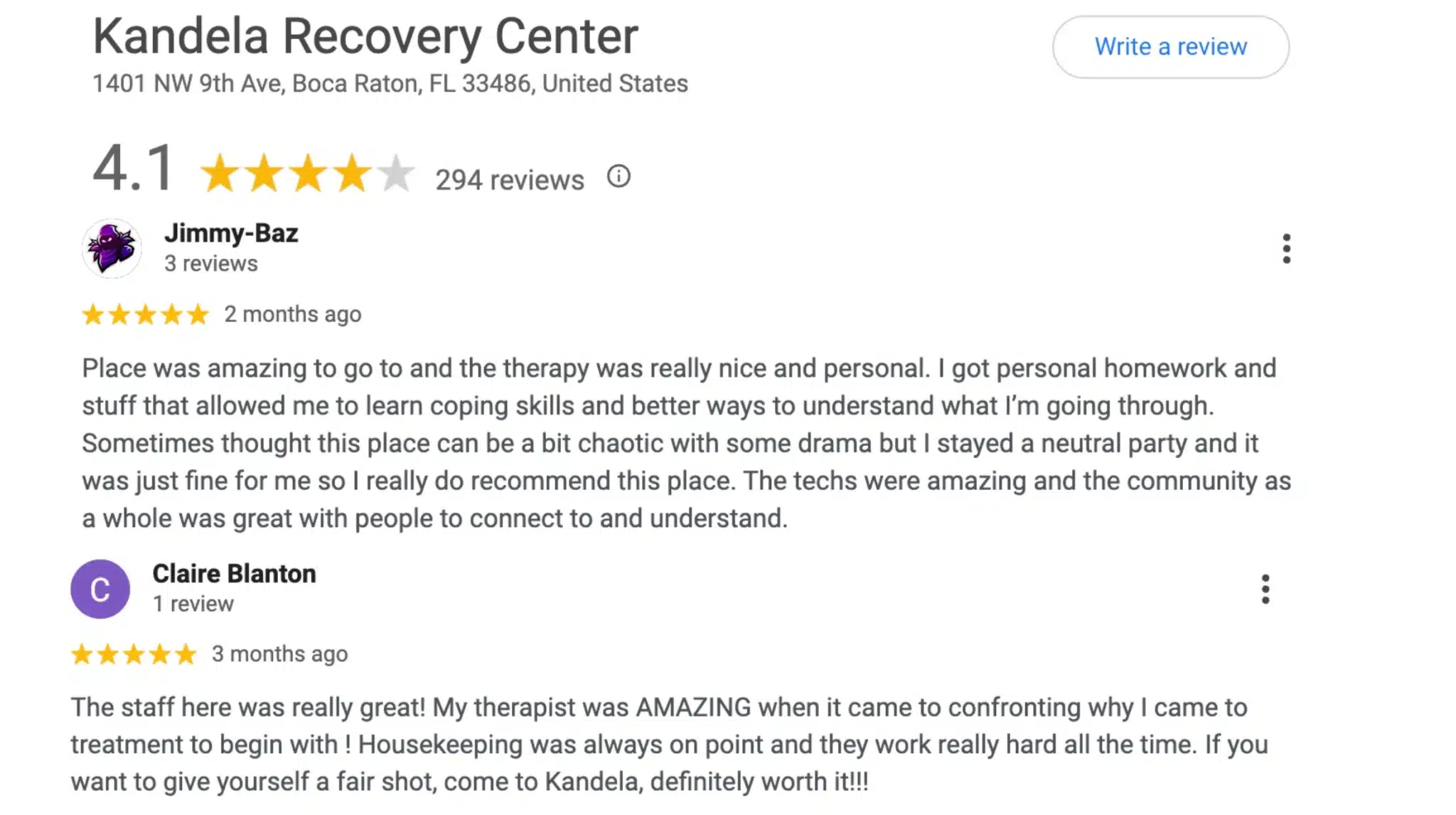
Kandela Recovery Center reviews on Google average 4.1 stars across nearly 300 verified submissions. Reading through them gives you a realistic picture before you call. Positive reviews consistently mention staff warmth, individualized therapy approaches, and food quality by name.
One verified patient put it plainly: “If you want to give yourself a fair shot, come to Kandela, definitely worth it.” Case managers Linda and Christina are named repeatedly across unrelated reviews, which points to consistent performance rather than isolated good days. Other patients have credited the healing arts programming — specifically art therapy and guided meditation — with helping them engage when traditional talk therapy felt inaccessible early in their stay.
Critical Kandela Recovery Center reviews raise concerns about vaping enforcement inconsistency, billing transparency, and discharge planning feeling rushed for some patients. These are worth addressing directly during your intake call before you commit to anything. Ask specifically: what does the discharge planning process look like, and who manages it?
You can verify Kandela’s credentials, accepted insurance, and therapy approaches on their independently verified listing on Psychology Today before making any decisions.
What to Bring to Kandela Recovery Center
Packing the right things prevents delays at intake. Based on Kandela’s published admissions guidance, bring comfortable clothing appropriate for the program duration, personal hygiene items, a current list of all medications with dosages plus the medications themselves in original pharmacy packaging, a government-issued photo ID, your insurance card, cash or a credit card for incidentals, a journal or notebook, and books or other low-screen personal items for downtime.
Staff will go through all personal belongings on arrival and hold anything that may interfere with the treatment process. Those items are returned at discharge. Do not bring undisclosed substances or items not on the intake list — this complicates the intake process and can delay the start of treatment.
| When to Seek Emergency Care Instead of a Treatment Center: Call 911 or go to your nearest emergency room immediately if the person you’re concerned about is actively suicidal with a plan and means to carry it out, is experiencing a first-episode psychotic break, is unconscious or unresponsive, is having seizures related to alcohol or benzodiazepine withdrawal, or is a danger to others. Residential programs like Kandela are appropriate for psychiatric stabilization — acute medical emergencies require emergency medical services first. |
Cost and Insurance at Kandela Recovery Center
Kandela accepts most major private insurance plans and offers a free verification process before admission. Multiple payment options are available, making access straightforward regardless of financial situation.
| Category | Details |
| Insurance | Most major private insurance plans accepted |
| Verification | Free insurance check before any commitment |
| Credit Cards | Visa, Mastercard, American Express, Discover |
| Digital Payments | PayPal, Venmo, Zelle |
| Bank/Cash | ACH transfer, wire transfer, cash, check |
| Other Accounts | HSA accounts accepted |
| Self-Pay | Available; typically funded through personal savings, loans, or family support |
When you call, ask for a full breakdown of what your plan covers across each service category. Knowing the numbers before admission removes one of the most common sources of stress after discharge.
| Tip: When calling to verify insurance, ask specifically whether your plan covers residential psychiatric care separately from detox services. These are often billed under different benefit categories — your coverage level for each may differ significantly, and knowing the breakdown upfront prevents unexpected billing after discharge. |
Other Residential Treatment Centers Worth Knowing
Kandela may be the right fit, or another program may align better with a specific clinical need, location, or insurance situation. These are established facilities with documented clinical programs: Hazelden Betty Ford Foundation, one of the most recognized names in addiction and co-occurring disorder treatment, with multiple locations and a long clinical track record; McLean Hospital, a Harvard Medical School-affiliated psychiatric hospital in Massachusetts offering inpatient, residential, and outpatient programs; Sierra Tucson, a residential center in Arizona focused on addiction, trauma, mood disorders, and chronic pain; The Meadows, a residential facility in Wickenburg, Arizona with a long-standing focus on trauma and co-occurring psychiatric conditions; and Sheppard Pratt, a psychiatric health system based in Maryland consistently ranked among the top facilities in the country.
No single facility is the right fit for every person. The most useful step is identifying which clinical needs matter most, then asking each program directly how they address them before making any decision.
| Note: The SAMHSA National Helpline charges nothing and requires no insurance. If you’re not sure where to start, this number is one of the most accessible first steps available. The counselors can help you figure out what level of care makes sense before you ever call a facility directly. |
Final Verdict
Kandela Recovery Center is a legitimate, well-structured facility for adults who need more than weekly therapy sessions. The accreditation is real. The programs — from CBT and DBT to healing arts and alumni support — are specific and clinically grounded. The patient feedback is honest, including the parts that aren’t perfect.
If you’re considering Kandela for yourself or someone you love, the best first move is a simple call. The admissions team is available at any hour, insurance verification is free, and you’re not committing to anything by asking questions. If you’re not at that point yet, the helpline section above is a place to start that doesn’t require any commitment at all.
Frequently Asked Questions
What conditions does Kandela Recovery Center treat?
Kandela treats adults 18 and older with major depressive disorder, bipolar I and II, anxiety disorders, OCD, BPD, schizophrenia, PTSD, and dual diagnosis cases involving co-occurring substance use disorders. The clinical team conducts a full psychiatric intake assessment to confirm the facility is an appropriate match before admission begins.
How long is the program at Kandela Recovery Center?
The minimum stay is seven days, though most patients remain significantly longer. The clinical team determines duration during the intake assessment, with stays of 14 to 45 days being most common. Program length is driven by clinical progress rather than a fixed calendar.
What do Kandela Recovery Center reviews say about the experience?
Kandela Recovery Center reviews on Google average 4.1 stars across nearly 300 submissions. Recurring themes in positive reviews include staff warmth, individualized therapy, and food quality. Critical reviews raise concerns about billing transparency and discharge planning, which are worth asking about directly during your admissions call.
Where is Kandela Recovery Center located?
Kandela Recovery Center is located in Boca Raton, Florida, at 1401 NW 9th Ave, Boca Raton, FL 33486. It operates as part of the Flyland Recovery Network, which has additional facilities across the United States under different names.
What therapies does Kandela offer?
Kandela uses CBT, DBT, ACT, art therapy, yoga, guided meditation, and nutritional therapy, alongside individual sessions, group therapy, and healing arts programming including sound healing and drum circles. All healing arts sessions are included at no additional cost.
Is Kandela Recovery Center accredited?
Yes. Kandela holds Joint Commission accreditation, Florida DCF licensure, and LegitScript certification. Joint Commission status requires independent review and ongoing evaluation — one of the strongest credentialing signals in American mental healthcare.
Does Kandela Recovery Center accept insurance?
Kandela accepts most major private insurance plans and offers a free insurance verification process before any commitment is made. Multiple self-pay options are also available including HSA accounts, digital payments, and bank transfers. When calling to verify, ask separately about coverage for residential psychiatric care and detox services, as these are often billed under different benefit categories.
Sources
- Kandela Recovery Center. Official Website. https://kandelarecovery.com/
- Psychology Today (2025). “Kandela Recovery Center: Verified Treatment Center Listing, Boca Raton, FL.” Psychology Today Treatment Finder. https://www.psychologytoday.com/us/treatment-rehab/kandela-recovery-center-boca-raton-fl/1103766
- Maya Thompson for FunWithDizzies.com (2025). “Cold Turkey Alcohol: Risks, Symptoms, and Safer Options.” https://funwithdizzies.com/cold-turkey-alcohol-risks-symptoms-and-safer-options/
- Maya Thompson for FunWithDizzies.com (2025). “Suboxone Withdrawal: Symptoms and Safe Ways to Stop.” https://funwithdizzies.com/suboxone-withdrawal-symptoms-and-safe-ways-to-stop/
- Substance Abuse and Mental Health Services Administration (2024). “National Survey on Drug Use and Health.” SAMHSA. https://www.samhsa.gov/data/
- Hazelden Betty Ford Foundation. Official Website. https://www.hazeldenbettyford.org
- McLean Hospital. Official Website. https://www.mcleanhospital.org
- Sierra Tucson. Official Website. https://www.sierratucson.com
- The Meadows. Official Website. https://www.themeadows.com
- Sheppard Pratt. Official Website. https://www.sheppardpratt.org