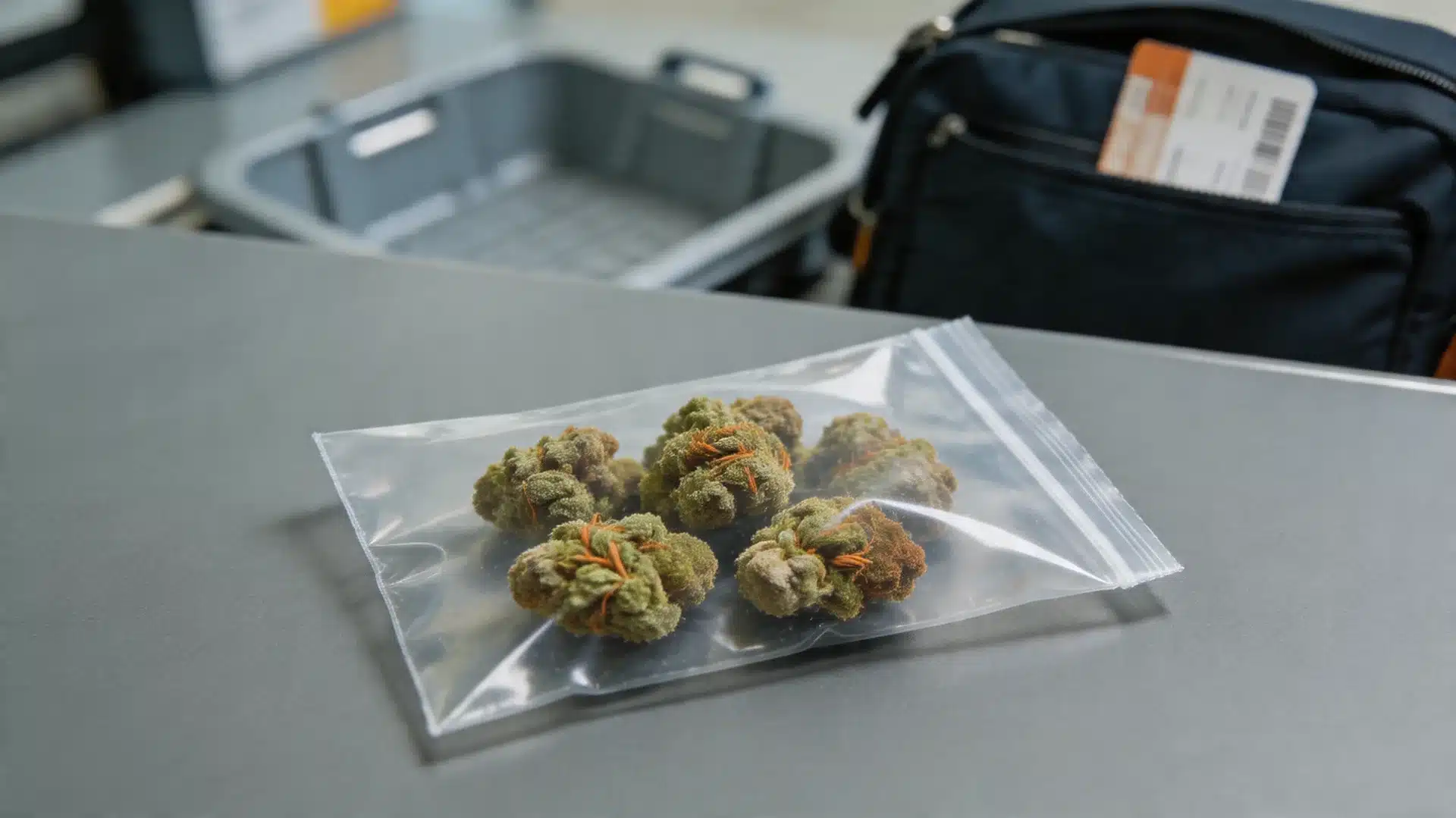
Quick Glance: Flying With Marijuana
| Scenario | Legal Under Federal Law? | Risk Level | Likely Outcome If Found |
| Flower/bud, legal state airport | No | Medium | Disposal or referral to local police; rarely arrest |
| Flower/bud, prohibition state airport | No | High | Referral to police; possible arrest or citation |
| Edibles, legal state airport | No (unless hemp, under 0.3% THC) | Medium | Confiscation or disposal; officer discretion |
| Vape pen or cartridge | No (if THC-derived) | Medium to high | Referral to local law enforcement |
| Medical marijuana, valid card | No, the card provides no federal protection | Medium | Same as recreational; TSA follows federal law |
| Between two legal states | No, interstate transport is federally illegal | Medium | Varies by airport and responding officer |
| International flight | No, absolute prohibition | Very high | Customs referral; potential criminal prosecution |
If you have ever stood at a security checkpoint, suddenly remembered the joint in your jacket pocket, and felt your heart drop somewhere around floor level, you are not alone. Cannabis is legal for recreational use in more than half of US states, and that number keeps climbing.
It is easy to forget that the rules change the moment you walk into an airport. The question “can you fly with marijuana?” sounds simple. The answer is not. Federal law says no. TSA policy says they are not looking. Local law says it depends on where you land. And the interaction between all three is where most of the confusion and most of the risk actually live. This covers what you need to know before you pack anything.
Can You Fly With Marijuana: What This Question Is Really Asking
Can you fly with marijuana? It is one of those questions that looks like a single question but is actually three.
The first is legal: federal law says no. Marijuana is a Schedule I controlled substance, and airports operate under federal jurisdiction regardless of which state you are in. The second is practical: will TSA catch you, and what happens if they do? TSA’s job is threat detection, not drug enforcement, and outcomes vary widely depending on where you are flying.
The third is about form: does it matter whether you are carrying flower, an edible, a vape, or a concentrate? Yes. Each carries a different detection risk and a different legal consequence. Most people asking this question are actually asking all three at once.
The Marijuana Policy Project’s analysis confirms that while TSA’s enforcement posture has shifted toward security threats rather than drug detection, the underlying legal framework has not changed. Marijuana remains federally illegal regardless of state legalization, and TSA officers are required to report any discovery to law enforcement. Most people asking “can you fly with marijuana” are really asking all three questions at once, and getting the answer to one while assuming it covers the rest is where most travel-related cannabis problems start.
Why Federal Law Overrides Your State: Every Time
The single most important fact about flying with marijuana is that airports are federal territory. The TSA checkpoint, the airspace, and the aircraft all fall under federal jurisdiction regardless of which state the airport sits in.
Traveling from California to New York, two fully legal states, changes nothing. The moment you enter a TSA screening area, federal law applies, and federal law classifies marijuana as a Schedule I controlled substance with no accepted medical use. Crossing state lines with marijuana is a federal offense, regardless of the airport. Even driving between two legal states is technically federal drug trafficking. Flying makes it unambiguous: you are in federal airspace, operated by a federal agency. Your state-issued receipt, medical card, or recreational possession right means nothing past the security line.
The federal penalty for interstate marijuana transport is significant. A first offense conviction for drug trafficking carries a minimum of five years in federal prison and a fine of up to $250,000. State-level lenience does not touch federal sentencing.
| 📝 Note: The rescheduling process moving marijuana from Schedule I to Schedule III is ongoing following President Trump’s December 2025 executive order. However, rescheduling has not been finalized as of April 2026 and does not change current TSA rules, airport enforcement, or federal travel law. Flying with marijuana remains federally illegal under existing law. |
What TSA Actually Does: By Product Type
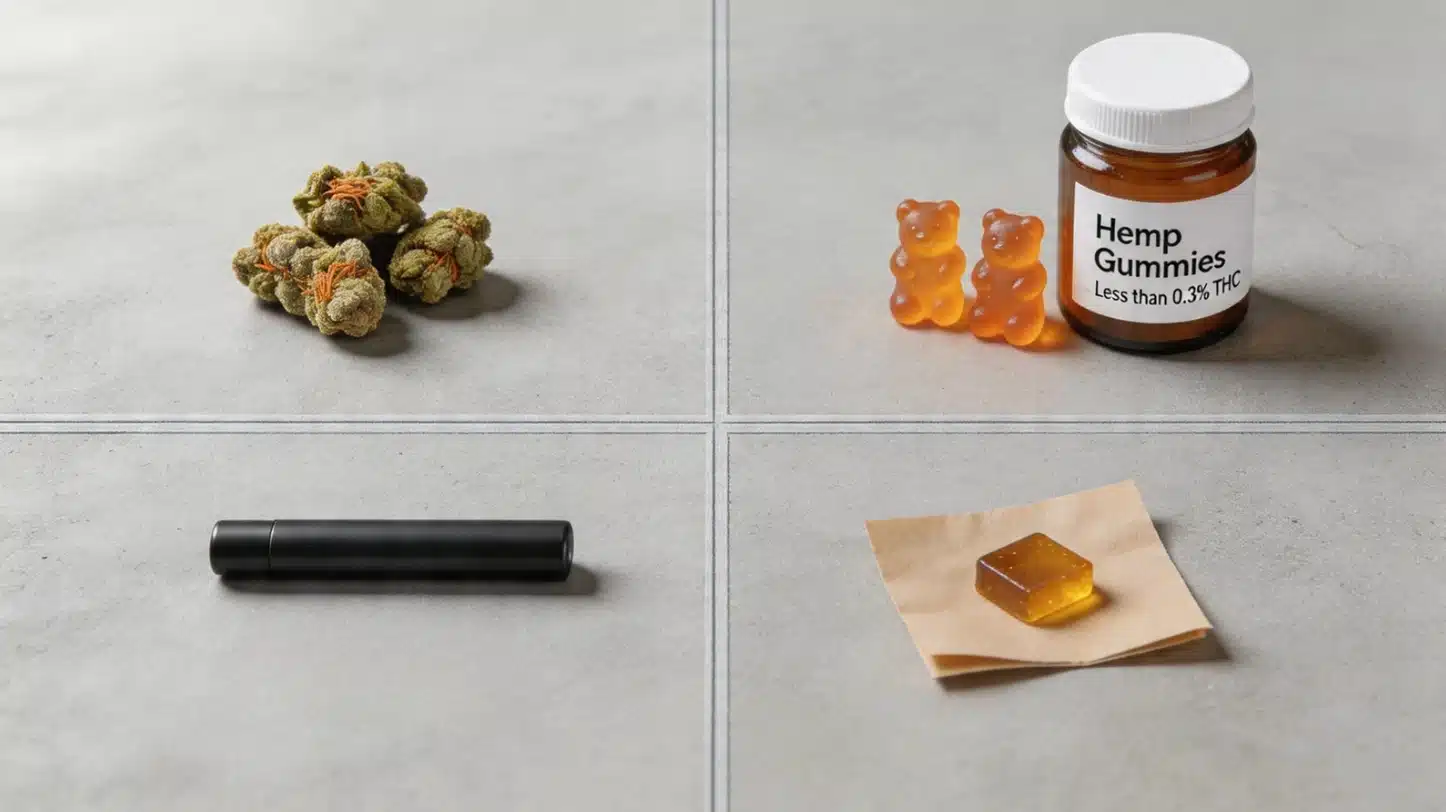
TSA’s screening mission is to detect threats to aviation security, not enforce drug law. That distinction shapes how different cannabis products are handled at the checkpoint, and the risk profile varies significantly depending on what you are carrying.
1. Flower
Cannabis flower is the most detectable product at any checkpoint. Its dense organic structure appears clearly on X-ray, and the smell draws attention if a bag is opened for any reason. TSA agents easily identify it on sight. Most checkpoint discoveries involve flowers.
Detection risk is high, and there is no room for ambiguity about what it is. Note that many legal-state airports no longer train dogs to alert on marijuana, which reduces one detection risk, but visual X-ray screening remains the primary exposure.
2. Edibles
Edibles, gummies, chocolates, and baked goods are far harder to flag on X-ray. TSA agents cannot identify cannabis visually in unlabelled food. Routine screening rarely catches them. Risk rises sharply if a bag is searched for another reason and products carry clear cannabis labeling. The breakdown of TSA rules and legal risk for THC gummies covers the product-specific legal distinctions thoroughly, including what COA documentation can and cannot do for you at a checkpoint.
3. Vape Pens
THC cartridges are federally illegal regardless of form. Lithium batteries are banned from checked luggage due to fire risk, forcing vape pens into carry-on bags, directly through the checkpoint. This increases detection exposure significantly. For a full breakdown of pen hardware types and how they interact with travel rules, the guide to weed pen types covers the key distinctions. Most standard cartridges fall under the liquid limit, but the requirement to carry them through screening is the more pressing concern for anyone thinking through the risk.
4. Concentrates
Concentrates, wax, shatter, and oil carry the highest legal exposure of any product type. In states like Texas, they are classified as controlled substance extracts, with penalties far exceeding those for the flower. A small amount that draws a warning in California could mean felony charges at a Texas airport. Form shapes legal consequences, not just detection risk. Concentrates represent the worst outcome on both counts.
As Green Rush News’s detailed breakdown of what TSA actually does when they find cannabis confirms, TSA states its screening is not designed to detect marijuana, but the mandatory reporting obligation applies the moment anything is found during routine screening. “Not looking for it” and “required to report it if found” are two separate policies. The legal risk lives entirely in that gap.
What Happens When TSA Finds It
The TSA’s official policy on marijuana makes the process clear: TSA does not search for cannabis, but when any cannabis product is discovered during routine security screening, officers are required to refer the matter to local law enforcement. What happens after that referral depends entirely on the airport location and local jurisdiction, not on TSA policy.
| Outcome | When It Happens | Who Decides |
| No action taken | Small personal amount; legal state airport; officer uses discretion | TSA officer or local police |
| Asked to dispose | Legal state airport; personal amount; officer confirms it is cannabis | Local airport police |
| Confiscation without charges | Product seized; passenger allowed to continue; matter closed | Local law enforcement |
| Referral and delay | Officer is uncertain or the quantity is larger, the bag is held pending review | TSA refers; police decide |
| Citation or fine | Prohibition state; personal amount; civil penalty applies locally | Local law enforcement |
| Arrest and charges | Prohibition state; larger quantity; concentrates or commercial amount | Local law enforcement |
The outcome is never predictable in advance. The same amount of the same product can result in disposal at one airport and criminal charges at another, depending entirely on which law enforcement jurisdiction responds. The only consistent variable is that the TSA referral itself is mandatory and non-negotiable. What the responding officers choose to do is where the variation lies.
| ⚠️ Advisory: Prohibition states represent genuine legal exposure even for small personal amounts. Texas classifies possession of less than two ounces as a Class B misdemeanor, carrying up to 180 days in jail. Concentrates are treated as extracts under Texas law and carry felony-level charges. Knowing your destination’s enforcement posture before packing is not optional. It is the most important risk factor you can actually control. |
What To Do If TSA Flags You
Being stopped at a checkpoint with cannabis is not automatically the end of your travel day, but how you handle the next few minutes matters. The responding officer has significant discretion, and your behavior shapes what they do with it.
Stay calm and say as little as necessary. You are not required to explain how you obtained the product, where you purchased it, or what you intended to do with it. Anything you volunteer can become part of a law enforcement report. If local police are called, you have the right to remain silent and the right to ask for an attorney before answering questions.
Do not attempt to grab the product or leave the checkpoint area without permission. Both actions escalate a potentially low-consequence encounter into a much more serious one.
If you are at a legal-state airport and the amount is within state possession limits, cooperating calmly with disposal or confiscation typically ends the encounter there. If you are at a prohibition-state airport, treat it as a law enforcement interaction from the start: polite, minimal, and with counsel in mind.
Medical Marijuana and Why Your Card Changes Nothing at the Checkpoint
A medical marijuana card is a state-issued document, and TSA operates under federal law. The two systems do not communicate at the checkpoint. Your card provides zero protection from TSA’s mandatory reporting obligation or the federal prohibition on transporting marijuana.
As GoodRx’s breakdown of medical marijuana and TSA rules confirms, even FDA-approved cannabis-based medications require a prescription and specific documentation. The only cannabis-related products that are genuinely permitted for air travel are hemp-derived CBD products containing less than 0.3% THC, or FDA-approved medications like Epidiolex. Any dispensary-purchased product, flower, edible, tincture, or cartridge, is federally illegal at the checkpoint regardless of documentation. Medical cards carry no federal weight at a TSA screening area.
They do have practical value in some contexts. At LAX, LAPD officers have discretion not to arrest passengers within California’s possession limits, and some lenient-state airports extend similar discretion to medical patients. But this is local police policy, not federal accommodation, and it is not guaranteed anywhere.
| 📝 Note: If you use cannabis medicinally and cannot travel without it, the safest legal approach is to purchase at your destination from a licensed dispensary if it is a legal state, or to consult with your prescribing provider about FDA-approved alternatives that are permitted for air travel. |
State-by-State: Where the Real Risk Lives
The federal prohibition applies uniformly across every airport in the country. But the practical outcome of a TSA referral to local law enforcement varies dramatically depending on which state you are flying through.
1. Legal-State Airports
At legal-state airports, local enforcement posture differs significantly from federal policy. TSA’s reporting requirement still applies, but what happens after the referral depends entirely on the responding officer’s jurisdiction.
- LAX airport police operate under California law and cannot arrest passengers within state possession limits
- New York’s Port Authority does not issue citations for amounts within state legal limits
- Oregon’s Portland airport instructs local police to let passengers board after a TSA referral, if the amount is within state limits
- Seattle-Tacoma Airport allows adult passengers to carry marijuana at or under Washington state’s legal limit
- Low-enforcement posture at legal-state airports applies to personal-use quantities only
The federal reporting obligation does not disappear at legal-state airports. The distinction is what the responding officer does once they arrive, and that outcome is shaped entirely by state and local law.
2. Prohibition-State Airports
At prohibition-state airports, the same TSA referral that elsewhere results in a warning can lead to arrest. State law governs the responding officer, and several major hub states still classify marijuana as a controlled substance.
- Texas, Florida, Georgia, Alabama, and Tennessee officers enforce state-controlled substance laws
- Personal-use quantities that prompt disposal requests at LAX can mean criminal charges in Texas
- Enforcement records confirm regular cannabis arrests originating from TSA screening referrals
- Form matters: concentrates carry felony-level exposure in several prohibition states
The gap between legal-state and prohibition-state outcomes is not marginal. It is the difference between a brief conversation and a criminal record, for the same quantity of the same product.
3. Transit Layovers
Layover exposure is one of the least understood risks in cannabis travel. Your departure and destination states do not determine which law applies if your bag is searched during a connection.
- Texas law applies to anything found in your bag at a Texas layover airport
- Origin and destination state laws offer no protection during a prohibition-state connection
- Bags searched for any unrelated reason are subject to the laws of the layover state
- Routing through legal-state airports at booking reduces this risk when alternatives exist
Layover risk is entirely avoidable with deliberate routing. When legal-state connections are available at comparable cost and timing, the legal exposure difference between options is significant enough to factor into booking decisions.
4. Hemp vs. THC at Checkpoints
Hemp-derived products occupy a different legal category than marijuana-derived ones at the federal level. That distinction determines whether what you are carrying is federally compliant before you reach the checkpoint. For a full breakdown of where the line falls, the guide to hemp versus THC similarities, differences, and legal factors covers the product-level distinctions in full.
- Hemp-derived products under 0.3% Delta-9 THC are federally legal under the 2018 Farm Bill
- Marijuana-derived products remain Schedule I controlled substances regardless of state law
- Mislabelled or unlabelled products create ambiguity that works against you if a bag is searched
- Documentation of hemp origin and THC concentration strengthens the federal compliance case
Federal compliance depends on the product’s origin and concentration, not on its appearance or packaging.
International Travel: Zero Tolerance
International travel with any marijuana product, medical, recreational, hemp-adjacent, or otherwise, carries a level of legal risk that most legal professionals describe as simply not worth taking under any circumstances. The federal prohibition that applies domestically is the most lenient cannabis rule you will encounter in international travel, and it is already an absolute prohibition.
US Customs and Border Protection (CBP) enforces federal law at international departures and arrivals. Unlike TSA, CBP operates with broad search authority and is specifically tasked with detecting drug trafficking. Countries including Singapore, Japan, and most of the Middle East impose severe criminal penalties, including lengthy imprisonment, for any amount of cannabis. In the UAE, any amount of marijuana possession carries a minimum four-year prison sentence. Japan imposes a minimum five-year sentence for a first offense. The fact that your product was legally purchased in California provides zero protection at a foreign customs checkpoint.
Even in countries where cannabis is more tolerated, the act of transporting it across the US border constitutes a federal export violation, and importing it into any country is governed by that country’s law, regardless of what US law says about the product itself.
| ⚠️ Advisory: Do not bring any form of marijuana on international flights. The risk is not proportional to the product, and no documentation, card, or federal compliance standard changes the exposure at foreign customs. Purchase at your destination where legal, or go without. |
Amnesty Boxes: The Exit Ramp Before Security
Several airports in cannabis-legal states have installed cannabis amnesty boxes, secure disposal containers positioned before the TSA checkpoint where travelers can surrender any cannabis products without legal penalty. Using an amnesty box is the cleanest legal exit if you realize at the airport that you are carrying something you cannot take through security.
Airports with confirmed amnesty boxes include Chicago O’Hare and Midway, Harry Reid International Airport in Las Vegas, San Francisco International Airport, Colorado Springs Airport, and several others. Denver International Airport, despite being in Colorado, notably does not have amnesty boxes and does not permit cannabis on airport property. The boxes are maintained by local law enforcement and airport authorities. Items placed in them are collected and destroyed without a charge or record attached to the person who used them. They are genuinely consequence-free: using one costs you the product and nothing else.
| 📝 Tip: Check your departure airport’s website before traveling to confirm whether amnesty boxes are available and where they are located. Not every legal-state airport has them, and placement varies. Some are at terminal entrances, while others are positioned immediately before TSA checkpoints. |
Final Thoughts
The legal answer to “can you fly with marijuana” has not changed: federal law prohibits it at every US airport checkpoint and in all US airspace, and that prohibition applies regardless of your departure state, destination state, or medical status.
What has changed is the practical reality around enforcement. TSA is not hunting for your stash, and legal-state airports have increasingly adopted low-enforcement postures for personal amounts. The gap between those two realities is real, but it is not the same as safety. The outcome of a TSA referral is determined by local law enforcement, and law enforcement in prohibition states does not offer the same latitude as California or New York.
Know what you are carrying, know where you are going, and make the amnesty box your best friend if you arrive at the airport with something you cannot take through security. The product is replaceable. The legal exposure is not worth it. Drop a comment below and share your questions.
Disclaimer: This content is for informational purposes only and does not constitute legal advice. Cannabis laws vary by state, country, and airport. Always verify current regulations before traveling.
Frequently Asked Questions
Can you fly with marijuana domestically?
No. Marijuana remains federally illegal, and airports operate under federal jurisdiction regardless of state law. TSA is not actively searching for it, but any discovery during routine screening triggers a mandatory referral to local law enforcement, with outcomes determined by the airport’s state.
Does airport security check for marijuana?
TSA’s primary mission is to detect security threats, weapons, and explosives, not to enforce drug laws. Agents are not actively searching for marijuana, and many legal-state airports no longer train dogs to alert on cannabis. However, if cannabis is discovered during routine screening, TSA is required by federal policy to notify local law enforcement immediately.
Can you fly with recreational marijuana between two legal states?
No. Interstate transport of marijuana is a federal offense regardless of the legal status of both states. Airport security operates under federal, not state, law. Flying between California and Colorado does not create any legal exemption from the federal prohibition on transporting marijuana.
Can you fly with a joint in your checked bag?
Checked bags go through TSA screening and face the same legal exposure as carry-on bags. There is no bag location exemption under federal law. A joint found in a checked bag triggers the same mandatory law enforcement referral and the same range of possible outcomes as one found in a carry-on.
Can you fly with medical marijuana if you have a card?
No. A medical marijuana card is a state-issued document. TSA operates under federal law, and the two systems provide no legal accommodation at the checkpoint. A card may influence how local police respond after a TSA referral at lenient-state airports, but it does not prevent the referral itself or override federal prohibition.
What is the penalty for flying with marijuana?
Penalties depend entirely on the airport’s location and the responding law enforcement. In legal states, disposal or confiscation is the most common outcome for small amounts. In prohibition states like Texas or Florida, criminal charges ranging from misdemeanor to felony are possible depending on quantity and product type. Federal drug trafficking charges for interstate transport carry a minimum five-year sentence and fines up to $250,000 for a first offense.
What should I do if TSA stops me with marijuana?
Stay calm, say as little as possible, and do not volunteer information about where you obtained the product. You are not required to answer questions without an attorney present. If you are at a legal-state airport and the amount is within state limits, cooperating with disposal or confiscation usually ends the encounter. If you are at a prohibition-state airport, treat it as a law enforcement interaction from the start.
Can you fly with marijuana internationally?
No. International travel with any marijuana product carries serious legal risk across every jurisdiction involved, US federal law, destination country law, and transit country law. Some countries, including Japan and the UAE, impose multi-year prison sentences for any amount. No documentation provides legal protection at international customs or foreign borders.
Sources
- Marijuana Policy Project, “Can I Travel on an Airplane With Marijuana?” Policy analysis of federal marijuana law as it applies to air travel; enforcement posture and airport jurisdiction.
- Green Rush News, “Flying with Weed: What TSA Actually Does When They Find Cannabis.” Detailed breakdown of TSA’s non-enforcement posture, mandatory reporting requirement, and state-by-state outcome variation.
- TSA, “Medical Marijuana.” Official TSA policy on cannabis products; what is and is not permitted under federal law and officer reporting requirements.
- GoodRx, “Can You Fly With Medical Cannabis? TSA and Federal Rules.” Medical marijuana card limitations at federal checkpoints; FDA-approved exceptions and practical guidance.
- FunWithDizzies, “Can You Fly With THC Gummies?” TSA rules and legal risk for edibles and hemp-derived products; COA documentation and product-level compliance.
- FunWithDizzies, “Hemp vs THC: Similarities, Differences, and Factors.” Legal distinctions between hemp-derived and marijuana-derived products; the 0.3% threshold and federal compliance at checkpoints.